{"title":"Impact of Ongoing Treatment With Inhaled Corticosteroids During Specific Inhalation Challenges for Diagnosing Occupational Asthma","authors":"Gabriel Lavoie MD , Catherine Lemière MD, MSc","doi":"10.1016/j.jaip.2024.07.021","DOIUrl":null,"url":null,"abstract":"<div><h3>Background</h3><div>Specific inhalation challenge (SIC) tests are still the reference test for diagnosing sensitizer-induced occupational asthma (SIOA). The European Respiratory Society recommends the cessation of inhaled corticosteroids (ICS) 72 hours before SIC.</div></div><div><h3>Objective</h3><div>To assess the effect of an ongoing ICS treatment during SIC on the maximum fall in forced expiratory volume in 1 second (FEV<sub>1</sub>), the change in methacholine provocative concentration of methacholine inducing a 20% fall in FEV<sub>1</sub> (PC<sub>20</sub>), and sputum eosinophil counts after exposure to the suspected agent.</div></div><div><h3>Methods</h3><div>We performed a retrospective analysis using a database of cases referred to our center for suspected SIOA from 1999 to 2022. The results of the SIC were compared between subjects treated with ICS during SIC and steroid-naïve subjects.</div></div><div><h3>Results</h3><div>Six hundred and seventy-one individuals underwent SIC in the laboratory. Three hundred and eighteen were treated with ICS, whereas 353 were steroid naïve. The proportion of subjects with a positive SIC was greater among ICS-treated subjects (39. 6%) compared with steroid-naïve subjects (27.5%, <em>P</em> < .001). A treatment with ICS did not influence the outcome of the SIC. There was no difference in the change in PC<sub>20</sub> or the percentage of sputum eosinophils after SIC between steroid-treated and steroid-naïve subjects.</div></div><div><h3>Conclusions</h3><div>An ongoing ICS treatment during an SIC did not affect the occurrence of an asthmatic reaction, the change in airway responsiveness, or eosinophilic inflammation after exposure to the suspected agent in subjects who have been treated with ICS for a long period of time.</div></div>","PeriodicalId":51323,"journal":{"name":"Journal of Allergy and Clinical Immunology-In Practice","volume":"12 11","pages":"Pages 2977-2982"},"PeriodicalIF":6.6000,"publicationDate":"2024-11-01","publicationTypes":"Journal Article","fieldsOfStudy":null,"isOpenAccess":false,"openAccessPdf":"","citationCount":"0","resultStr":null,"platform":"Semanticscholar","paperid":null,"PeriodicalName":"Journal of Allergy and Clinical Immunology-In Practice","FirstCategoryId":"3","ListUrlMain":"https://www.sciencedirect.com/science/article/pii/S2213219824007712","RegionNum":1,"RegionCategory":"医学","ArticlePicture":[],"TitleCN":null,"AbstractTextCN":null,"PMCID":null,"EPubDate":"2024/7/31 0:00:00","PubModel":"Epub","JCR":"Q1","JCRName":"ALLERGY","Score":null,"Total":0}
引用次数: 0
Abstract
Background
Specific inhalation challenge (SIC) tests are still the reference test for diagnosing sensitizer-induced occupational asthma (SIOA). The European Respiratory Society recommends the cessation of inhaled corticosteroids (ICS) 72 hours before SIC.
Objective
To assess the effect of an ongoing ICS treatment during SIC on the maximum fall in forced expiratory volume in 1 second (FEV1), the change in methacholine provocative concentration of methacholine inducing a 20% fall in FEV1 (PC20), and sputum eosinophil counts after exposure to the suspected agent.
Methods
We performed a retrospective analysis using a database of cases referred to our center for suspected SIOA from 1999 to 2022. The results of the SIC were compared between subjects treated with ICS during SIC and steroid-naïve subjects.
Results
Six hundred and seventy-one individuals underwent SIC in the laboratory. Three hundred and eighteen were treated with ICS, whereas 353 were steroid naïve. The proportion of subjects with a positive SIC was greater among ICS-treated subjects (39. 6%) compared with steroid-naïve subjects (27.5%, P < .001). A treatment with ICS did not influence the outcome of the SIC. There was no difference in the change in PC20 or the percentage of sputum eosinophils after SIC between steroid-treated and steroid-naïve subjects.
Conclusions
An ongoing ICS treatment during an SIC did not affect the occurrence of an asthmatic reaction, the change in airway responsiveness, or eosinophilic inflammation after exposure to the suspected agent in subjects who have been treated with ICS for a long period of time.
期刊介绍:
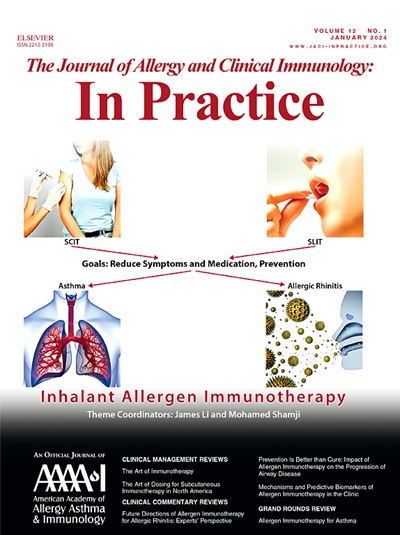
JACI: In Practice is an official publication of the American Academy of Allergy, Asthma & Immunology (AAAAI). It is a companion title to The Journal of Allergy and Clinical Immunology, and it aims to provide timely clinical papers, case reports, and management recommendations to clinical allergists and other physicians dealing with allergic and immunologic diseases in their practice. The mission of JACI: In Practice is to offer valid and impactful information that supports evidence-based clinical decisions in the diagnosis and management of asthma, allergies, immunologic conditions, and related diseases.
This journal publishes articles on various conditions treated by allergist-immunologists, including food allergy, respiratory disorders (such as asthma, rhinitis, nasal polyps, sinusitis, cough, ABPA, and hypersensitivity pneumonitis), drug allergy, insect sting allergy, anaphylaxis, dermatologic disorders (such as atopic dermatitis, contact dermatitis, urticaria, angioedema, and HAE), immunodeficiency, autoinflammatory syndromes, eosinophilic disorders, and mast cell disorders.
The focus of the journal is on providing cutting-edge clinical information that practitioners can use in their everyday practice or to acquire new knowledge and skills for the benefit of their patients. However, mechanistic or translational studies without immediate or near future clinical relevance, as well as animal studies, are not within the scope of the journal.




 京公网安备 11010802042870号
京ICP备2023020795号-1
京公网安备 11010802042870号
京ICP备2023020795号-1

 分享
分享
 求助内容:
求助内容: 应助结果提醒方式:
 扫码关注我们
