M.N. Somashekar , M. Dhanalakshmi , T.S. Nagamani , T. Subhas Chandra , T.M. Sharanakumar , C.R. Ravikumar
{"title":"Photocatalytic and electrochemical sensor detection of ascorbic and uric acid using novel plant extract green synthesis of CaO nanoparticles","authors":"M.N. Somashekar , M. Dhanalakshmi , T.S. Nagamani , T. Subhas Chandra , T.M. Sharanakumar , C.R. Ravikumar","doi":"10.1016/j.sintl.2024.100308","DOIUrl":null,"url":null,"abstract":"<div><div>In the present work, a novel fuel made from the leaves of the Gotu kola (Centella Asiatica) plant is used to produce calcium oxide nanoparticles (CaO NPs) in an eco-friendly manner. The results of the PXRD experiments, the average crystallite size for CaO NPs is 38 nm, which is consistent with the findings of the TEM. As per DRS investigation, the energy gap of CaONPs is 3.253 eV. Fast Blue (FB) and Fast Orange (FO) dye photodegradation was effectively enhanced by the plant-mediated CaO NPs under UV-light irradiation, showing high efficiency within 120 min. The CaO demonstrated remarkable photodegradation process against the FO and FB dyes under UV light, with rates of 79.52 % and 61.43 % after 120 min. CaO NPs' electrochemical characteristics were ascertained using a carbon paste electrode (CPE) dipped in a 0.1N HCl solution. In cyclic voltammetry evaluation, the green CaO NPs showed greater sensitivity at various scan rates. Ascorbic acid and uric acid were finally shown to have exceptional redox reaction and ascorbic acid and uric acid detection capabilities when they were used as analytes.</div></div>","PeriodicalId":21733,"journal":{"name":"Sensors International","volume":"6 ","pages":"Article 100308"},"PeriodicalIF":0.0000,"publicationDate":"2025-01-01","publicationTypes":"Journal Article","fieldsOfStudy":null,"isOpenAccess":false,"openAccessPdf":"","citationCount":"0","resultStr":null,"platform":"Semanticscholar","paperid":null,"PeriodicalName":"Sensors International","FirstCategoryId":"1085","ListUrlMain":"https://www.sciencedirect.com/science/article/pii/S2666351124000305","RegionNum":0,"RegionCategory":null,"ArticlePicture":[],"TitleCN":null,"AbstractTextCN":null,"PMCID":null,"EPubDate":"2024/11/12 0:00:00","PubModel":"Epub","JCR":"","JCRName":"","Score":null,"Total":0}
引用次数: 0
Abstract
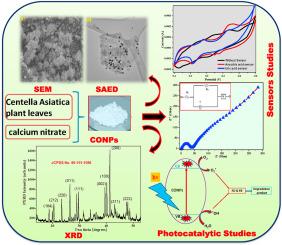
In the present work, a novel fuel made from the leaves of the Gotu kola (Centella Asiatica) plant is used to produce calcium oxide nanoparticles (CaO NPs) in an eco-friendly manner. The results of the PXRD experiments, the average crystallite size for CaO NPs is 38 nm, which is consistent with the findings of the TEM. As per DRS investigation, the energy gap of CaONPs is 3.253 eV. Fast Blue (FB) and Fast Orange (FO) dye photodegradation was effectively enhanced by the plant-mediated CaO NPs under UV-light irradiation, showing high efficiency within 120 min. The CaO demonstrated remarkable photodegradation process against the FO and FB dyes under UV light, with rates of 79.52 % and 61.43 % after 120 min. CaO NPs' electrochemical characteristics were ascertained using a carbon paste electrode (CPE) dipped in a 0.1N HCl solution. In cyclic voltammetry evaluation, the green CaO NPs showed greater sensitivity at various scan rates. Ascorbic acid and uric acid were finally shown to have exceptional redox reaction and ascorbic acid and uric acid detection capabilities when they were used as analytes.




 京公网安备 11010802042870号
京ICP备2023020795号-1
京公网安备 11010802042870号
京ICP备2023020795号-1

 分享
分享

 求助内容:
求助内容: 应助结果提醒方式:
 扫码关注我们
