Hussain Gharehbaghi , Maryam Jamshidi , Abdulla Almomani
{"title":"Experimental and numerical investigation of energy absorption in honeycomb structures based on lozenge grid unit cells under various loading angles","authors":"Hussain Gharehbaghi , Maryam Jamshidi , Abdulla Almomani","doi":"10.1016/j.jcomc.2024.100546","DOIUrl":null,"url":null,"abstract":"<div><div>The present study aims to numerically and experimentally analyze the energy absorption characteristics of honeycomb structures using Lozenge grid unit cells made from continuous glass fibers reinforced polylactic acid (PLA). The design and load-bearing capability of the Lozenge grid was also examined under different orientations angles. The composite grids were also subjected to heat treatment after the tests, at 70 °C, in order to measure its effect on the energy absorption capacity. The Lozenge grid specimens were additively manufactured using fused filament fabrication. The mechanical properties and failure models were described using the VUSDFLD subroutine in order to simulate the Lozenge structure under quasi-static compressive load. The results revealed a good correlation between the numerical and the experimental values. Moreover, Lozenge grid unit cells based structures at 0 or 90° was found with the highest energy absorption capacity. Meanwhile, the least energy absorption was seen at 45°. Overall, the structures had much higher energy absorption capacity at angles closer to 0 and 90°. Outcomes from this work is aimed toward understanding the damage tolerance of Lozenge lattices, and hence the reliability of such new emerging lightweight structures.</div></div>","PeriodicalId":34525,"journal":{"name":"Composites Part C Open Access","volume":"15 ","pages":"Article 100546"},"PeriodicalIF":7.0000,"publicationDate":"2024-10-01","publicationTypes":"Journal Article","fieldsOfStudy":null,"isOpenAccess":false,"openAccessPdf":"","citationCount":"0","resultStr":null,"platform":"Semanticscholar","paperid":null,"PeriodicalName":"Composites Part C Open Access","FirstCategoryId":"1085","ListUrlMain":"https://www.sciencedirect.com/science/article/pii/S2666682024001154","RegionNum":0,"RegionCategory":null,"ArticlePicture":[],"TitleCN":null,"AbstractTextCN":null,"PMCID":null,"EPubDate":"2024/11/28 0:00:00","PubModel":"Epub","JCR":"Q2","JCRName":"MATERIALS SCIENCE, COMPOSITES","Score":null,"Total":0}
引用次数: 0
Abstract
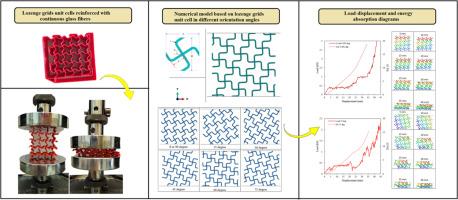
The present study aims to numerically and experimentally analyze the energy absorption characteristics of honeycomb structures using Lozenge grid unit cells made from continuous glass fibers reinforced polylactic acid (PLA). The design and load-bearing capability of the Lozenge grid was also examined under different orientations angles. The composite grids were also subjected to heat treatment after the tests, at 70 °C, in order to measure its effect on the energy absorption capacity. The Lozenge grid specimens were additively manufactured using fused filament fabrication. The mechanical properties and failure models were described using the VUSDFLD subroutine in order to simulate the Lozenge structure under quasi-static compressive load. The results revealed a good correlation between the numerical and the experimental values. Moreover, Lozenge grid unit cells based structures at 0 or 90° was found with the highest energy absorption capacity. Meanwhile, the least energy absorption was seen at 45°. Overall, the structures had much higher energy absorption capacity at angles closer to 0 and 90°. Outcomes from this work is aimed toward understanding the damage tolerance of Lozenge lattices, and hence the reliability of such new emerging lightweight structures.





 京公网安备 11010802042870号
京ICP备2023020795号-1
京公网安备 11010802042870号
京ICP备2023020795号-1

 分享
分享
 求助内容:
求助内容: 应助结果提醒方式:
 扫码关注我们
