Weidong Gu, Zhiyao Yang, Qinxia Yang, Hang Zhang, Yanlin Wang, Qinyi He, Changzi Ge
{"title":"Wind-driven mechanisms for allometric growth of Spartina alterniflora leaves: Implications for adaptive management","authors":"Weidong Gu, Zhiyao Yang, Qinxia Yang, Hang Zhang, Yanlin Wang, Qinyi He, Changzi Ge","doi":"10.1016/j.ocecoaman.2025.107556","DOIUrl":null,"url":null,"abstract":"<div><div><em>Spartina alterniflora</em> not only has service functions but also causes ecological disasters; hence, it should be managed adaptively rather than eradicated. The laminae and leaf sheaths differ in functions and the wind pressures on the two plant components are different. Thus, it is inferred that differences in allometric growth between the leaf sheaths and laminae occur in regions with different wind speeds: the laminae become smaller than the leaf sheaths in high-wind-speed regions; the laminae become larger in low-wind-speed regions. To verify this inference, the leaf traits of <em>S. alterniflora</em> along the Xiaoqing River and in the Tiaozini Wetland were investigated. The leaf traits varied with study area: they presented distinct allometric growth curves between laminae and leaf sheaths; the lamina length and area, dry weight of the leaf sheaths, and dry weight of the laminae in the Tiaozini Wetland were smaller than those along Xiaoqing River; <em>S. alterniflora</em> tended to have large leaf sheaths and small laminae in the Tiaozini Wetland. Thus, wind speed affects the allometric growth between the leaf sheaths and laminae, and the lamina size in the high-wind-speed area tend to miniaturize. Measures that can further reduce the lamina size in high-wind-speed areas or enlarge the lamina size in low-wind-speed areas are detrimental to the survival and proliferation of <em>S. alterniflora</em>, and can be used for adaptive management.</div></div>","PeriodicalId":54698,"journal":{"name":"Ocean & Coastal Management","volume":"262 ","pages":"Article 107556"},"PeriodicalIF":5.4000,"publicationDate":"2025-03-01","publicationTypes":"Journal Article","fieldsOfStudy":null,"isOpenAccess":false,"openAccessPdf":"","citationCount":"0","resultStr":null,"platform":"Semanticscholar","paperid":null,"PeriodicalName":"Ocean & Coastal Management","FirstCategoryId":"93","ListUrlMain":"https://www.sciencedirect.com/science/article/pii/S0964569125000183","RegionNum":2,"RegionCategory":"环境科学与生态学","ArticlePicture":[],"TitleCN":null,"AbstractTextCN":null,"PMCID":null,"EPubDate":"2025/1/30 0:00:00","PubModel":"Epub","JCR":"Q1","JCRName":"OCEANOGRAPHY","Score":null,"Total":0}
引用次数: 0
Abstract
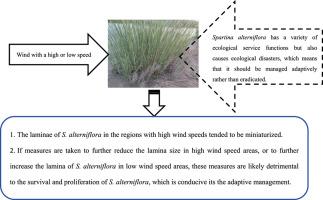
Spartina alterniflora not only has service functions but also causes ecological disasters; hence, it should be managed adaptively rather than eradicated. The laminae and leaf sheaths differ in functions and the wind pressures on the two plant components are different. Thus, it is inferred that differences in allometric growth between the leaf sheaths and laminae occur in regions with different wind speeds: the laminae become smaller than the leaf sheaths in high-wind-speed regions; the laminae become larger in low-wind-speed regions. To verify this inference, the leaf traits of S. alterniflora along the Xiaoqing River and in the Tiaozini Wetland were investigated. The leaf traits varied with study area: they presented distinct allometric growth curves between laminae and leaf sheaths; the lamina length and area, dry weight of the leaf sheaths, and dry weight of the laminae in the Tiaozini Wetland were smaller than those along Xiaoqing River; S. alterniflora tended to have large leaf sheaths and small laminae in the Tiaozini Wetland. Thus, wind speed affects the allometric growth between the leaf sheaths and laminae, and the lamina size in the high-wind-speed area tend to miniaturize. Measures that can further reduce the lamina size in high-wind-speed areas or enlarge the lamina size in low-wind-speed areas are detrimental to the survival and proliferation of S. alterniflora, and can be used for adaptive management.
期刊介绍:
Ocean & Coastal Management is the leading international journal dedicated to the study of all aspects of ocean and coastal management from the global to local levels.
We publish rigorously peer-reviewed manuscripts from all disciplines, and inter-/trans-disciplinary and co-designed research, but all submissions must make clear the relevance to management and/or governance issues relevant to the sustainable development and conservation of oceans and coasts.
Comparative studies (from sub-national to trans-national cases, and other management / policy arenas) are encouraged, as are studies that critically assess current management practices and governance approaches. Submissions involving robust analysis, development of theory, and improvement of management practice are especially welcome.




 京公网安备 11010802042870号
京ICP备2023020795号-1
京公网安备 11010802042870号
京ICP备2023020795号-1

 分享
分享
 求助内容:
求助内容: 应助结果提醒方式:
 扫码关注我们
