Tracy Butler, Kewei Chen, Abigail Patchell, Xiangling Mao, Dikoma Shungu, Diany Paola Calderon, Jeanne T Paz, Sudhin A Shah
{"title":"Elevated Plasma Complement C1Q Measured Subacutely after Traumatic Brain Injury Is Associated with Poor Functional Outcome Independent of Initial Injury Severity.","authors":"Tracy Butler, Kewei Chen, Abigail Patchell, Xiangling Mao, Dikoma Shungu, Diany Paola Calderon, Jeanne T Paz, Sudhin A Shah","doi":"10.1089/neur.2024.0152","DOIUrl":null,"url":null,"abstract":"<p><p>Following traumatic brain injury (TBI), secondary processes, including inflammation, contribute significantly to long-term cognitive and functional impairments. Targeting these secondary processes during the subacute period after TBI represents a feasible therapeutic target. This study investigates the role of complement factor 1q (C1Q) in TBI recovery. Motivated by our rodent studies showing that thalamic inflammation post-TBI is dependent on C1Q and that blocking C1Q during the subacute period can prevent thalamic inflammation and improve aspects of TBI outcome, particularly sleep, we measured plasma C1Q levels 3-6 months post-injury in 27 patients with TBI ranging from complicated mild to severe, as well as 30 controls. TBI patients had significantly higher plasma C1Q levels (<i>p</i> = 0.031). We assessed the correlation between plasma C1Q and functional outcomes using the Glasgow Outcome Scale-Extended (GOSE), controlling for initial injury severity. Higher plasma C1Q levels were associated with worse functional outcomes (rho = -0.395, <i>p</i> = 0.046), independent of initial injury severity. These findings suggest that subacute plasma C1Q may be a novel prognostic biomarker for TBI outcomes. More importantly, subacute plasma C1Q may provide a window into ongoing, C1Q-mediated maladaptive neuroinflammatory processes after TBI that we have shown to be remediable in rodents using a safe-in-human drug that blocks C1Q. Since the initial injury cannot be changed, the ability to intervene subacutely could provide critical therapeutic benefits to the millions affected by TBI each year.</p>","PeriodicalId":74300,"journal":{"name":"Neurotrauma reports","volume":"6 1","pages":"190-194"},"PeriodicalIF":1.8000,"publicationDate":"2025-02-12","publicationTypes":"Journal Article","fieldsOfStudy":null,"isOpenAccess":false,"openAccessPdf":"https://www.ncbi.nlm.nih.gov/pmc/articles/PMC11931099/pdf/","citationCount":"0","resultStr":null,"platform":"Semanticscholar","paperid":null,"PeriodicalName":"Neurotrauma reports","FirstCategoryId":"1085","ListUrlMain":"https://doi.org/10.1089/neur.2024.0152","RegionNum":0,"RegionCategory":null,"ArticlePicture":[],"TitleCN":null,"AbstractTextCN":null,"PMCID":null,"EPubDate":"2025/1/1 0:00:00","PubModel":"eCollection","JCR":"Q3","JCRName":"CLINICAL NEUROLOGY","Score":null,"Total":0}
引用次数: 0
Abstract
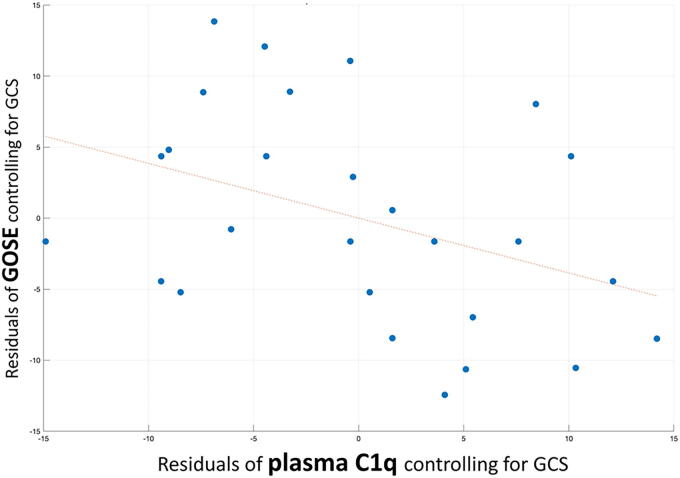
Following traumatic brain injury (TBI), secondary processes, including inflammation, contribute significantly to long-term cognitive and functional impairments. Targeting these secondary processes during the subacute period after TBI represents a feasible therapeutic target. This study investigates the role of complement factor 1q (C1Q) in TBI recovery. Motivated by our rodent studies showing that thalamic inflammation post-TBI is dependent on C1Q and that blocking C1Q during the subacute period can prevent thalamic inflammation and improve aspects of TBI outcome, particularly sleep, we measured plasma C1Q levels 3-6 months post-injury in 27 patients with TBI ranging from complicated mild to severe, as well as 30 controls. TBI patients had significantly higher plasma C1Q levels (p = 0.031). We assessed the correlation between plasma C1Q and functional outcomes using the Glasgow Outcome Scale-Extended (GOSE), controlling for initial injury severity. Higher plasma C1Q levels were associated with worse functional outcomes (rho = -0.395, p = 0.046), independent of initial injury severity. These findings suggest that subacute plasma C1Q may be a novel prognostic biomarker for TBI outcomes. More importantly, subacute plasma C1Q may provide a window into ongoing, C1Q-mediated maladaptive neuroinflammatory processes after TBI that we have shown to be remediable in rodents using a safe-in-human drug that blocks C1Q. Since the initial injury cannot be changed, the ability to intervene subacutely could provide critical therapeutic benefits to the millions affected by TBI each year.




 京公网安备 11010802042870号
京ICP备2023020795号-1
京公网安备 11010802042870号
京ICP备2023020795号-1

 分享
分享

 求助内容:
求助内容: 应助结果提醒方式:
 扫码关注我们
