Phuong T. Do, Bailey Richardson, Samuel C. Brydon, Therese M. Fulloon, Stephen J. Blanksby, Hendrik Frisch, Berwyck L. J. Poad
{"title":"Mass Spectrometry Directed Structural Elucidation of Isomeric [2 + 2] Photocycloadducts","authors":"Phuong T. Do, Bailey Richardson, Samuel C. Brydon, Therese M. Fulloon, Stephen J. Blanksby, Hendrik Frisch, Berwyck L. J. Poad","doi":"10.1021/acs.analchem.4c05228","DOIUrl":null,"url":null,"abstract":"[2 + 2] Photocycloaddition reactions are powerful tools for synthetic chemistry. However, analysis of the head-to-head or head-to-tail conformation of the resulting cycloadducts is often challenging by conventional spectroscopic methods. Herein, we report the analysis of coumarin and styrylpyrene cycloadducts by cyclic ion-mobility tandem mass spectrometry (cIM-MS/MS) to characterize the regioisomeric products of this important class of photoresponsive groups. Photodissociation (PD) and collision-induced dissociation (CID) of the cycloadduct ions in the gas phase gave similar products to photodissociation in solution with regiospecific fragmentation of the core cyclobutane ring. The styrylpyrene cycloadduct ion was observed to be more stable than the coumarin analog under CID conditions, reflecting the impact of different substituents on the stability of the cyclobutane ring. Exploiting the difference in cyclobutane fragmentation for head-to-head and head-to-tail styrylpyrene cycloadduct isomers, ion mobility enabled CID-MS/MS was applied successfully to differentiate and identify these isomers. The developed method proved to be robust even to complex molecular structures and enabled the identification and separation of photocycloadducts resulting from styrylpyrene terminated peptides, providing access to a rapid analysis of challenging cycloadduct isomers.","PeriodicalId":27,"journal":{"name":"Analytical Chemistry","volume":"89 1","pages":""},"PeriodicalIF":6.7000,"publicationDate":"2025-04-02","publicationTypes":"Journal Article","fieldsOfStudy":null,"isOpenAccess":false,"openAccessPdf":"","citationCount":"0","resultStr":null,"platform":"Semanticscholar","paperid":null,"PeriodicalName":"Analytical Chemistry","FirstCategoryId":"92","ListUrlMain":"https://doi.org/10.1021/acs.analchem.4c05228","RegionNum":1,"RegionCategory":"化学","ArticlePicture":[],"TitleCN":null,"AbstractTextCN":null,"PMCID":null,"EPubDate":"","PubModel":"","JCR":"Q1","JCRName":"CHEMISTRY, ANALYTICAL","Score":null,"Total":0}
引用次数: 0
Abstract
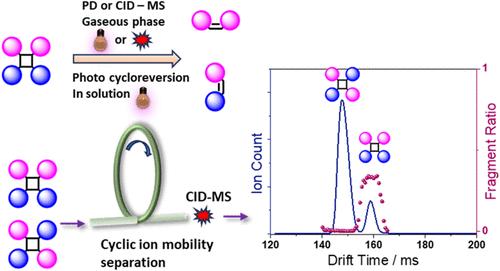
[2 + 2] Photocycloaddition reactions are powerful tools for synthetic chemistry. However, analysis of the head-to-head or head-to-tail conformation of the resulting cycloadducts is often challenging by conventional spectroscopic methods. Herein, we report the analysis of coumarin and styrylpyrene cycloadducts by cyclic ion-mobility tandem mass spectrometry (cIM-MS/MS) to characterize the regioisomeric products of this important class of photoresponsive groups. Photodissociation (PD) and collision-induced dissociation (CID) of the cycloadduct ions in the gas phase gave similar products to photodissociation in solution with regiospecific fragmentation of the core cyclobutane ring. The styrylpyrene cycloadduct ion was observed to be more stable than the coumarin analog under CID conditions, reflecting the impact of different substituents on the stability of the cyclobutane ring. Exploiting the difference in cyclobutane fragmentation for head-to-head and head-to-tail styrylpyrene cycloadduct isomers, ion mobility enabled CID-MS/MS was applied successfully to differentiate and identify these isomers. The developed method proved to be robust even to complex molecular structures and enabled the identification and separation of photocycloadducts resulting from styrylpyrene terminated peptides, providing access to a rapid analysis of challenging cycloadduct isomers.
期刊介绍:
Analytical Chemistry, a peer-reviewed research journal, focuses on disseminating new and original knowledge across all branches of analytical chemistry. Fundamental articles may explore general principles of chemical measurement science and need not directly address existing or potential analytical methodology. They can be entirely theoretical or report experimental results. Contributions may cover various phases of analytical operations, including sampling, bioanalysis, electrochemistry, mass spectrometry, microscale and nanoscale systems, environmental analysis, separations, spectroscopy, chemical reactions and selectivity, instrumentation, imaging, surface analysis, and data processing. Papers discussing known analytical methods should present a significant, original application of the method, a notable improvement, or results on an important analyte.



 京公网安备 11010802042870号
京ICP备2023020795号-1
京公网安备 11010802042870号
京ICP备2023020795号-1

 分享
分享
 求助内容:
求助内容: 应助结果提醒方式:
 扫码关注我们
