Isabelle Hesling, Bixente Dilharreguy, Sue Peppé, Marion Amirault, Manuel Bouvard, Michèle Allard
{"title":"The integration of prosodic speech in high functioning autism: a preliminary FMRI study.","authors":"Isabelle Hesling, Bixente Dilharreguy, Sue Peppé, Marion Amirault, Manuel Bouvard, Michèle Allard","doi":"10.1371/journal.pone.0011571","DOIUrl":null,"url":null,"abstract":"<p><strong>Background: </strong>Autism is a neurodevelopmental disorder characterized by a specific triad of symptoms such as abnormalities in social interaction, abnormalities in communication and restricted activities and interests. While verbal autistic subjects may present a correct mastery of the formal aspects of speech, they have difficulties in prosody (music of speech), leading to communication disorders. Few behavioural studies have revealed a prosodic impairment in children with autism, and among the few fMRI studies aiming at assessing the neural network involved in language, none has specifically studied prosodic speech. The aim of the present study was to characterize specific prosodic components such as linguistic prosody (intonation, rhythm and emphasis) and emotional prosody and to correlate them with the neural network underlying them.</p><p><strong>Methodology/principal findings: </strong>We used a behavioural test (Profiling Elements of the Prosodic System, PEPS) and fMRI to characterize prosodic deficits and investigate the neural network underlying prosodic processing. Results revealed the existence of a link between perceptive and productive prosodic deficits for some prosodic components (rhythm, emphasis and affect) in HFA and also revealed that the neural network involved in prosodic speech perception exhibits abnormal activation in the left SMG as compared to controls (activation positively correlated with intonation and emphasis) and an absence of deactivation patterns in regions involved in the default mode.</p><p><strong>Conclusions/significance: </strong>These prosodic impairments could not only result from activation patterns abnormalities but also from an inability to adequately use the strategy of the default network inhibition, both mechanisms that have to be considered for decreasing task performance in High Functioning Autism.</p>","PeriodicalId":20189,"journal":{"name":"PLoS ONE","volume":" ","pages":"e11571"},"PeriodicalIF":2.6000,"publicationDate":"2010-07-13","publicationTypes":"Journal Article","fieldsOfStudy":null,"isOpenAccess":false,"openAccessPdf":"https://sci-hub-pdf.com/10.1371/journal.pone.0011571","citationCount":"66","resultStr":null,"platform":"Semanticscholar","paperid":null,"PeriodicalName":"PLoS ONE","FirstCategoryId":"103","ListUrlMain":"https://doi.org/10.1371/journal.pone.0011571","RegionNum":3,"RegionCategory":"综合性期刊","ArticlePicture":[],"TitleCN":null,"AbstractTextCN":null,"PMCID":null,"EPubDate":"","PubModel":"","JCR":"Q1","JCRName":"MULTIDISCIPLINARY SCIENCES","Score":null,"Total":0}
引用次数: 66
Abstract
Background: Autism is a neurodevelopmental disorder characterized by a specific triad of symptoms such as abnormalities in social interaction, abnormalities in communication and restricted activities and interests. While verbal autistic subjects may present a correct mastery of the formal aspects of speech, they have difficulties in prosody (music of speech), leading to communication disorders. Few behavioural studies have revealed a prosodic impairment in children with autism, and among the few fMRI studies aiming at assessing the neural network involved in language, none has specifically studied prosodic speech. The aim of the present study was to characterize specific prosodic components such as linguistic prosody (intonation, rhythm and emphasis) and emotional prosody and to correlate them with the neural network underlying them.
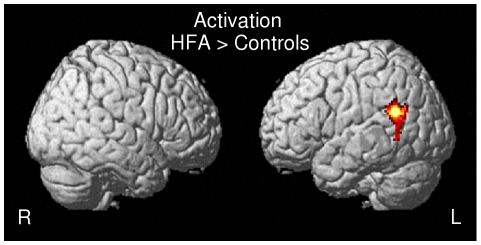
Methodology/principal findings: We used a behavioural test (Profiling Elements of the Prosodic System, PEPS) and fMRI to characterize prosodic deficits and investigate the neural network underlying prosodic processing. Results revealed the existence of a link between perceptive and productive prosodic deficits for some prosodic components (rhythm, emphasis and affect) in HFA and also revealed that the neural network involved in prosodic speech perception exhibits abnormal activation in the left SMG as compared to controls (activation positively correlated with intonation and emphasis) and an absence of deactivation patterns in regions involved in the default mode.
Conclusions/significance: These prosodic impairments could not only result from activation patterns abnormalities but also from an inability to adequately use the strategy of the default network inhibition, both mechanisms that have to be considered for decreasing task performance in High Functioning Autism.
期刊介绍:
PLOS ONE is an international, peer-reviewed, open-access, online publication. PLOS ONE welcomes reports on primary research from any scientific discipline. It provides:
* Open-access—freely accessible online, authors retain copyright
* Fast publication times
* Peer review by expert, practicing researchers
* Post-publication tools to indicate quality and impact
* Community-based dialogue on articles
* Worldwide media coverage






 京公网安备 11010802042870号
京ICP备2023020795号-1
京公网安备 11010802042870号
京ICP备2023020795号-1

 分享
分享
 求助内容:
求助内容: 应助结果提醒方式:
 扫码关注我们
