Cleaning the Cellular Factory-Deletion of McrA in Aspergillus oryzae NSAR1 and the Generation of a Novel Kojic Acid Deficient Strain for Cleaner Heterologous Production of Secondary Metabolites.
Trong T Dao, Kate M J de Mattos-Shipley, Ian M Prosser, Katherine Williams, Marija K Zacharova, Colin M Lazarus, Christine L Willis, Andrew M Bailey
{"title":"Cleaning the Cellular Factory-Deletion of McrA in <i>Aspergillus oryzae</i> NSAR1 and the Generation of a Novel Kojic Acid Deficient Strain for Cleaner Heterologous Production of Secondary Metabolites.","authors":"Trong T Dao, Kate M J de Mattos-Shipley, Ian M Prosser, Katherine Williams, Marija K Zacharova, Colin M Lazarus, Christine L Willis, Andrew M Bailey","doi":"10.3389/ffunb.2021.632542","DOIUrl":null,"url":null,"abstract":"<p><p>The use of filamentous fungi as cellular factories, where natural product pathways can be refactored and expressed in a host strain, continues to aid the field of natural product discovery. Much work has been done to develop host strains which are genetically tractable, and for which there are multiple selectable markers and controllable expression systems. To fully exploit these strains, it is beneficial to understand their natural metabolic capabilities, as such knowledge can rule out host metabolites from analysis of transgenic lines and highlight any potential interplay between endogenous and exogenous pathways. Additionally, once identified, the deletion of secondary metabolite pathways from host strains can simplify the detection and purification of heterologous compounds. To this end, secondary metabolite production in <i>Aspergillus oryzae</i> strain NSAR1 has been investigated via the deletion of the newly discovered negative regulator of secondary metabolism, <i>mcrA</i> (multicluster regulator A). In all ascomycetes previously studied <i>mcrA</i> deletion led to an increase in secondary metabolite production. Surprisingly, the only detectable phenotypic change in NSAR1 was a doubling in the yields of kojic acid, with no novel secondary metabolites produced. This supports the previous claim that secondary metabolite production has been repressed in <i>A. oryzae</i> and demonstrates that such repression is not McrA-mediated. Strain NSAR1 was then modified by employing CRISPR-Cas9 technology to disrupt the production of kojic acid, generating the novel strain NSARΔK, which combines the various beneficial traits of NSAR1 with a uniquely clean secondary metabolite background.</p>","PeriodicalId":73084,"journal":{"name":"Frontiers in fungal biology","volume":"2 ","pages":"632542"},"PeriodicalIF":3.8000,"publicationDate":"2021-02-09","publicationTypes":"Journal Article","fieldsOfStudy":null,"isOpenAccess":false,"openAccessPdf":"https://www.ncbi.nlm.nih.gov/pmc/articles/PMC10512265/pdf/","citationCount":"0","resultStr":null,"platform":"Semanticscholar","paperid":null,"PeriodicalName":"Frontiers in fungal biology","FirstCategoryId":"1085","ListUrlMain":"https://doi.org/10.3389/ffunb.2021.632542","RegionNum":0,"RegionCategory":null,"ArticlePicture":[],"TitleCN":null,"AbstractTextCN":null,"PMCID":null,"EPubDate":"2021/1/1 0:00:00","PubModel":"eCollection","JCR":"Q3","JCRName":"MYCOLOGY","Score":null,"Total":0}
引用次数: 0
Abstract
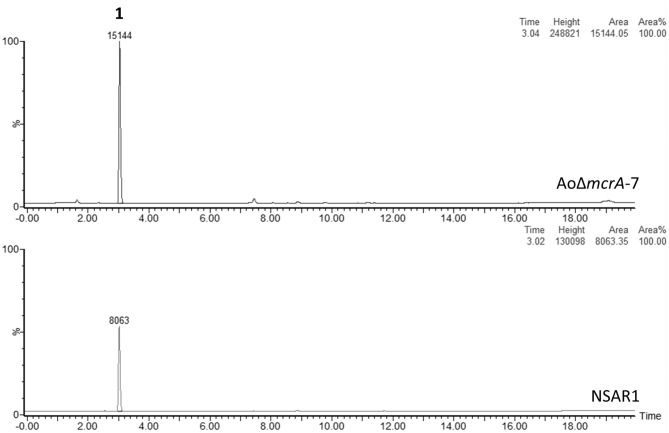
The use of filamentous fungi as cellular factories, where natural product pathways can be refactored and expressed in a host strain, continues to aid the field of natural product discovery. Much work has been done to develop host strains which are genetically tractable, and for which there are multiple selectable markers and controllable expression systems. To fully exploit these strains, it is beneficial to understand their natural metabolic capabilities, as such knowledge can rule out host metabolites from analysis of transgenic lines and highlight any potential interplay between endogenous and exogenous pathways. Additionally, once identified, the deletion of secondary metabolite pathways from host strains can simplify the detection and purification of heterologous compounds. To this end, secondary metabolite production in Aspergillus oryzae strain NSAR1 has been investigated via the deletion of the newly discovered negative regulator of secondary metabolism, mcrA (multicluster regulator A). In all ascomycetes previously studied mcrA deletion led to an increase in secondary metabolite production. Surprisingly, the only detectable phenotypic change in NSAR1 was a doubling in the yields of kojic acid, with no novel secondary metabolites produced. This supports the previous claim that secondary metabolite production has been repressed in A. oryzae and demonstrates that such repression is not McrA-mediated. Strain NSAR1 was then modified by employing CRISPR-Cas9 technology to disrupt the production of kojic acid, generating the novel strain NSARΔK, which combines the various beneficial traits of NSAR1 with a uniquely clean secondary metabolite background.




 京公网安备 11010802042870号
京ICP备2023020795号-1
京公网安备 11010802042870号
京ICP备2023020795号-1

 分享
分享

 求助内容:
求助内容: 应助结果提醒方式:
 扫码关注我们
