{"title":"多次抗菌光动力治疗改善唐氏综合征患者牙周预后:一项为期12个月的随机临床试验","authors":"Rafael Ferreira, Sebastião Luiz Aguiar Greghi, Adriana Campos Passanezi Sant'Ana, Mariana Schutzer Ragghianti Zangrando, Carla Andreotti Damante","doi":"10.3390/dj13010033","DOIUrl":null,"url":null,"abstract":"<p><p><b>Background/Objectives:</b> Individuals with Down syndrome (DS) often present with severe periodontal disease at a young age. Adjuvant treatments to scaling and root planing (SRP), such as antimicrobial photodynamic therapy (aPDT), may benefit this population. This study evaluated the effectiveness of aPDT as an adjunct to SRP in individuals with DS. A randomized, double-blind, parallel trial was conducted with 37 individuals with DS. <b>Methods:</b> The test group (aPDT; <i>n</i> = 18) received SRP + aPDT, while the control group (C group; <i>n</i> = 19) received SRP only. For aPDT, a red laser (658 nm; 0.1 W; 2229 J/cm<sup>2</sup>; 40 s sweeping with optical fiber) combined with methylene blue (MB) (100 µg/mL) was applied across repeated sessions (on days 3, 7, and 14). Clinical parameters, such as plaque index (PI), clinical attachment level (CAL), probing depth (PD), and bleeding on probing (BOP), were recorded at baseline and after 3, 6, and 12 months of treatment. Statistical analyses were performed using parametric and non-parametric tests (<i>p</i> < 0.05). <b>Results:</b> Both treatments promoted improvements in all clinical periodontal parameters (<i>p</i> < 0.05). The aPDT group showed a statistically significant reduction in CAL at 3 months (aPDT = 4.58 mm vs. C = 4.72 mm; <i>p</i> < 0.05) and 12 months (aPDT = 4.59 mm vs. C = 4.84 mm; <i>p</i> < 0.05). <b>Conclusions:</b> aPDT improved periodontal health in the long term through a stable gain in attachment.</p>","PeriodicalId":11269,"journal":{"name":"Dentistry Journal","volume":"13 1","pages":""},"PeriodicalIF":3.1000,"publicationDate":"2025-01-15","publicationTypes":"Journal Article","fieldsOfStudy":null,"isOpenAccess":false,"openAccessPdf":"https://www.ncbi.nlm.nih.gov/pmc/articles/PMC11763426/pdf/","citationCount":"0","resultStr":"{\"title\":\"Multiple Sessions of Antimicrobial Photodynamic Therapy Improve Periodontal Outcomes in Patients with Down Syndrome: A 12-Month Randomized Clinical Trial.\",\"authors\":\"Rafael Ferreira, Sebastião Luiz Aguiar Greghi, Adriana Campos Passanezi Sant'Ana, Mariana Schutzer Ragghianti Zangrando, Carla Andreotti Damante\",\"doi\":\"10.3390/dj13010033\",\"DOIUrl\":null,\"url\":null,\"abstract\":\"<p><p><b>Background/Objectives:</b> Individuals with Down syndrome (DS) often present with severe periodontal disease at a young age. Adjuvant treatments to scaling and root planing (SRP), such as antimicrobial photodynamic therapy (aPDT), may benefit this population. This study evaluated the effectiveness of aPDT as an adjunct to SRP in individuals with DS. A randomized, double-blind, parallel trial was conducted with 37 individuals with DS. <b>Methods:</b> The test group (aPDT; <i>n</i> = 18) received SRP + aPDT, while the control group (C group; <i>n</i> = 19) received SRP only. For aPDT, a red laser (658 nm; 0.1 W; 2229 J/cm<sup>2</sup>; 40 s sweeping with optical fiber) combined with methylene blue (MB) (100 µg/mL) was applied across repeated sessions (on days 3, 7, and 14). Clinical parameters, such as plaque index (PI), clinical attachment level (CAL), probing depth (PD), and bleeding on probing (BOP), were recorded at baseline and after 3, 6, and 12 months of treatment. Statistical analyses were performed using parametric and non-parametric tests (<i>p</i> < 0.05). <b>Results:</b> Both treatments promoted improvements in all clinical periodontal parameters (<i>p</i> < 0.05). The aPDT group showed a statistically significant reduction in CAL at 3 months (aPDT = 4.58 mm vs. C = 4.72 mm; <i>p</i> < 0.05) and 12 months (aPDT = 4.59 mm vs. C = 4.84 mm; <i>p</i> < 0.05). <b>Conclusions:</b> aPDT improved periodontal health in the long term through a stable gain in attachment.</p>\",\"PeriodicalId\":11269,\"journal\":{\"name\":\"Dentistry Journal\",\"volume\":\"13 1\",\"pages\":\"\"},\"PeriodicalIF\":3.1000,\"publicationDate\":\"2025-01-15\",\"publicationTypes\":\"Journal Article\",\"fieldsOfStudy\":null,\"isOpenAccess\":false,\"openAccessPdf\":\"https://www.ncbi.nlm.nih.gov/pmc/articles/PMC11763426/pdf/\",\"citationCount\":\"0\",\"resultStr\":null,\"platform\":\"Semanticscholar\",\"paperid\":null,\"PeriodicalName\":\"Dentistry Journal\",\"FirstCategoryId\":\"1085\",\"ListUrlMain\":\"https://doi.org/10.3390/dj13010033\",\"RegionNum\":0,\"RegionCategory\":null,\"ArticlePicture\":[],\"TitleCN\":null,\"AbstractTextCN\":null,\"PMCID\":null,\"EPubDate\":\"\",\"PubModel\":\"\",\"JCR\":\"Q2\",\"JCRName\":\"DENTISTRY, ORAL SURGERY & MEDICINE\",\"Score\":null,\"Total\":0}","platform":"Semanticscholar","paperid":null,"PeriodicalName":"Dentistry Journal","FirstCategoryId":"1085","ListUrlMain":"https://doi.org/10.3390/dj13010033","RegionNum":0,"RegionCategory":null,"ArticlePicture":[],"TitleCN":null,"AbstractTextCN":null,"PMCID":null,"EPubDate":"","PubModel":"","JCR":"Q2","JCRName":"DENTISTRY, ORAL SURGERY & MEDICINE","Score":null,"Total":0}
引用次数: 0
摘要
背景/目的:唐氏综合征(DS)患者通常在年轻时表现为严重的牙周病。辅助治疗,如抗菌光动力治疗(aPDT),以洗垢和根刨(SRP),可能有利于这个群体。本研究评估了aPDT作为退行性痴呆患者SRP辅助疗法的有效性。对37例退行性痴呆患者进行了一项随机、双盲、平行试验。方法:试验组(aPDT;n = 18)接受SRP + aPDT治疗,对照组(C组;n = 19)仅收到SRP。对于aPDT,红色激光(658nm;0.1 W;2229 J / cm2;用光纤扫描40 s)结合亚甲基蓝(MB)(100µg/mL),在重复的疗程(第3、7和14天)中应用。临床参数,如斑块指数(PI)、临床附着水平(CAL)、探探深度(PD)和探探出血(BOP),分别在基线和治疗3、6、12个月后记录。采用参数检验和非参数检验进行统计学分析(p < 0.05)。结果:两种治疗方法均能促进牙周临床指标的改善(p < 0.05)。aPDT组在3个月时CAL降低具有统计学意义(aPDT = 4.58 mm vs. C = 4.72 mm;p < 0.05)和12个月(aPDT = 4.59 mm vs. C = 4.84 mm;P < 0.05)。结论:aPDT通过稳定的附着增加,长期改善牙周健康。
Multiple Sessions of Antimicrobial Photodynamic Therapy Improve Periodontal Outcomes in Patients with Down Syndrome: A 12-Month Randomized Clinical Trial.
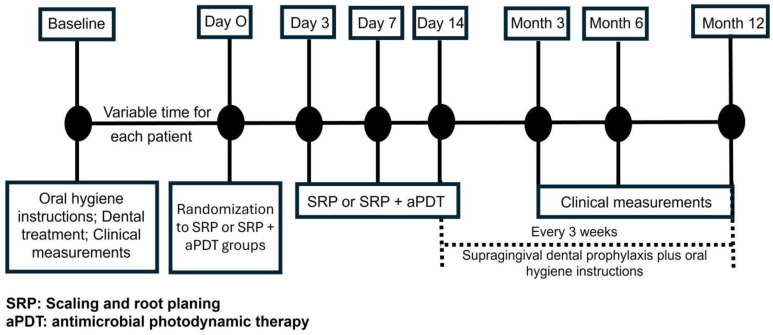
Background/Objectives: Individuals with Down syndrome (DS) often present with severe periodontal disease at a young age. Adjuvant treatments to scaling and root planing (SRP), such as antimicrobial photodynamic therapy (aPDT), may benefit this population. This study evaluated the effectiveness of aPDT as an adjunct to SRP in individuals with DS. A randomized, double-blind, parallel trial was conducted with 37 individuals with DS. Methods: The test group (aPDT; n = 18) received SRP + aPDT, while the control group (C group; n = 19) received SRP only. For aPDT, a red laser (658 nm; 0.1 W; 2229 J/cm2; 40 s sweeping with optical fiber) combined with methylene blue (MB) (100 µg/mL) was applied across repeated sessions (on days 3, 7, and 14). Clinical parameters, such as plaque index (PI), clinical attachment level (CAL), probing depth (PD), and bleeding on probing (BOP), were recorded at baseline and after 3, 6, and 12 months of treatment. Statistical analyses were performed using parametric and non-parametric tests (p < 0.05). Results: Both treatments promoted improvements in all clinical periodontal parameters (p < 0.05). The aPDT group showed a statistically significant reduction in CAL at 3 months (aPDT = 4.58 mm vs. C = 4.72 mm; p < 0.05) and 12 months (aPDT = 4.59 mm vs. C = 4.84 mm; p < 0.05). Conclusions: aPDT improved periodontal health in the long term through a stable gain in attachment.






 京公网安备 11010802042870号
京ICP备2023020795号-1
京公网安备 11010802042870号
京ICP备2023020795号-1

 分享
分享
 求助内容:
求助内容: 应助结果提醒方式:
 扫码关注我们
