Yixiao Zhao, Nile Luu, Logan Hubbard, Shant Malkasian, Sabee Molloi
{"title":"肺区域血流:猪模型低剂量双容积动态CT灌注成像的验证。","authors":"Yixiao Zhao, Nile Luu, Logan Hubbard, Shant Malkasian, Sabee Molloi","doi":"10.1186/s41747-025-00556-3","DOIUrl":null,"url":null,"abstract":"<p><strong>Background: </strong>We aimed to validate a low-dose two-volume pulmonary computed tomography (CT) perfusion technique.</p><p><strong>Methods: </strong>Five Yorkshire swine (weight 53.6 ± 2.6 kg) underwent 21 independent CT perfusion acquisitions. Intravenous contrast material (370 mg/mL iodine, 0.5 mL/kg) and saline chaser (0.5 mL/kg) were injected at 5 mL/s for each acquisition. Two-volume and multivolume dynamic CT perfusion data were acquired using a 320-slice CT, with multivolume measurements serving as the reference standard. The two-volume CT perfusion involved a low-dose (50 mA) volume scan before contrast injection and a diagnostic (300 mA) volume scan after bolus-tracking in the main pulmonary artery at the peak contrast enhancement. Multivolume CT perfusion included 15-20 volume scans for blood flow measurement. Paired sample t-test, linear regression, and Bland-Altman analysis compared both global and regional two-volume perfusion measurements to the reference standard. The reproducibility of the two-volume CT perfusion was assessed from two independent measurements under the same perfusion condition.</p><p><strong>Results: </strong>Two-volume global perfusion measurements (P<sub>2V</sub>) were related to reference multivolume (P<sub>MV</sub>) measurements by P<sub>2V</sub> = 0.96 × P<sub>MV</sub> + 0.45 (r = 0.92), with a root-mean-square error of 1.29 mL/min/g and a root-mean-square deviation of 1.29 mL/min/g. The CT dose index for the two-volume and multivolume CT perfusion measurements were 9.3 mGy and 184.8 mGy, respectively.</p><p><strong>Conclusion: </strong>We successfully validated a prospective, two-volume CT perfusion technique in a swine model. The findings affirm the feasibility of accurate and reproducible pulmonary blood flow measurement.</p><p><strong>Relevance statement: </strong>This two-volume CT pulmonary perfusion technique, validated in a swine model, demonstrates the feasibility of blood flow measurement with a substantial reduction in radiation exposure. It could allow low-dose regional blood flow measurement in the assessment of pulmonary artery disease in humans.</p><p><strong>Key points: </strong>Lung perfusion can be measured in mL/min/g using a prospective, two-volume CT technique. Flow measurement is achievable in a swine model with a radiation dose as low as 9.3 mGy. CT angiography and perfusion can be acquired following a single contrast injection.</p>","PeriodicalId":36926,"journal":{"name":"European Radiology Experimental","volume":"9 1","pages":"17"},"PeriodicalIF":3.6000,"publicationDate":"2025-02-18","publicationTypes":"Journal Article","fieldsOfStudy":null,"isOpenAccess":false,"openAccessPdf":"https://www.ncbi.nlm.nih.gov/pmc/articles/PMC11836245/pdf/","citationCount":"0","resultStr":"{\"title\":\"Pulmonary regional blood flow: validation of low-dose two-volume dynamic CT perfusion imaging in a swine model.\",\"authors\":\"Yixiao Zhao, Nile Luu, Logan Hubbard, Shant Malkasian, Sabee Molloi\",\"doi\":\"10.1186/s41747-025-00556-3\",\"DOIUrl\":null,\"url\":null,\"abstract\":\"<p><strong>Background: </strong>We aimed to validate a low-dose two-volume pulmonary computed tomography (CT) perfusion technique.</p><p><strong>Methods: </strong>Five Yorkshire swine (weight 53.6 ± 2.6 kg) underwent 21 independent CT perfusion acquisitions. Intravenous contrast material (370 mg/mL iodine, 0.5 mL/kg) and saline chaser (0.5 mL/kg) were injected at 5 mL/s for each acquisition. Two-volume and multivolume dynamic CT perfusion data were acquired using a 320-slice CT, with multivolume measurements serving as the reference standard. The two-volume CT perfusion involved a low-dose (50 mA) volume scan before contrast injection and a diagnostic (300 mA) volume scan after bolus-tracking in the main pulmonary artery at the peak contrast enhancement. Multivolume CT perfusion included 15-20 volume scans for blood flow measurement. Paired sample t-test, linear regression, and Bland-Altman analysis compared both global and regional two-volume perfusion measurements to the reference standard. The reproducibility of the two-volume CT perfusion was assessed from two independent measurements under the same perfusion condition.</p><p><strong>Results: </strong>Two-volume global perfusion measurements (P<sub>2V</sub>) were related to reference multivolume (P<sub>MV</sub>) measurements by P<sub>2V</sub> = 0.96 × P<sub>MV</sub> + 0.45 (r = 0.92), with a root-mean-square error of 1.29 mL/min/g and a root-mean-square deviation of 1.29 mL/min/g. The CT dose index for the two-volume and multivolume CT perfusion measurements were 9.3 mGy and 184.8 mGy, respectively.</p><p><strong>Conclusion: </strong>We successfully validated a prospective, two-volume CT perfusion technique in a swine model. The findings affirm the feasibility of accurate and reproducible pulmonary blood flow measurement.</p><p><strong>Relevance statement: </strong>This two-volume CT pulmonary perfusion technique, validated in a swine model, demonstrates the feasibility of blood flow measurement with a substantial reduction in radiation exposure. It could allow low-dose regional blood flow measurement in the assessment of pulmonary artery disease in humans.</p><p><strong>Key points: </strong>Lung perfusion can be measured in mL/min/g using a prospective, two-volume CT technique. Flow measurement is achievable in a swine model with a radiation dose as low as 9.3 mGy. CT angiography and perfusion can be acquired following a single contrast injection.</p>\",\"PeriodicalId\":36926,\"journal\":{\"name\":\"European Radiology Experimental\",\"volume\":\"9 1\",\"pages\":\"17\"},\"PeriodicalIF\":3.6000,\"publicationDate\":\"2025-02-18\",\"publicationTypes\":\"Journal Article\",\"fieldsOfStudy\":null,\"isOpenAccess\":false,\"openAccessPdf\":\"https://www.ncbi.nlm.nih.gov/pmc/articles/PMC11836245/pdf/\",\"citationCount\":\"0\",\"resultStr\":null,\"platform\":\"Semanticscholar\",\"paperid\":null,\"PeriodicalName\":\"European Radiology Experimental\",\"FirstCategoryId\":\"1085\",\"ListUrlMain\":\"https://doi.org/10.1186/s41747-025-00556-3\",\"RegionNum\":0,\"RegionCategory\":null,\"ArticlePicture\":[],\"TitleCN\":null,\"AbstractTextCN\":null,\"PMCID\":null,\"EPubDate\":\"\",\"PubModel\":\"\",\"JCR\":\"Q1\",\"JCRName\":\"RADIOLOGY, NUCLEAR MEDICINE & MEDICAL IMAGING\",\"Score\":null,\"Total\":0}","platform":"Semanticscholar","paperid":null,"PeriodicalName":"European Radiology Experimental","FirstCategoryId":"1085","ListUrlMain":"https://doi.org/10.1186/s41747-025-00556-3","RegionNum":0,"RegionCategory":null,"ArticlePicture":[],"TitleCN":null,"AbstractTextCN":null,"PMCID":null,"EPubDate":"","PubModel":"","JCR":"Q1","JCRName":"RADIOLOGY, NUCLEAR MEDICINE & MEDICAL IMAGING","Score":null,"Total":0}
Pulmonary regional blood flow: validation of low-dose two-volume dynamic CT perfusion imaging in a swine model.
Background: We aimed to validate a low-dose two-volume pulmonary computed tomography (CT) perfusion technique.
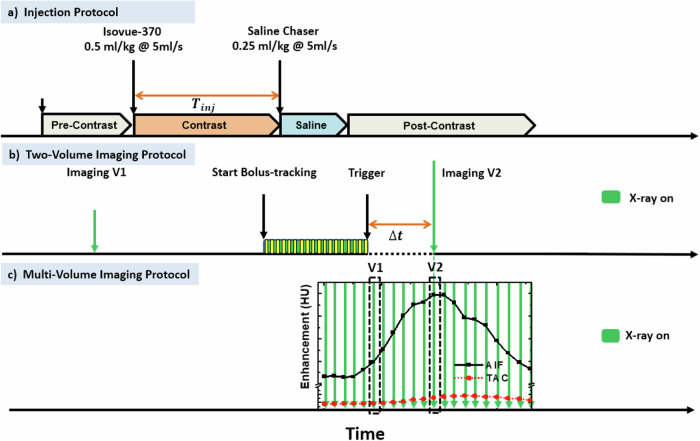
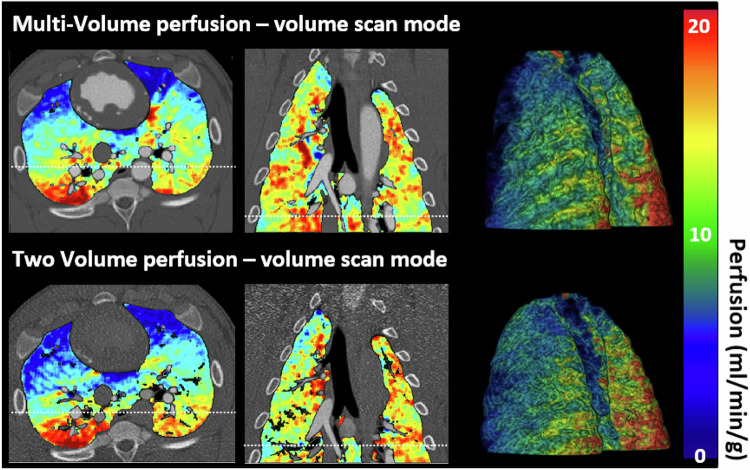
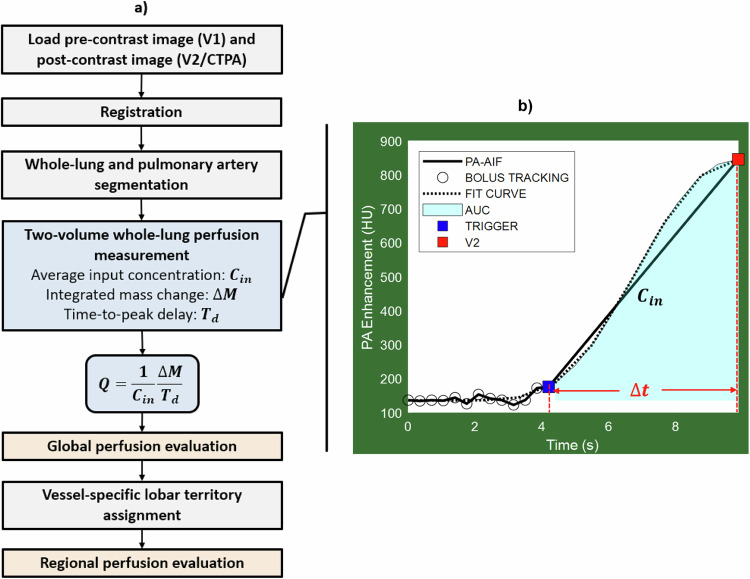
Methods: Five Yorkshire swine (weight 53.6 ± 2.6 kg) underwent 21 independent CT perfusion acquisitions. Intravenous contrast material (370 mg/mL iodine, 0.5 mL/kg) and saline chaser (0.5 mL/kg) were injected at 5 mL/s for each acquisition. Two-volume and multivolume dynamic CT perfusion data were acquired using a 320-slice CT, with multivolume measurements serving as the reference standard. The two-volume CT perfusion involved a low-dose (50 mA) volume scan before contrast injection and a diagnostic (300 mA) volume scan after bolus-tracking in the main pulmonary artery at the peak contrast enhancement. Multivolume CT perfusion included 15-20 volume scans for blood flow measurement. Paired sample t-test, linear regression, and Bland-Altman analysis compared both global and regional two-volume perfusion measurements to the reference standard. The reproducibility of the two-volume CT perfusion was assessed from two independent measurements under the same perfusion condition.
Results: Two-volume global perfusion measurements (P2V) were related to reference multivolume (PMV) measurements by P2V = 0.96 × PMV + 0.45 (r = 0.92), with a root-mean-square error of 1.29 mL/min/g and a root-mean-square deviation of 1.29 mL/min/g. The CT dose index for the two-volume and multivolume CT perfusion measurements were 9.3 mGy and 184.8 mGy, respectively.
Conclusion: We successfully validated a prospective, two-volume CT perfusion technique in a swine model. The findings affirm the feasibility of accurate and reproducible pulmonary blood flow measurement.
Relevance statement: This two-volume CT pulmonary perfusion technique, validated in a swine model, demonstrates the feasibility of blood flow measurement with a substantial reduction in radiation exposure. It could allow low-dose regional blood flow measurement in the assessment of pulmonary artery disease in humans.
Key points: Lung perfusion can be measured in mL/min/g using a prospective, two-volume CT technique. Flow measurement is achievable in a swine model with a radiation dose as low as 9.3 mGy. CT angiography and perfusion can be acquired following a single contrast injection.




 京公网安备 11010802042870号
京ICP备2023020795号-1
京公网安备 11010802042870号
京ICP备2023020795号-1

 分享
分享
 求助内容:
求助内容: 应助结果提醒方式:
 扫码关注我们
