{"title":"气味诱导轻度认知障碍患者poc -前额叶皮层-内侧颞叶皮层功能连通性改变。","authors":"Weiping Li, Jianan Zhou, Shuying Li, Min Wu, Yajing Zhu, Qian Chen, Futao Chen, Xuefeng Ma, Xin Zhang, Zhengge Wang, Jiaming Lu, Bing Zhang","doi":"10.3389/fnagi.2025.1502171","DOIUrl":null,"url":null,"abstract":"<p><strong>Background: </strong>Mild cognitive impairment (MCI) is associated with an increased risk of dementia in older adults. Olfactory impairment may indicate prodromal dementia, yet its underlying mechanisms are not fully understood. This study aimed to investigate the alterations in functional connectivity (FC) of odor-induced olfactory neural circuits in MCI patients.</p><p><strong>Methods: </strong>The study included 39 MCI patients and 42 normal controls (NCs). All subjects underwent cognitive assessments, olfactory behavior tests, and odor-based functional magnetic resonance imaging (fMRI). Differences in FC within olfactory circuits were analyzed using the generalized psychophysiological interaction (gPPI) method.</p><p><strong>Results: </strong>Mild cognitive impairment patients showed significant cognitive deficits, including lower scores on the Mini-Mental State Examination (MMSE) and Montreal Cognitive Assessment (MoCA), alongside impairments in episodic memory, visuospatial memory, executive function, language, attention, olfactory threshold, and total olfactory function. Compared to NCs, MCI patients exhibited reduced activation in the bilateral primary olfactory cortex (bPOC) during olfactory stimulation. Odor-induced bPOC activation correlated with olfactory thresholds across the cohort. During odor stimulation, MCI patients showed increased FC from the bPOC to the right anterior frontal lobe, particularly the middle frontal gyrus (MFG) and superior frontal gyrus (SFG). Conversely, FC from the right anterior frontal lobe to the medial temporal cortex, including the fusiform and parahippocampal gyri, was reduced in MCI patients. Increased FC from the bPOC to the right SFG/MFG negatively correlated with episodic memory, while decreased FC to the right fusiform/parahippocampal gyri positively correlated with attention, language ability, and olfactory identification.</p><p><strong>Conclusion: </strong>This study indicates that impaired FC within the primary olfactory cortex (POC)-anterior frontal cortex-medial temporal cortex circuit is a sensitive neuroimaging marker for early MCI identification. The primary dysfunction appears in the POC, suggesting that FC alterations from this region may provide novel diagnostic and therapeutic avenues for early intervention.</p>","PeriodicalId":12450,"journal":{"name":"Frontiers in Aging Neuroscience","volume":"17 ","pages":"1502171"},"PeriodicalIF":4.5000,"publicationDate":"2025-02-20","publicationTypes":"Journal Article","fieldsOfStudy":null,"isOpenAccess":false,"openAccessPdf":"https://www.ncbi.nlm.nih.gov/pmc/articles/PMC11882847/pdf/","citationCount":"0","resultStr":"{\"title\":\"Odor induced functional connectivity alteration of POC-anterior frontal cortex-medial temporal cortex in patients with mild cognitive impairment.\",\"authors\":\"Weiping Li, Jianan Zhou, Shuying Li, Min Wu, Yajing Zhu, Qian Chen, Futao Chen, Xuefeng Ma, Xin Zhang, Zhengge Wang, Jiaming Lu, Bing Zhang\",\"doi\":\"10.3389/fnagi.2025.1502171\",\"DOIUrl\":null,\"url\":null,\"abstract\":\"<p><strong>Background: </strong>Mild cognitive impairment (MCI) is associated with an increased risk of dementia in older adults. Olfactory impairment may indicate prodromal dementia, yet its underlying mechanisms are not fully understood. This study aimed to investigate the alterations in functional connectivity (FC) of odor-induced olfactory neural circuits in MCI patients.</p><p><strong>Methods: </strong>The study included 39 MCI patients and 42 normal controls (NCs). All subjects underwent cognitive assessments, olfactory behavior tests, and odor-based functional magnetic resonance imaging (fMRI). Differences in FC within olfactory circuits were analyzed using the generalized psychophysiological interaction (gPPI) method.</p><p><strong>Results: </strong>Mild cognitive impairment patients showed significant cognitive deficits, including lower scores on the Mini-Mental State Examination (MMSE) and Montreal Cognitive Assessment (MoCA), alongside impairments in episodic memory, visuospatial memory, executive function, language, attention, olfactory threshold, and total olfactory function. Compared to NCs, MCI patients exhibited reduced activation in the bilateral primary olfactory cortex (bPOC) during olfactory stimulation. Odor-induced bPOC activation correlated with olfactory thresholds across the cohort. During odor stimulation, MCI patients showed increased FC from the bPOC to the right anterior frontal lobe, particularly the middle frontal gyrus (MFG) and superior frontal gyrus (SFG). Conversely, FC from the right anterior frontal lobe to the medial temporal cortex, including the fusiform and parahippocampal gyri, was reduced in MCI patients. Increased FC from the bPOC to the right SFG/MFG negatively correlated with episodic memory, while decreased FC to the right fusiform/parahippocampal gyri positively correlated with attention, language ability, and olfactory identification.</p><p><strong>Conclusion: </strong>This study indicates that impaired FC within the primary olfactory cortex (POC)-anterior frontal cortex-medial temporal cortex circuit is a sensitive neuroimaging marker for early MCI identification. The primary dysfunction appears in the POC, suggesting that FC alterations from this region may provide novel diagnostic and therapeutic avenues for early intervention.</p>\",\"PeriodicalId\":12450,\"journal\":{\"name\":\"Frontiers in Aging Neuroscience\",\"volume\":\"17 \",\"pages\":\"1502171\"},\"PeriodicalIF\":4.5000,\"publicationDate\":\"2025-02-20\",\"publicationTypes\":\"Journal Article\",\"fieldsOfStudy\":null,\"isOpenAccess\":false,\"openAccessPdf\":\"https://www.ncbi.nlm.nih.gov/pmc/articles/PMC11882847/pdf/\",\"citationCount\":\"0\",\"resultStr\":null,\"platform\":\"Semanticscholar\",\"paperid\":null,\"PeriodicalName\":\"Frontiers in Aging Neuroscience\",\"FirstCategoryId\":\"3\",\"ListUrlMain\":\"https://doi.org/10.3389/fnagi.2025.1502171\",\"RegionNum\":2,\"RegionCategory\":\"医学\",\"ArticlePicture\":[],\"TitleCN\":null,\"AbstractTextCN\":null,\"PMCID\":null,\"EPubDate\":\"2025/1/1 0:00:00\",\"PubModel\":\"eCollection\",\"JCR\":\"Q2\",\"JCRName\":\"GERIATRICS & GERONTOLOGY\",\"Score\":null,\"Total\":0}","platform":"Semanticscholar","paperid":null,"PeriodicalName":"Frontiers in Aging Neuroscience","FirstCategoryId":"3","ListUrlMain":"https://doi.org/10.3389/fnagi.2025.1502171","RegionNum":2,"RegionCategory":"医学","ArticlePicture":[],"TitleCN":null,"AbstractTextCN":null,"PMCID":null,"EPubDate":"2025/1/1 0:00:00","PubModel":"eCollection","JCR":"Q2","JCRName":"GERIATRICS & GERONTOLOGY","Score":null,"Total":0}
Odor induced functional connectivity alteration of POC-anterior frontal cortex-medial temporal cortex in patients with mild cognitive impairment.
Background: Mild cognitive impairment (MCI) is associated with an increased risk of dementia in older adults. Olfactory impairment may indicate prodromal dementia, yet its underlying mechanisms are not fully understood. This study aimed to investigate the alterations in functional connectivity (FC) of odor-induced olfactory neural circuits in MCI patients.
Methods: The study included 39 MCI patients and 42 normal controls (NCs). All subjects underwent cognitive assessments, olfactory behavior tests, and odor-based functional magnetic resonance imaging (fMRI). Differences in FC within olfactory circuits were analyzed using the generalized psychophysiological interaction (gPPI) method.
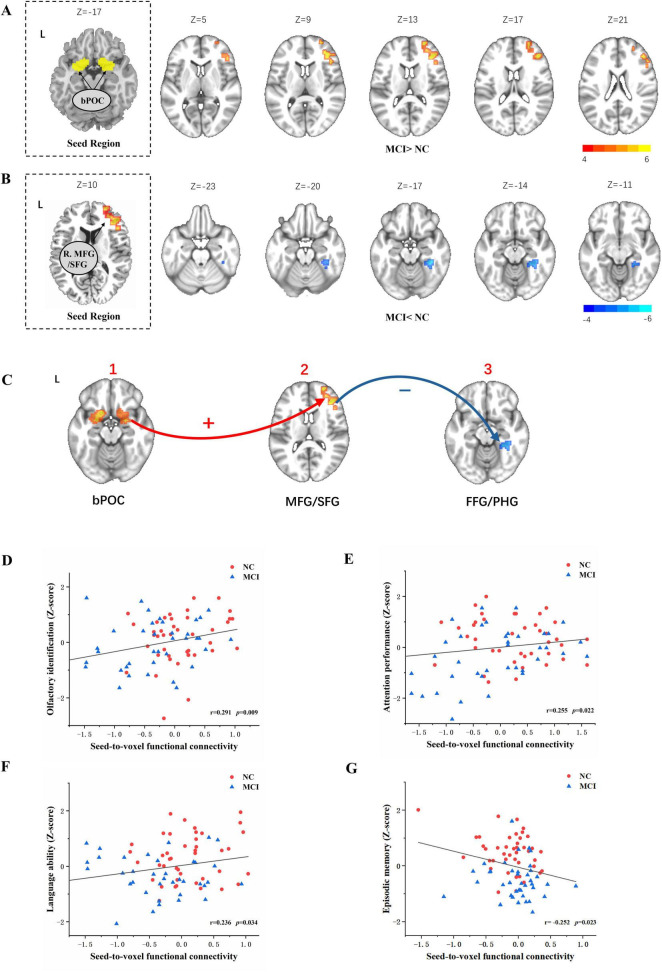
Results: Mild cognitive impairment patients showed significant cognitive deficits, including lower scores on the Mini-Mental State Examination (MMSE) and Montreal Cognitive Assessment (MoCA), alongside impairments in episodic memory, visuospatial memory, executive function, language, attention, olfactory threshold, and total olfactory function. Compared to NCs, MCI patients exhibited reduced activation in the bilateral primary olfactory cortex (bPOC) during olfactory stimulation. Odor-induced bPOC activation correlated with olfactory thresholds across the cohort. During odor stimulation, MCI patients showed increased FC from the bPOC to the right anterior frontal lobe, particularly the middle frontal gyrus (MFG) and superior frontal gyrus (SFG). Conversely, FC from the right anterior frontal lobe to the medial temporal cortex, including the fusiform and parahippocampal gyri, was reduced in MCI patients. Increased FC from the bPOC to the right SFG/MFG negatively correlated with episodic memory, while decreased FC to the right fusiform/parahippocampal gyri positively correlated with attention, language ability, and olfactory identification.
Conclusion: This study indicates that impaired FC within the primary olfactory cortex (POC)-anterior frontal cortex-medial temporal cortex circuit is a sensitive neuroimaging marker for early MCI identification. The primary dysfunction appears in the POC, suggesting that FC alterations from this region may provide novel diagnostic and therapeutic avenues for early intervention.
期刊介绍:
Frontiers in Aging Neuroscience is a leading journal in its field, publishing rigorously peer-reviewed research that advances our understanding of the mechanisms of Central Nervous System aging and age-related neural diseases. Specialty Chief Editor Thomas Wisniewski at the New York University School of Medicine is supported by an outstanding Editorial Board of international researchers. This multidisciplinary open-access journal is at the forefront of disseminating and communicating scientific knowledge and impactful discoveries to researchers, academics, clinicians and the public worldwide.






 京公网安备 11010802042870号
京ICP备2023020795号-1
京公网安备 11010802042870号
京ICP备2023020795号-1

 分享
分享
 求助内容:
求助内容: 应助结果提醒方式:
 扫码关注我们
