Estrella Torres, Joachim Ciers, Nelson Rebelo, Filip Hjort, Michael A. Bergmann, Sarina Graupeter, Johannes Enslin, Giulia Cardinalli, Tim Wernicke, Michael Kneissl, Åsa Haglund
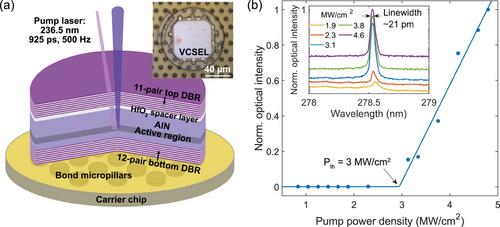
{"title":"具有精确腔长控制的紫外- c垂直腔面发射激光器","authors":"Estrella Torres, Joachim Ciers, Nelson Rebelo, Filip Hjort, Michael A. Bergmann, Sarina Graupeter, Johannes Enslin, Giulia Cardinalli, Tim Wernicke, Michael Kneissl, Åsa Haglund","doi":"10.1002/lpor.202402203","DOIUrl":null,"url":null,"abstract":"<p>In vertical-cavity surface-emitting lasers (VCSELs), the cavity length defines the resonance wavelength, which is directly related to the laser detuning, that is, the difference between resonance wavelength and gain peak. A low detuning maximizes the modal gain leading to a reduction of the threshold. Therefore, controlling the cavity length of VCSELs is of great importance. Here optically pumped ultraviolet-C (wavelength <span></span><math>\n <semantics>\n <mo>≤</mo>\n <annotation>$\\le$</annotation>\n </semantics></math> 280 nm) VCSELs with precise cavity length control are demonstrated. The VCSEL structure is formed by an AlN cavity with 5 <span></span><math>\n <semantics>\n <mrow>\n <mo>×</mo>\n <mrow></mrow>\n </mrow>\n <annotation>$\\ensuremath{\\times{}}$</annotation>\n </semantics></math> Al<sub>0.40</sub>Ga<sub>0.60</sub>/Al<sub>0.70</sub>Ga<sub>0.30</sub>N quantum wells and a top HfO<sub>2</sub> spacer layer with dielectric SiO<sub>2</sub>/HfO<sub>2</sub> distributed Bragg reflectors on both sides of the cavity. To access the N-face side of the cavity, a new methodology referred to as photo-assisted electrochemical etching is employed for substrate removal. Across a 0.9 mm <span></span><math>\n <semantics>\n <mo>×</mo>\n <annotation>$\\times$</annotation>\n </semantics></math> 1.2 mm area, the lasing wavelength varies a maximum of 1.17 nm between different UVC VCSELs, exhibiting threshold pump power densities from 0.7 MW/cm<sup>2</sup> to 3.7 MW/cm<sup>2</sup> and detuning values between 0 to 2 nm. The results show that VCSELs with a cavity length variation lower than 1<span></span><math>\n <semantics>\n <mo>%</mo>\n <annotation>$\\%$</annotation>\n </semantics></math> can be obtained with this technology.</p>","PeriodicalId":204,"journal":{"name":"Laser & Photonics Reviews","volume":"19 13","pages":""},"PeriodicalIF":10.0000,"publicationDate":"2025-03-29","publicationTypes":"Journal Article","fieldsOfStudy":null,"isOpenAccess":false,"openAccessPdf":"https://onlinelibrary.wiley.com/doi/epdf/10.1002/lpor.202402203","citationCount":"0","resultStr":"{\"title\":\"Ultraviolet-C Vertical-Cavity Surface-Emitting Lasers with Precise Cavity Length Control\",\"authors\":\"Estrella Torres, Joachim Ciers, Nelson Rebelo, Filip Hjort, Michael A. Bergmann, Sarina Graupeter, Johannes Enslin, Giulia Cardinalli, Tim Wernicke, Michael Kneissl, Åsa Haglund\",\"doi\":\"10.1002/lpor.202402203\",\"DOIUrl\":null,\"url\":null,\"abstract\":\"<p>In vertical-cavity surface-emitting lasers (VCSELs), the cavity length defines the resonance wavelength, which is directly related to the laser detuning, that is, the difference between resonance wavelength and gain peak. A low detuning maximizes the modal gain leading to a reduction of the threshold. Therefore, controlling the cavity length of VCSELs is of great importance. Here optically pumped ultraviolet-C (wavelength <span></span><math>\\n <semantics>\\n <mo>≤</mo>\\n <annotation>$\\\\le$</annotation>\\n </semantics></math> 280 nm) VCSELs with precise cavity length control are demonstrated. The VCSEL structure is formed by an AlN cavity with 5 <span></span><math>\\n <semantics>\\n <mrow>\\n <mo>×</mo>\\n <mrow></mrow>\\n </mrow>\\n <annotation>$\\\\ensuremath{\\\\times{}}$</annotation>\\n </semantics></math> Al<sub>0.40</sub>Ga<sub>0.60</sub>/Al<sub>0.70</sub>Ga<sub>0.30</sub>N quantum wells and a top HfO<sub>2</sub> spacer layer with dielectric SiO<sub>2</sub>/HfO<sub>2</sub> distributed Bragg reflectors on both sides of the cavity. To access the N-face side of the cavity, a new methodology referred to as photo-assisted electrochemical etching is employed for substrate removal. Across a 0.9 mm <span></span><math>\\n <semantics>\\n <mo>×</mo>\\n <annotation>$\\\\times$</annotation>\\n </semantics></math> 1.2 mm area, the lasing wavelength varies a maximum of 1.17 nm between different UVC VCSELs, exhibiting threshold pump power densities from 0.7 MW/cm<sup>2</sup> to 3.7 MW/cm<sup>2</sup> and detuning values between 0 to 2 nm. The results show that VCSELs with a cavity length variation lower than 1<span></span><math>\\n <semantics>\\n <mo>%</mo>\\n <annotation>$\\\\%$</annotation>\\n </semantics></math> can be obtained with this technology.</p>\",\"PeriodicalId\":204,\"journal\":{\"name\":\"Laser & Photonics Reviews\",\"volume\":\"19 13\",\"pages\":\"\"},\"PeriodicalIF\":10.0000,\"publicationDate\":\"2025-03-29\",\"publicationTypes\":\"Journal Article\",\"fieldsOfStudy\":null,\"isOpenAccess\":false,\"openAccessPdf\":\"https://onlinelibrary.wiley.com/doi/epdf/10.1002/lpor.202402203\",\"citationCount\":\"0\",\"resultStr\":null,\"platform\":\"Semanticscholar\",\"paperid\":null,\"PeriodicalName\":\"Laser & Photonics Reviews\",\"FirstCategoryId\":\"101\",\"ListUrlMain\":\"https://onlinelibrary.wiley.com/doi/10.1002/lpor.202402203\",\"RegionNum\":1,\"RegionCategory\":\"物理与天体物理\",\"ArticlePicture\":[],\"TitleCN\":null,\"AbstractTextCN\":null,\"PMCID\":null,\"EPubDate\":\"\",\"PubModel\":\"\",\"JCR\":\"Q1\",\"JCRName\":\"OPTICS\",\"Score\":null,\"Total\":0}","platform":"Semanticscholar","paperid":null,"PeriodicalName":"Laser & Photonics Reviews","FirstCategoryId":"101","ListUrlMain":"https://onlinelibrary.wiley.com/doi/10.1002/lpor.202402203","RegionNum":1,"RegionCategory":"物理与天体物理","ArticlePicture":[],"TitleCN":null,"AbstractTextCN":null,"PMCID":null,"EPubDate":"","PubModel":"","JCR":"Q1","JCRName":"OPTICS","Score":null,"Total":0}
Ultraviolet-C Vertical-Cavity Surface-Emitting Lasers with Precise Cavity Length Control
In vertical-cavity surface-emitting lasers (VCSELs), the cavity length defines the resonance wavelength, which is directly related to the laser detuning, that is, the difference between resonance wavelength and gain peak. A low detuning maximizes the modal gain leading to a reduction of the threshold. Therefore, controlling the cavity length of VCSELs is of great importance. Here optically pumped ultraviolet-C (wavelength 280 nm) VCSELs with precise cavity length control are demonstrated. The VCSEL structure is formed by an AlN cavity with 5 Al0.40Ga0.60/Al0.70Ga0.30N quantum wells and a top HfO2 spacer layer with dielectric SiO2/HfO2 distributed Bragg reflectors on both sides of the cavity. To access the N-face side of the cavity, a new methodology referred to as photo-assisted electrochemical etching is employed for substrate removal. Across a 0.9 mm 1.2 mm area, the lasing wavelength varies a maximum of 1.17 nm between different UVC VCSELs, exhibiting threshold pump power densities from 0.7 MW/cm2 to 3.7 MW/cm2 and detuning values between 0 to 2 nm. The results show that VCSELs with a cavity length variation lower than 1 can be obtained with this technology.
期刊介绍:
Laser & Photonics Reviews is a reputable journal that publishes high-quality Reviews, original Research Articles, and Perspectives in the field of photonics and optics. It covers both theoretical and experimental aspects, including recent groundbreaking research, specific advancements, and innovative applications.
As evidence of its impact and recognition, Laser & Photonics Reviews boasts a remarkable 2022 Impact Factor of 11.0, according to the Journal Citation Reports from Clarivate Analytics (2023). Moreover, it holds impressive rankings in the InCites Journal Citation Reports: in 2021, it was ranked 6th out of 101 in the field of Optics, 15th out of 161 in Applied Physics, and 12th out of 69 in Condensed Matter Physics.
The journal uses the ISSN numbers 1863-8880 for print and 1863-8899 for online publications.





 京公网安备 11010802042870号
京ICP备2023020795号-1
京公网安备 11010802042870号
京ICP备2023020795号-1

 分享
分享
 求助内容:
求助内容: 应助结果提醒方式:
 扫码关注我们
