Yi Zhang, Guifen Cheng, Ling Chen, Xiaoxia Wang, Lixia Lin, Qiao Huang, Jinhua Guo, Bei Gong, Tiemei Shen
{"title":"老年人身体功能和认知障碍的患病率及相关因素:一项基于人群的区域横断面研究","authors":"Yi Zhang, Guifen Cheng, Ling Chen, Xiaoxia Wang, Lixia Lin, Qiao Huang, Jinhua Guo, Bei Gong, Tiemei Shen","doi":"10.3389/fnagi.2025.1534824","DOIUrl":null,"url":null,"abstract":"<p><strong>Background and aims: </strong>As the country with the largest and fastest-aging older population worldwide, China has hosted an increasing number of regional investigations into disability among older adults. However, the prevalence of disabilities related to physical function and cognition in southern China remains unknown. This study aimed to assess the prevalence of and associated factors for cognitive and physical function impairment in individuals aged 60 years and older.</p><p><strong>Methods: </strong>For this population-based cross-sectional study, a total of 5,603 participants were recruited between June 2021 and December 2022 using a multistage, stratified, cluster sampling procedure. Instruments, including a general questionnaire, basic and instrumental activities of daily living, the Chinese version of the Mini-Mental State Examination (MMSE), the Patient Health Questionnaire-9 (PHQ-9), and the Generalized Anxiety Disorder-7 (GAD-7), were used to collect data through a WeChat mini program. Binary and multivariate logistic regression analyses were applied to explore the influencing factors.</p><p><strong>Results: </strong>The prevalence of physical function and cognitive impairment among older adults was 37.3 and 31.0%, respectively. Multivariate regression analyses revealed that age, family income, education level, place of residence, medication type, annual physical examinations, weekly social activities, support from family or friends, hearing disorders, walking disorders, and depression were all associated with both physical function and cognitive impairment. Moreover, an increased risk of physical function impairment correlated with BMI, region, income source, smoking, and weekly exercise, while cognitive impairment was associated with the number of children, insurance type, coronary heart disease, and anxiety. Physical function (<i>OR</i>: 1.79, 95% <i>CI</i>: 1.49-2.16) and cognitive impairment (<i>OR</i>: 1.83, 95% <i>CI</i>: 1.51-2.21) were mutually influential in our study.</p><p><strong>Conclusion: </strong>This study showed a high prevalence of various factors related to physical function and cognitive impairment. The results revealed that comprehensive and systematic prevention and control programs for disabilities should be developed to improve the quality of life for older adults.</p>","PeriodicalId":12450,"journal":{"name":"Frontiers in Aging Neuroscience","volume":"17 ","pages":"1534824"},"PeriodicalIF":4.5000,"publicationDate":"2025-03-14","publicationTypes":"Journal Article","fieldsOfStudy":null,"isOpenAccess":false,"openAccessPdf":"https://www.ncbi.nlm.nih.gov/pmc/articles/PMC11949958/pdf/","citationCount":"0","resultStr":"{\"title\":\"Prevalence and related factors of physical function and cognitive impairment among older adults: a population-based regional cross-sectional study.\",\"authors\":\"Yi Zhang, Guifen Cheng, Ling Chen, Xiaoxia Wang, Lixia Lin, Qiao Huang, Jinhua Guo, Bei Gong, Tiemei Shen\",\"doi\":\"10.3389/fnagi.2025.1534824\",\"DOIUrl\":null,\"url\":null,\"abstract\":\"<p><strong>Background and aims: </strong>As the country with the largest and fastest-aging older population worldwide, China has hosted an increasing number of regional investigations into disability among older adults. However, the prevalence of disabilities related to physical function and cognition in southern China remains unknown. This study aimed to assess the prevalence of and associated factors for cognitive and physical function impairment in individuals aged 60 years and older.</p><p><strong>Methods: </strong>For this population-based cross-sectional study, a total of 5,603 participants were recruited between June 2021 and December 2022 using a multistage, stratified, cluster sampling procedure. Instruments, including a general questionnaire, basic and instrumental activities of daily living, the Chinese version of the Mini-Mental State Examination (MMSE), the Patient Health Questionnaire-9 (PHQ-9), and the Generalized Anxiety Disorder-7 (GAD-7), were used to collect data through a WeChat mini program. Binary and multivariate logistic regression analyses were applied to explore the influencing factors.</p><p><strong>Results: </strong>The prevalence of physical function and cognitive impairment among older adults was 37.3 and 31.0%, respectively. Multivariate regression analyses revealed that age, family income, education level, place of residence, medication type, annual physical examinations, weekly social activities, support from family or friends, hearing disorders, walking disorders, and depression were all associated with both physical function and cognitive impairment. Moreover, an increased risk of physical function impairment correlated with BMI, region, income source, smoking, and weekly exercise, while cognitive impairment was associated with the number of children, insurance type, coronary heart disease, and anxiety. Physical function (<i>OR</i>: 1.79, 95% <i>CI</i>: 1.49-2.16) and cognitive impairment (<i>OR</i>: 1.83, 95% <i>CI</i>: 1.51-2.21) were mutually influential in our study.</p><p><strong>Conclusion: </strong>This study showed a high prevalence of various factors related to physical function and cognitive impairment. The results revealed that comprehensive and systematic prevention and control programs for disabilities should be developed to improve the quality of life for older adults.</p>\",\"PeriodicalId\":12450,\"journal\":{\"name\":\"Frontiers in Aging Neuroscience\",\"volume\":\"17 \",\"pages\":\"1534824\"},\"PeriodicalIF\":4.5000,\"publicationDate\":\"2025-03-14\",\"publicationTypes\":\"Journal Article\",\"fieldsOfStudy\":null,\"isOpenAccess\":false,\"openAccessPdf\":\"https://www.ncbi.nlm.nih.gov/pmc/articles/PMC11949958/pdf/\",\"citationCount\":\"0\",\"resultStr\":null,\"platform\":\"Semanticscholar\",\"paperid\":null,\"PeriodicalName\":\"Frontiers in Aging Neuroscience\",\"FirstCategoryId\":\"3\",\"ListUrlMain\":\"https://doi.org/10.3389/fnagi.2025.1534824\",\"RegionNum\":2,\"RegionCategory\":\"医学\",\"ArticlePicture\":[],\"TitleCN\":null,\"AbstractTextCN\":null,\"PMCID\":null,\"EPubDate\":\"2025/1/1 0:00:00\",\"PubModel\":\"eCollection\",\"JCR\":\"Q2\",\"JCRName\":\"GERIATRICS & GERONTOLOGY\",\"Score\":null,\"Total\":0}","platform":"Semanticscholar","paperid":null,"PeriodicalName":"Frontiers in Aging Neuroscience","FirstCategoryId":"3","ListUrlMain":"https://doi.org/10.3389/fnagi.2025.1534824","RegionNum":2,"RegionCategory":"医学","ArticlePicture":[],"TitleCN":null,"AbstractTextCN":null,"PMCID":null,"EPubDate":"2025/1/1 0:00:00","PubModel":"eCollection","JCR":"Q2","JCRName":"GERIATRICS & GERONTOLOGY","Score":null,"Total":0}
Prevalence and related factors of physical function and cognitive impairment among older adults: a population-based regional cross-sectional study.
Background and aims: As the country with the largest and fastest-aging older population worldwide, China has hosted an increasing number of regional investigations into disability among older adults. However, the prevalence of disabilities related to physical function and cognition in southern China remains unknown. This study aimed to assess the prevalence of and associated factors for cognitive and physical function impairment in individuals aged 60 years and older.
Methods: For this population-based cross-sectional study, a total of 5,603 participants were recruited between June 2021 and December 2022 using a multistage, stratified, cluster sampling procedure. Instruments, including a general questionnaire, basic and instrumental activities of daily living, the Chinese version of the Mini-Mental State Examination (MMSE), the Patient Health Questionnaire-9 (PHQ-9), and the Generalized Anxiety Disorder-7 (GAD-7), were used to collect data through a WeChat mini program. Binary and multivariate logistic regression analyses were applied to explore the influencing factors.
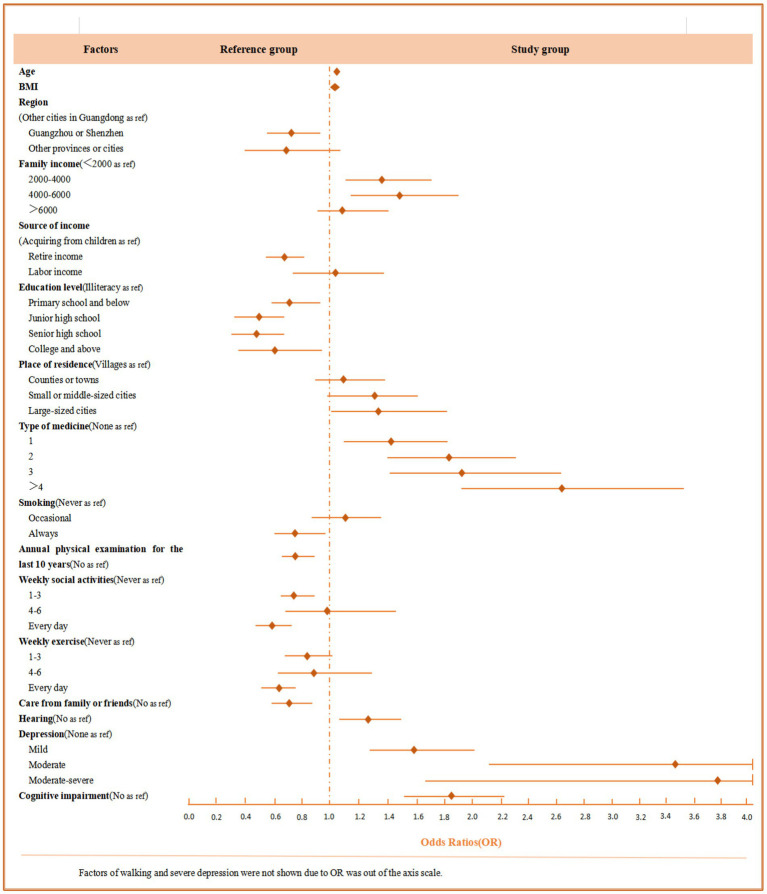
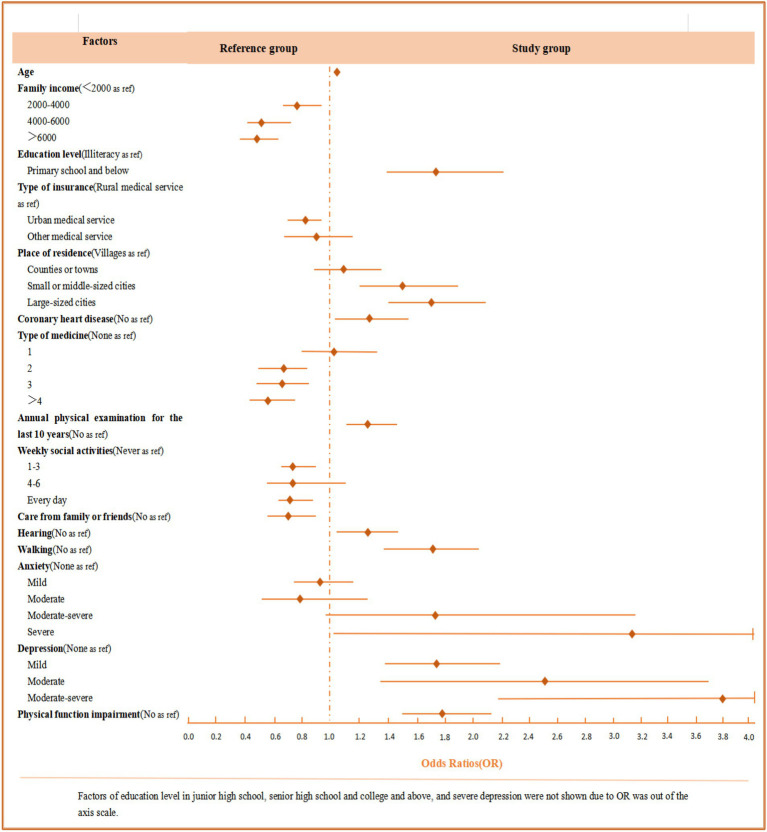
Results: The prevalence of physical function and cognitive impairment among older adults was 37.3 and 31.0%, respectively. Multivariate regression analyses revealed that age, family income, education level, place of residence, medication type, annual physical examinations, weekly social activities, support from family or friends, hearing disorders, walking disorders, and depression were all associated with both physical function and cognitive impairment. Moreover, an increased risk of physical function impairment correlated with BMI, region, income source, smoking, and weekly exercise, while cognitive impairment was associated with the number of children, insurance type, coronary heart disease, and anxiety. Physical function (OR: 1.79, 95% CI: 1.49-2.16) and cognitive impairment (OR: 1.83, 95% CI: 1.51-2.21) were mutually influential in our study.
Conclusion: This study showed a high prevalence of various factors related to physical function and cognitive impairment. The results revealed that comprehensive and systematic prevention and control programs for disabilities should be developed to improve the quality of life for older adults.
期刊介绍:
Frontiers in Aging Neuroscience is a leading journal in its field, publishing rigorously peer-reviewed research that advances our understanding of the mechanisms of Central Nervous System aging and age-related neural diseases. Specialty Chief Editor Thomas Wisniewski at the New York University School of Medicine is supported by an outstanding Editorial Board of international researchers. This multidisciplinary open-access journal is at the forefront of disseminating and communicating scientific knowledge and impactful discoveries to researchers, academics, clinicians and the public worldwide.




 京公网安备 11010802042870号
京ICP备2023020795号-1
京公网安备 11010802042870号
京ICP备2023020795号-1

 分享
分享
 求助内容:
求助内容: 应助结果提醒方式:
 扫码关注我们
