{"title":"高性能非对称超级电容器中嵌入还原氧化石墨烯的镍酸锡纳米结构的结构调制","authors":"E. Murugan and F. Lyric","doi":"10.1039/D5NR00396B","DOIUrl":null,"url":null,"abstract":"<p >Development of a new, cost-effective, advanced energy storage material <em>via</em> a simple method is a great challenge among researchers. In this study, we have synthesized efficient spinel tin nickelate nano-popcorns, SnNi<small><sub>2</sub></small>O<small><sub>4</sub></small> (SNNPs), <em>via</em> a solvothermal process. Furthermore, to enhance their charge transfer characteristics, SNNPs were impregnated on reduced graphene oxide (rGO) nanosheets through ultrasonication to obtain SnNi<small><sub>2</sub></small>O<small><sub>4</sub></small>@rGO (SNNPR). By varying the percentage load ratio of SNNPs and rGO, six different nanocomposites, namely, SNNPR-1, SNNPR-2, SNNPR-3, SNNPR-4, SNNPR-5 and SNNPR-6, were produced. They were thoroughly characterized using spectroscopic and microscopic techniques. The electrochemical analysis of all the SNNP-based electrode materials was performed using cyclic voltammetry (CV), galvanostatic charge–discharge (GCD) and electrochemical impedance spectroscopy (EIS). Among these six electrode materials, SNNPR-3 produces a maximum specific capacitance (<em>C</em><small><sub>sp</sub></small>) of 225 mA h g<small><sup>−1</sup></small> (1624 F g<small><sup>−1</sup></small>) in a three-electrode assembly at 1 A g<small><sup>−1</sup></small> and retains a cycle stability of 94% up to 1000 cycles. Based on the superiority of SNNPR-3, an asymmetric supercapacitor (ASC) was fabricated with SNNPR-3 as the cathode and activated carbon (AC) as the anode (SNNPR-3//AC). Exhibiting a thorough electrochemical performance, the present ASC yielded a specific capacitance, <em>C</em><small><sub>sp</sub></small> of 264 F g<small><sup>−1</sup></small>, high energy density of 62.3 W h kg<small><sup>−1</sup></small> and power density of 2600 W kg<small><sup>−1</sup></small>. The device exhibited 80.02% of retention capacitance even after 5000 cycles. Also, SNNPR-3//AC was able to illuminate a green light emitting diode. Therefore, this asymmetric energy storage device has enormous potential for practical applications in the future.</p>","PeriodicalId":92,"journal":{"name":"Nanoscale","volume":" 18","pages":" 11578-11591"},"PeriodicalIF":5.1000,"publicationDate":"2025-04-03","publicationTypes":"Journal Article","fieldsOfStudy":null,"isOpenAccess":false,"openAccessPdf":"","citationCount":"0","resultStr":"{\"title\":\"Structural modulation of tin nickelate nanostructures embedded in reduced graphene oxide for high-performance asymmetric supercapacitors†\",\"authors\":\"E. Murugan and F. Lyric\",\"doi\":\"10.1039/D5NR00396B\",\"DOIUrl\":null,\"url\":null,\"abstract\":\"<p >Development of a new, cost-effective, advanced energy storage material <em>via</em> a simple method is a great challenge among researchers. In this study, we have synthesized efficient spinel tin nickelate nano-popcorns, SnNi<small><sub>2</sub></small>O<small><sub>4</sub></small> (SNNPs), <em>via</em> a solvothermal process. Furthermore, to enhance their charge transfer characteristics, SNNPs were impregnated on reduced graphene oxide (rGO) nanosheets through ultrasonication to obtain SnNi<small><sub>2</sub></small>O<small><sub>4</sub></small>@rGO (SNNPR). By varying the percentage load ratio of SNNPs and rGO, six different nanocomposites, namely, SNNPR-1, SNNPR-2, SNNPR-3, SNNPR-4, SNNPR-5 and SNNPR-6, were produced. They were thoroughly characterized using spectroscopic and microscopic techniques. The electrochemical analysis of all the SNNP-based electrode materials was performed using cyclic voltammetry (CV), galvanostatic charge–discharge (GCD) and electrochemical impedance spectroscopy (EIS). Among these six electrode materials, SNNPR-3 produces a maximum specific capacitance (<em>C</em><small><sub>sp</sub></small>) of 225 mA h g<small><sup>−1</sup></small> (1624 F g<small><sup>−1</sup></small>) in a three-electrode assembly at 1 A g<small><sup>−1</sup></small> and retains a cycle stability of 94% up to 1000 cycles. Based on the superiority of SNNPR-3, an asymmetric supercapacitor (ASC) was fabricated with SNNPR-3 as the cathode and activated carbon (AC) as the anode (SNNPR-3//AC). Exhibiting a thorough electrochemical performance, the present ASC yielded a specific capacitance, <em>C</em><small><sub>sp</sub></small> of 264 F g<small><sup>−1</sup></small>, high energy density of 62.3 W h kg<small><sup>−1</sup></small> and power density of 2600 W kg<small><sup>−1</sup></small>. The device exhibited 80.02% of retention capacitance even after 5000 cycles. Also, SNNPR-3//AC was able to illuminate a green light emitting diode. Therefore, this asymmetric energy storage device has enormous potential for practical applications in the future.</p>\",\"PeriodicalId\":92,\"journal\":{\"name\":\"Nanoscale\",\"volume\":\" 18\",\"pages\":\" 11578-11591\"},\"PeriodicalIF\":5.1000,\"publicationDate\":\"2025-04-03\",\"publicationTypes\":\"Journal Article\",\"fieldsOfStudy\":null,\"isOpenAccess\":false,\"openAccessPdf\":\"\",\"citationCount\":\"0\",\"resultStr\":null,\"platform\":\"Semanticscholar\",\"paperid\":null,\"PeriodicalName\":\"Nanoscale\",\"FirstCategoryId\":\"88\",\"ListUrlMain\":\"https://pubs.rsc.org/en/content/articlelanding/2025/nr/d5nr00396b\",\"RegionNum\":3,\"RegionCategory\":\"材料科学\",\"ArticlePicture\":[],\"TitleCN\":null,\"AbstractTextCN\":null,\"PMCID\":null,\"EPubDate\":\"\",\"PubModel\":\"\",\"JCR\":\"Q1\",\"JCRName\":\"CHEMISTRY, MULTIDISCIPLINARY\",\"Score\":null,\"Total\":0}","platform":"Semanticscholar","paperid":null,"PeriodicalName":"Nanoscale","FirstCategoryId":"88","ListUrlMain":"https://pubs.rsc.org/en/content/articlelanding/2025/nr/d5nr00396b","RegionNum":3,"RegionCategory":"材料科学","ArticlePicture":[],"TitleCN":null,"AbstractTextCN":null,"PMCID":null,"EPubDate":"","PubModel":"","JCR":"Q1","JCRName":"CHEMISTRY, MULTIDISCIPLINARY","Score":null,"Total":0}
引用次数: 0
摘要
通过简单的方法开发一种新型、经济、先进的储能材料是研究人员面临的巨大挑战。在这项研究中,我们通过溶热工艺合成了一种高效的尖晶石锡镍酸盐纳米多孔体 SnNi2O4(SNNPs)。此外,为了增强其电荷转移特性,我们还通过超声处理将 SNNPs 浸渍到还原型氧化石墨烯(rGO)纳米片上,从而得到 SnNi2O4@rGO (SNNPR)。通过改变 SNNPs 和 rGO 的负载比例,制备出六种不同的纳米复合材料,即 SNNPR-1、SNNPR-2、SNNPR-3、SNNPR-4、SNNPR-5 和 SNNPR-6。通过光谱和显微镜技术对它们进行了全面的表征。通过循环伏安法(CV)、伽伐诺静态充放电法(GCD)和电化学阻抗光谱法(EIS)对所有基于 SNNPs 的电极材料进行了电化学分析。在这六种电极材料中,SNNPR-3 在 1 A g-1 的条件下,在三电极组装中产生的最大比电容(Csp)为 225 mAh g-1(1624 F g-1),循环稳定性高达 94%(1000 次循环)。基于 SNNPR-3 的优越性,以 SNNPR-3 为阴极、活性炭(AC)为阳极(SNNPR-3//AC),制备了不对称超级电容器(ASC)。通过电化学性能测试,该 ASC 的比电容 Csp 为 264 F g"-1",能量密度高达 62.3 Wh Kg"-1",功率密度为 2600 W kg"-1"。即使在 5000 次循环后,该器件仍能保持 80.02% 的电容。此外,SNNPR-3//AC 还能点亮绿色发光二极管。因此,这种非对称储能装置在未来的实际应用中具有巨大的潜力。
Structural modulation of tin nickelate nanostructures embedded in reduced graphene oxide for high-performance asymmetric supercapacitors†
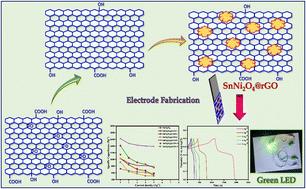
Development of a new, cost-effective, advanced energy storage material via a simple method is a great challenge among researchers. In this study, we have synthesized efficient spinel tin nickelate nano-popcorns, SnNi2O4 (SNNPs), via a solvothermal process. Furthermore, to enhance their charge transfer characteristics, SNNPs were impregnated on reduced graphene oxide (rGO) nanosheets through ultrasonication to obtain SnNi2O4@rGO (SNNPR). By varying the percentage load ratio of SNNPs and rGO, six different nanocomposites, namely, SNNPR-1, SNNPR-2, SNNPR-3, SNNPR-4, SNNPR-5 and SNNPR-6, were produced. They were thoroughly characterized using spectroscopic and microscopic techniques. The electrochemical analysis of all the SNNP-based electrode materials was performed using cyclic voltammetry (CV), galvanostatic charge–discharge (GCD) and electrochemical impedance spectroscopy (EIS). Among these six electrode materials, SNNPR-3 produces a maximum specific capacitance (Csp) of 225 mA h g−1 (1624 F g−1) in a three-electrode assembly at 1 A g−1 and retains a cycle stability of 94% up to 1000 cycles. Based on the superiority of SNNPR-3, an asymmetric supercapacitor (ASC) was fabricated with SNNPR-3 as the cathode and activated carbon (AC) as the anode (SNNPR-3//AC). Exhibiting a thorough electrochemical performance, the present ASC yielded a specific capacitance, Csp of 264 F g−1, high energy density of 62.3 W h kg−1 and power density of 2600 W kg−1. The device exhibited 80.02% of retention capacitance even after 5000 cycles. Also, SNNPR-3//AC was able to illuminate a green light emitting diode. Therefore, this asymmetric energy storage device has enormous potential for practical applications in the future.
期刊介绍:
Nanoscale is a high-impact international journal, publishing high-quality research across nanoscience and nanotechnology. Nanoscale publishes a full mix of research articles on experimental and theoretical work, including reviews, communications, and full papers.Highly interdisciplinary, this journal appeals to scientists, researchers and professionals interested in nanoscience and nanotechnology, quantum materials and quantum technology, including the areas of physics, chemistry, biology, medicine, materials, energy/environment, information technology, detection science, healthcare and drug discovery, and electronics.




 京公网安备 11010802042870号
京ICP备2023020795号-1
京公网安备 11010802042870号
京ICP备2023020795号-1

 分享
分享
 求助内容:
求助内容: 应助结果提醒方式:
 扫码关注我们
