{"title":"半乳糖凝集素-7特异性纳米体的发展:癌症免疫治疗和分子成像的意义","authors":"Rita Nehmé, Marlène Fortier, Myriam Létourneau, Camille Fuselier, Philippine Granger Joly de Boissel, Alyssa Dumoulin, Brigitte Guérin, Véronique Dumulon-Perreault, Samia Ait-Mohand, Otman Sarrhini, Sacha T. Larda, Yarileny Castellanos Villamizar, Mighel Bernier, Natalia Porębska, Łukasz Opaliński, David Chatenet, Nicolas Doucet, Yves St-Pierre","doi":"10.1021/acs.jmedchem.5c00071","DOIUrl":null,"url":null,"abstract":"Galectins play significant roles in regulating immune responses, posing challenges for cancer immunotherapy. The development of galectin inhibitors has been limited by their high structural homology and the lack of noninvasive imaging tools to identify potential responsive patients. We developed 12 galectin-7-specific inhibitors using nanobodies (Nbs) and identified G7N8 as the lead Nb. G7N8 was conjugated with the NOTA chelator, labeled with copper-64 ([<sup>64</sup>Cu]Cu), and used as a radiotracer for PET imaging in a triple-negative breast cancer (TNBC) mouse model. Nbs demonstrated high affinity for galectin-7, with no binding activity for other galectins tested. The lead Nbs inhibited galectin-7 binding to T-cell glycoreceptors and reduced subsequent apoptosis. PET imaging with [<sup>64</sup>Cu]Cu-NOTA-G7N8 showed selective radiotracer accumulation at 20 h (<i>P</i> = 0.001). We developed galectin-7-specific Nbs that inhibit T-cell apoptosis and enable PET imaging of TNBC, providing novel tools for investigating immune regulation and enhancing cancer immunotherapy.","PeriodicalId":46,"journal":{"name":"Journal of Medicinal Chemistry","volume":"2 1","pages":""},"PeriodicalIF":6.8000,"publicationDate":"2025-04-10","publicationTypes":"Journal Article","fieldsOfStudy":null,"isOpenAccess":false,"openAccessPdf":"","citationCount":"0","resultStr":"{\"title\":\"Development of Galectin-7-Specific Nanobodies: Implications for Immunotherapy and Molecular Imaging in Cancer\",\"authors\":\"Rita Nehmé, Marlène Fortier, Myriam Létourneau, Camille Fuselier, Philippine Granger Joly de Boissel, Alyssa Dumoulin, Brigitte Guérin, Véronique Dumulon-Perreault, Samia Ait-Mohand, Otman Sarrhini, Sacha T. Larda, Yarileny Castellanos Villamizar, Mighel Bernier, Natalia Porębska, Łukasz Opaliński, David Chatenet, Nicolas Doucet, Yves St-Pierre\",\"doi\":\"10.1021/acs.jmedchem.5c00071\",\"DOIUrl\":null,\"url\":null,\"abstract\":\"Galectins play significant roles in regulating immune responses, posing challenges for cancer immunotherapy. The development of galectin inhibitors has been limited by their high structural homology and the lack of noninvasive imaging tools to identify potential responsive patients. We developed 12 galectin-7-specific inhibitors using nanobodies (Nbs) and identified G7N8 as the lead Nb. G7N8 was conjugated with the NOTA chelator, labeled with copper-64 ([<sup>64</sup>Cu]Cu), and used as a radiotracer for PET imaging in a triple-negative breast cancer (TNBC) mouse model. Nbs demonstrated high affinity for galectin-7, with no binding activity for other galectins tested. The lead Nbs inhibited galectin-7 binding to T-cell glycoreceptors and reduced subsequent apoptosis. PET imaging with [<sup>64</sup>Cu]Cu-NOTA-G7N8 showed selective radiotracer accumulation at 20 h (<i>P</i> = 0.001). We developed galectin-7-specific Nbs that inhibit T-cell apoptosis and enable PET imaging of TNBC, providing novel tools for investigating immune regulation and enhancing cancer immunotherapy.\",\"PeriodicalId\":46,\"journal\":{\"name\":\"Journal of Medicinal Chemistry\",\"volume\":\"2 1\",\"pages\":\"\"},\"PeriodicalIF\":6.8000,\"publicationDate\":\"2025-04-10\",\"publicationTypes\":\"Journal Article\",\"fieldsOfStudy\":null,\"isOpenAccess\":false,\"openAccessPdf\":\"\",\"citationCount\":\"0\",\"resultStr\":null,\"platform\":\"Semanticscholar\",\"paperid\":null,\"PeriodicalName\":\"Journal of Medicinal Chemistry\",\"FirstCategoryId\":\"3\",\"ListUrlMain\":\"https://doi.org/10.1021/acs.jmedchem.5c00071\",\"RegionNum\":1,\"RegionCategory\":\"医学\",\"ArticlePicture\":[],\"TitleCN\":null,\"AbstractTextCN\":null,\"PMCID\":null,\"EPubDate\":\"\",\"PubModel\":\"\",\"JCR\":\"Q1\",\"JCRName\":\"CHEMISTRY, MEDICINAL\",\"Score\":null,\"Total\":0}","platform":"Semanticscholar","paperid":null,"PeriodicalName":"Journal of Medicinal Chemistry","FirstCategoryId":"3","ListUrlMain":"https://doi.org/10.1021/acs.jmedchem.5c00071","RegionNum":1,"RegionCategory":"医学","ArticlePicture":[],"TitleCN":null,"AbstractTextCN":null,"PMCID":null,"EPubDate":"","PubModel":"","JCR":"Q1","JCRName":"CHEMISTRY, MEDICINAL","Score":null,"Total":0}
引用次数: 0
摘要
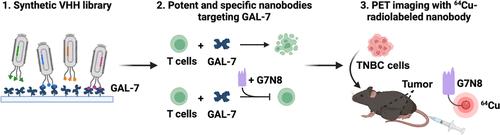
Galectins 在调节免疫反应方面发挥着重要作用,给癌症免疫疗法带来了挑战。由于半凝集素抑制剂的结构同源性很高,而且缺乏无创成像工具来识别潜在的反应患者,因此半凝集素抑制剂的开发受到了限制。我们利用纳米抗体(Nbs)开发了12种galectin-7特异性抑制剂,并确定G7N8为先导Nbs。G7N8 与 NOTA 螯合剂共轭,用铜-64([64Cu]Cu)标记,并在三阴性乳腺癌(TNBC)小鼠模型中用作 PET 成像的放射性示踪剂。Nbs 对 galectin-7 表现出很高的亲和力,而对测试的其他 galectin 没有结合活性。先导 Nbs 可抑制 galectin-7 与 T 细胞糖受体的结合,并减少随后的细胞凋亡。使用[64Cu]Cu-NOTA-G7N8进行的正电子发射计算机断层成像显示,20小时后放射性示踪剂会选择性地积累(P = 0.001)。我们开发的galectin-7特异性Nbs可抑制T细胞凋亡并实现TNBC的PET成像,为研究免疫调节和加强癌症免疫疗法提供了新的工具。
Development of Galectin-7-Specific Nanobodies: Implications for Immunotherapy and Molecular Imaging in Cancer
Galectins play significant roles in regulating immune responses, posing challenges for cancer immunotherapy. The development of galectin inhibitors has been limited by their high structural homology and the lack of noninvasive imaging tools to identify potential responsive patients. We developed 12 galectin-7-specific inhibitors using nanobodies (Nbs) and identified G7N8 as the lead Nb. G7N8 was conjugated with the NOTA chelator, labeled with copper-64 ([64Cu]Cu), and used as a radiotracer for PET imaging in a triple-negative breast cancer (TNBC) mouse model. Nbs demonstrated high affinity for galectin-7, with no binding activity for other galectins tested. The lead Nbs inhibited galectin-7 binding to T-cell glycoreceptors and reduced subsequent apoptosis. PET imaging with [64Cu]Cu-NOTA-G7N8 showed selective radiotracer accumulation at 20 h (P = 0.001). We developed galectin-7-specific Nbs that inhibit T-cell apoptosis and enable PET imaging of TNBC, providing novel tools for investigating immune regulation and enhancing cancer immunotherapy.
期刊介绍:
The Journal of Medicinal Chemistry is a prestigious biweekly peer-reviewed publication that focuses on the multifaceted field of medicinal chemistry. Since its inception in 1959 as the Journal of Medicinal and Pharmaceutical Chemistry, it has evolved to become a cornerstone in the dissemination of research findings related to the design, synthesis, and development of therapeutic agents.
The Journal of Medicinal Chemistry is recognized for its significant impact in the scientific community, as evidenced by its 2022 impact factor of 7.3. This metric reflects the journal's influence and the importance of its content in shaping the future of drug discovery and development. The journal serves as a vital resource for chemists, pharmacologists, and other researchers interested in the molecular mechanisms of drug action and the optimization of therapeutic compounds.




 京公网安备 11010802042870号
京ICP备2023020795号-1
京公网安备 11010802042870号
京ICP备2023020795号-1

 分享
分享
 求助内容:
求助内容: 应助结果提醒方式:
 扫码关注我们
