Preoperative clinical diagnostic accuracy of heart failure among patients undergoing major noncardiac surgery: a single-centre prospective observational analysis
Jessica R. Golbus , Hyeon Joo , Allison M. Janda , Michael D. Maile , Keith D. Aaronson , Milo C. Engoren , Ruth B. Cassidy , Sachin Kheterpal , Michael R. Mathis
{"title":"Preoperative clinical diagnostic accuracy of heart failure among patients undergoing major noncardiac surgery: a single-centre prospective observational analysis","authors":"Jessica R. Golbus , Hyeon Joo , Allison M. Janda , Michael D. Maile , Keith D. Aaronson , Milo C. Engoren , Ruth B. Cassidy , Sachin Kheterpal , Michael R. Mathis","doi":"10.1016/j.bjao.2022.100113","DOIUrl":null,"url":null,"abstract":"<div><h3>Background</h3><p>Reliable diagnosis of heart failure during preoperative evaluation is important for perioperative management and long-term care. We aimed to quantify preoperative heart failure diagnostic accuracy and explore characteristics of patients with heart failure misdiagnoses.</p></div><div><h3>Methods</h3><p>We performed an observational cohort study of adults undergoing major noncardiac surgery at an academic hospital between 2015 and 2019. A preoperative clinical diagnosis of heart failure was defined using keywords from the history and clinical examination or administrative documentation. Across stratified subsamples of cases with and without clinically diagnosed heart failure, health records were intensively reviewed by an expert panel to develop an adjudicated heart failure reference standard using diagnostic criteria congruent with consensus guidelines. We calculated agreement among experts, and analysed performance of clinically diagnosed heart failure compared with the adjudicated reference standard.</p></div><div><h3>Results</h3><p>Across 40 555 major noncardiac procedures, a stratified subsample of 511 patients was reviewed by the expert panel. The prevalence of heart failure was 9.1% based on clinically diagnosed compared with 13.3% (95% confidence interval [CI], 10.3–16.2%) estimated by the expert panel. Overall agreement and inter-rater reliability (kappa) among heart failure experts were 95% and 0.79, respectively. Based upon expert adjudication, heart failure was clinically diagnosed with an accuracy of 92.8% (90.6–95.1%), sensitivity 57.4% (53.1–61.7%), specificity 98.3% (97.1–99.4%), positive predictive value 83.5% (80.3–86.8%), and negative predictive value 93.8% (91.7–95.9%).</p></div><div><h3>Conclusions</h3><p>Limitations exist to the preoperative clinical diagnosis of heart failure, with nearly half of cases undiagnosed preoperatively. Considering the risks of undiagnosed heart failure, efforts to improve preoperative heart failure diagnoses are warranted.</p></div>","PeriodicalId":72418,"journal":{"name":"BJA open","volume":"4 ","pages":"Article 100113"},"PeriodicalIF":0.0000,"publicationDate":"2022-12-01","publicationTypes":"Journal Article","fieldsOfStudy":null,"isOpenAccess":false,"openAccessPdf":"https://ftp.ncbi.nlm.nih.gov/pub/pmc/oa_pdf/30/89/main.PMC9835767.pdf","citationCount":"2","resultStr":null,"platform":"Semanticscholar","paperid":null,"PeriodicalName":"BJA open","FirstCategoryId":"1085","ListUrlMain":"https://www.sciencedirect.com/science/article/pii/S2772609622001125","RegionNum":0,"RegionCategory":null,"ArticlePicture":[],"TitleCN":null,"AbstractTextCN":null,"PMCID":null,"EPubDate":"","PubModel":"","JCR":"","JCRName":"","Score":null,"Total":0}
引用次数: 2
Abstract
Background
Reliable diagnosis of heart failure during preoperative evaluation is important for perioperative management and long-term care. We aimed to quantify preoperative heart failure diagnostic accuracy and explore characteristics of patients with heart failure misdiagnoses.
Methods
We performed an observational cohort study of adults undergoing major noncardiac surgery at an academic hospital between 2015 and 2019. A preoperative clinical diagnosis of heart failure was defined using keywords from the history and clinical examination or administrative documentation. Across stratified subsamples of cases with and without clinically diagnosed heart failure, health records were intensively reviewed by an expert panel to develop an adjudicated heart failure reference standard using diagnostic criteria congruent with consensus guidelines. We calculated agreement among experts, and analysed performance of clinically diagnosed heart failure compared with the adjudicated reference standard.
Results
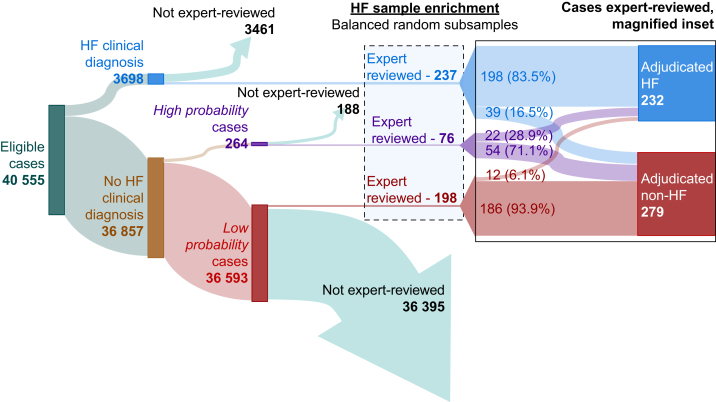
Across 40 555 major noncardiac procedures, a stratified subsample of 511 patients was reviewed by the expert panel. The prevalence of heart failure was 9.1% based on clinically diagnosed compared with 13.3% (95% confidence interval [CI], 10.3–16.2%) estimated by the expert panel. Overall agreement and inter-rater reliability (kappa) among heart failure experts were 95% and 0.79, respectively. Based upon expert adjudication, heart failure was clinically diagnosed with an accuracy of 92.8% (90.6–95.1%), sensitivity 57.4% (53.1–61.7%), specificity 98.3% (97.1–99.4%), positive predictive value 83.5% (80.3–86.8%), and negative predictive value 93.8% (91.7–95.9%).
Conclusions
Limitations exist to the preoperative clinical diagnosis of heart failure, with nearly half of cases undiagnosed preoperatively. Considering the risks of undiagnosed heart failure, efforts to improve preoperative heart failure diagnoses are warranted.




 京公网安备 11010802042870号
京ICP备2023020795号-1
京公网安备 11010802042870号
京ICP备2023020795号-1

 分享
分享
 求助内容:
求助内容: 应助结果提醒方式:
 扫码关注我们
