Evolutionary Perspective on Self-Concept: The Effects of Interpersonal Motivations and Inclusionary Status on Spontaneous Self-Descriptions of Communion and Agency.
Roy Azoulay, Moran Wilner-Sakal, Reut Tzabag, Eva Gilboa-Schechtman
{"title":"Evolutionary Perspective on Self-Concept: The Effects of Interpersonal Motivations and Inclusionary Status on Spontaneous Self-Descriptions of Communion and Agency.","authors":"Roy Azoulay, Moran Wilner-Sakal, Reut Tzabag, Eva Gilboa-Schechtman","doi":"10.1177/14747049221120095","DOIUrl":null,"url":null,"abstract":"<p><p>Evolutionary models suggest that self-concept is a dynamic structure shaped jointly by interpersonal motivations and social challenges. Yet, empirical data assessing this claim are sparse. We examined this question in two studies. In study 1, participants (N = 386) generated spontaneous self-descriptions and filled out questionnaires assessing dominance and affiliation motivations. We found that self-descriptions categorized as communion or agency were associated with affiliation and dominance motivations, respectively. In study 2, participants (N = 360) underwent an inclusionary manipulation (exclusion, inclusion, popularity) and completed self-description and motivation measures. We found that exclusion (compared to inclusion/popularity) enhanced the salience of communion self-descriptions such that participants described themselves using more communion traits. Finally, in the popularity condition (compared to exclusion/inclusion), an enhanced positive association between salience of agency self-descriptions and dominance motivation was found. Our results support evolutionary models suggesting that self-concept organization shapes and is being shaped by social motivations to enhance interpersonal functioning.</p>","PeriodicalId":72993,"journal":{"name":"","volume":"20 3","pages":"14747049221120095"},"PeriodicalIF":0.0,"publicationDate":"2022-07-01","publicationTypes":"Journal Article","fieldsOfStudy":null,"isOpenAccess":false,"openAccessPdf":"https://ftp.ncbi.nlm.nih.gov/pub/pmc/oa_pdf/9b/3a/10.1177_14747049221120095.PMC10358400.pdf","citationCount":"0","resultStr":null,"platform":"Semanticscholar","paperid":null,"PeriodicalName":"","FirstCategoryId":"102","ListUrlMain":"https://doi.org/10.1177/14747049221120095","RegionNum":0,"RegionCategory":null,"ArticlePicture":[],"TitleCN":null,"AbstractTextCN":null,"PMCID":null,"EPubDate":"","PubModel":"","JCR":"","JCRName":"","Score":null,"Total":0}
引用次数: 0
Abstract
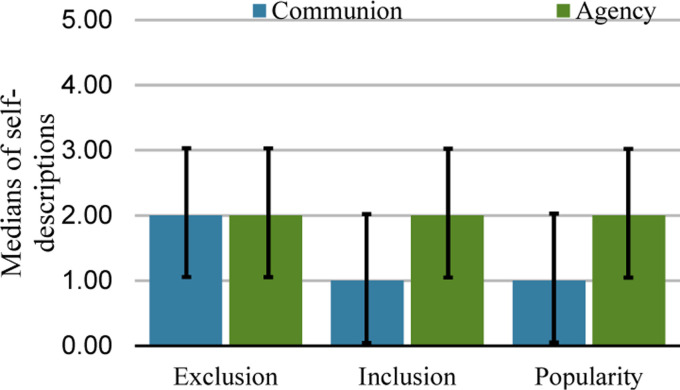
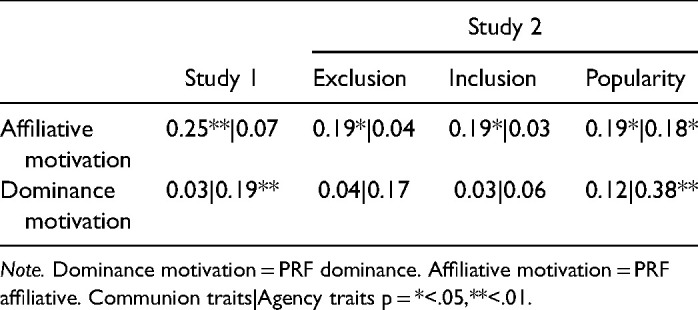
Evolutionary models suggest that self-concept is a dynamic structure shaped jointly by interpersonal motivations and social challenges. Yet, empirical data assessing this claim are sparse. We examined this question in two studies. In study 1, participants (N = 386) generated spontaneous self-descriptions and filled out questionnaires assessing dominance and affiliation motivations. We found that self-descriptions categorized as communion or agency were associated with affiliation and dominance motivations, respectively. In study 2, participants (N = 360) underwent an inclusionary manipulation (exclusion, inclusion, popularity) and completed self-description and motivation measures. We found that exclusion (compared to inclusion/popularity) enhanced the salience of communion self-descriptions such that participants described themselves using more communion traits. Finally, in the popularity condition (compared to exclusion/inclusion), an enhanced positive association between salience of agency self-descriptions and dominance motivation was found. Our results support evolutionary models suggesting that self-concept organization shapes and is being shaped by social motivations to enhance interpersonal functioning.



 京公网安备 11010802042870号
京ICP备2023020795号-1
京公网安备 11010802042870号
京ICP备2023020795号-1

 分享
分享
 求助内容:
求助内容: 应助结果提醒方式:
 扫码关注我们
