Megan E J Lott, William A Norfolk, Cody A Dailey, Amelia M Foley, Carolina Melendez-Declet, Megan J Robertson, Stephen L Rathbun, Erin K Lipp
{"title":"Direct wastewater extraction as a simple and effective method for SARS-CoV-2 surveillance and COVID-19 community-level monitoring.","authors":"Megan E J Lott, William A Norfolk, Cody A Dailey, Amelia M Foley, Carolina Melendez-Declet, Megan J Robertson, Stephen L Rathbun, Erin K Lipp","doi":"10.1093/femsmc/xtad004","DOIUrl":null,"url":null,"abstract":"<p><p>Wastewater surveillance has proven to be an effective tool to monitor the transmission and emergence of infectious agents at a community scale. Workflows for wastewater surveillance generally rely on concentration steps to increase the probability of detection of low-abundance targets, but preconcentration can substantially increase the time and cost of analyses while also introducing additional loss of target during processing. To address some of these issues, we conducted a longitudinal study implementing a simplified workflow for SARS-CoV-2 detection from wastewater, using a direct column-based extraction approach. Composite influent wastewater samples were collected weekly for 1 year between June 2020 and June 2021 in Athens-Clarke County, Georgia, USA. Bypassing any concentration step, low volumes (280 µl) of influent wastewater were extracted using a commercial kit, and immediately analyzed by RT-qPCR for the SARS-CoV-2 N1 and N2 gene targets. SARS-CoV-2 viral RNA was detected in 76% (193/254) of influent samples, and the recovery of the surrogate bovine coronavirus was 42% (IQR: 28%, 59%). N1 and N2 assay positivity, viral concentration, and flow-adjusted daily viral load correlated significantly with per-capita case reports of COVID-19 at the county-level (ρ = 0.69-0.82). To compensate for the method's high limit of detection (approximately 10<sup>6</sup>-10<sup>7</sup> copies l<sup>-1</sup> in wastewater), we extracted multiple small-volume replicates of each wastewater sample. With this approach, we detected as few as five cases of COVID-19 per 100 000 individuals. These results indicate that a direct-extraction-based workflow for SARS-CoV-2 wastewater surveillance can provide informative and actionable results.</p>","PeriodicalId":73024,"journal":{"name":"FEMS microbes","volume":"4 ","pages":"xtad004"},"PeriodicalIF":4.0000,"publicationDate":"2023-01-12","publicationTypes":"Journal Article","fieldsOfStudy":null,"isOpenAccess":false,"openAccessPdf":"https://www.ncbi.nlm.nih.gov/pmc/articles/PMC10117872/pdf/","citationCount":"0","resultStr":null,"platform":"Semanticscholar","paperid":null,"PeriodicalName":"FEMS microbes","FirstCategoryId":"1085","ListUrlMain":"https://doi.org/10.1093/femsmc/xtad004","RegionNum":0,"RegionCategory":null,"ArticlePicture":[],"TitleCN":null,"AbstractTextCN":null,"PMCID":null,"EPubDate":"2023/1/1 0:00:00","PubModel":"eCollection","JCR":"","JCRName":"","Score":null,"Total":0}
引用次数: 0
Abstract
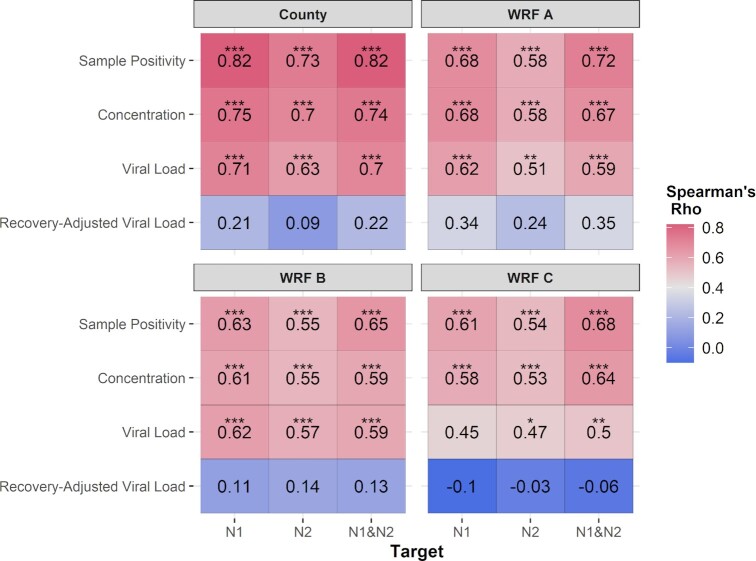
Wastewater surveillance has proven to be an effective tool to monitor the transmission and emergence of infectious agents at a community scale. Workflows for wastewater surveillance generally rely on concentration steps to increase the probability of detection of low-abundance targets, but preconcentration can substantially increase the time and cost of analyses while also introducing additional loss of target during processing. To address some of these issues, we conducted a longitudinal study implementing a simplified workflow for SARS-CoV-2 detection from wastewater, using a direct column-based extraction approach. Composite influent wastewater samples were collected weekly for 1 year between June 2020 and June 2021 in Athens-Clarke County, Georgia, USA. Bypassing any concentration step, low volumes (280 µl) of influent wastewater were extracted using a commercial kit, and immediately analyzed by RT-qPCR for the SARS-CoV-2 N1 and N2 gene targets. SARS-CoV-2 viral RNA was detected in 76% (193/254) of influent samples, and the recovery of the surrogate bovine coronavirus was 42% (IQR: 28%, 59%). N1 and N2 assay positivity, viral concentration, and flow-adjusted daily viral load correlated significantly with per-capita case reports of COVID-19 at the county-level (ρ = 0.69-0.82). To compensate for the method's high limit of detection (approximately 106-107 copies l-1 in wastewater), we extracted multiple small-volume replicates of each wastewater sample. With this approach, we detected as few as five cases of COVID-19 per 100 000 individuals. These results indicate that a direct-extraction-based workflow for SARS-CoV-2 wastewater surveillance can provide informative and actionable results.



 京公网安备 11010802042870号
京ICP备2023020795号-1
京公网安备 11010802042870号
京ICP备2023020795号-1

 分享
分享

 求助内容:
求助内容: 应助结果提醒方式:
 扫码关注我们
