Arão Belitardo de Oliveira, Peter T Katzmarzyk, Wagner Silva Dantas, Isabela Judith Martins Benseñor, Alessandra de Carvalho Goulart, Ulf Ekelund
{"title":"Profile of leisure-time physical activity and sedentary behavior in adults in Brazil: a nationwide survey, 2019.","authors":"Arão Belitardo de Oliveira, Peter T Katzmarzyk, Wagner Silva Dantas, Isabela Judith Martins Benseñor, Alessandra de Carvalho Goulart, Ulf Ekelund","doi":"10.1590/S2237-96222023000200016","DOIUrl":null,"url":null,"abstract":"<p><strong>Objectives: </strong>to estimate the prevalence of leisure-time physical activity and sedentary behavior in adults in Brazil.</p><p><strong>Methods: </strong>this was a cross-sectional, population-based study carried out in a sample of 88,531 Brazilians, using data from the 2019 National Health Survey; leisure-time physical activity (overall and aerobic exercise) was measured according to the World Health Organization guidelines; the weighted prevalence and respective 95% confidence intervals (95%CI) of physical activity, physical inactivity and sedentary behavior were estimated.</p><p><strong>Results: </strong>according to the selected sample, 26.4% (95%CI 25.9;27.1) of Brazilian adults were physically active, 14.0% (95%CI 13.5;14.4) were insufficiently physically active and 59.5% (95%CI 58.8;60.2) were physically inactive; sedentary behavior ≥ 6 hours was reported by 30.1% (95%CI 29.5;30.8) of the population; only 8.6% (95%CI 8.2;8.9) met the recommendations for muscle-strengthening activities.</p><p><strong>Conclusion: </strong>most Brazilian adults were physically inactive and did not meet international recommendations for leisure-time physical activity and reduction in sedentary behavior.</p>","PeriodicalId":51473,"journal":{"name":"Epidemiologia e Servicos de Saude","volume":"32 2","pages":"e2023168"},"PeriodicalIF":2.0000,"publicationDate":"2023-08-11","publicationTypes":"Journal Article","fieldsOfStudy":null,"isOpenAccess":false,"openAccessPdf":"https://www.ncbi.nlm.nih.gov/pmc/articles/PMC10421589/pdf/","citationCount":"0","resultStr":null,"platform":"Semanticscholar","paperid":null,"PeriodicalName":"Epidemiologia e Servicos de Saude","FirstCategoryId":"1085","ListUrlMain":"https://doi.org/10.1590/S2237-96222023000200016","RegionNum":0,"RegionCategory":null,"ArticlePicture":[],"TitleCN":null,"AbstractTextCN":null,"PMCID":null,"EPubDate":"2023/1/1 0:00:00","PubModel":"eCollection","JCR":"Q1","JCRName":"Multidisciplinary","Score":null,"Total":0}
引用次数: 0
Abstract
Objectives: to estimate the prevalence of leisure-time physical activity and sedentary behavior in adults in Brazil.
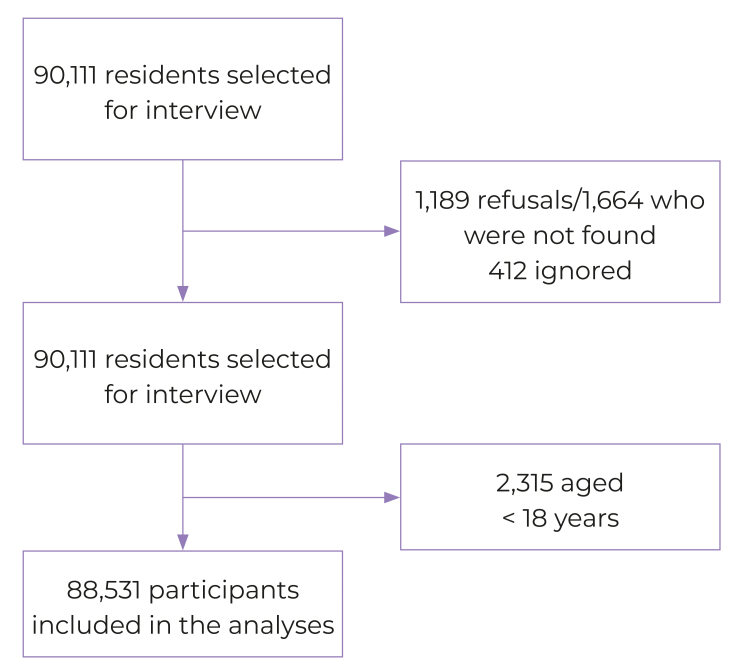
Methods: this was a cross-sectional, population-based study carried out in a sample of 88,531 Brazilians, using data from the 2019 National Health Survey; leisure-time physical activity (overall and aerobic exercise) was measured according to the World Health Organization guidelines; the weighted prevalence and respective 95% confidence intervals (95%CI) of physical activity, physical inactivity and sedentary behavior were estimated.
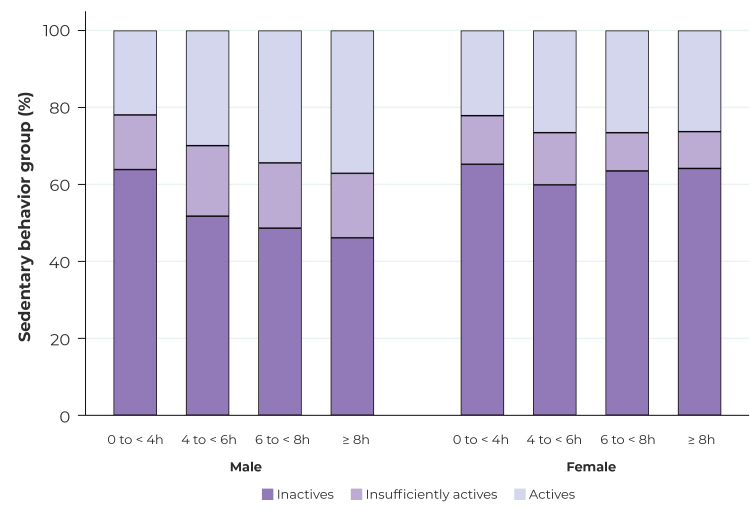
Results: according to the selected sample, 26.4% (95%CI 25.9;27.1) of Brazilian adults were physically active, 14.0% (95%CI 13.5;14.4) were insufficiently physically active and 59.5% (95%CI 58.8;60.2) were physically inactive; sedentary behavior ≥ 6 hours was reported by 30.1% (95%CI 29.5;30.8) of the population; only 8.6% (95%CI 8.2;8.9) met the recommendations for muscle-strengthening activities.
Conclusion: most Brazilian adults were physically inactive and did not meet international recommendations for leisure-time physical activity and reduction in sedentary behavior.




 京公网安备 11010802042870号
京ICP备2023020795号-1
京公网安备 11010802042870号
京ICP备2023020795号-1

 分享
分享
 求助内容:
求助内容: 应助结果提醒方式:
 扫码关注我们
