Ramya Balasubramanian, Mohd Rabi Bazaz, Tulasi Pasam, Naserunnisa Sharief, Laximan Velip, Gananadhamu Samanthula, Manoj P Dandekar
{"title":"Involvement of Microbiome Gut-Brain Axis in Neuroprotective Effect of Quercetin in Mouse Model of Repeated Mild Traumatic Brain Injury.","authors":"Ramya Balasubramanian, Mohd Rabi Bazaz, Tulasi Pasam, Naserunnisa Sharief, Laximan Velip, Gananadhamu Samanthula, Manoj P Dandekar","doi":"10.1007/s12017-022-08732-z","DOIUrl":null,"url":null,"abstract":"<p><p>Repeated mild traumatic brain injury (rmTBI) poses adversity in the form of neurological deficits. The ignition of long-term neurological aberrations post-TBI is appended with the microbiota gut-brain axis perturbation. Herein, we examined whether quercetin, which is anti-inflammatory and antioxidant flavonoid, serves as a prebiotic and modifies the compromised microbiome gut-brain axis in rmTBI mouse model. Male C57BL/6 mice were subjected to rmTBI for 7 times. The quercetin (50 mg/kg) was administered peroral from the day1 of first injury till 7 days post-injury. The neurobehavioral assessments were performed using return of righting reflex (ROR), rotarod, forced swimming test (FST), elevated zero maze (EZM), novel object recognition test (NORT), and Y-maze. Mice fecal samples, brains, and intestines were collected for molecular studies. Mice underwent rmTBI showed significant neurological deficits in ROR and rotarod test and also exhibited long-term neuropsychiatric aberrations like anxiety- and depression-like phenotypes, and cognitive deficits in EZM, FST, and Y-maze assays, respectively. Repeated peroral administration of quercetin ameliorated these neuropsychiatric problems. Quercetin treatment also restored the increased expression of GFAP and decreased expression of occludin and doublecortin in the frontal cortex and hippocampus of rmTBI mice. The altered levels of acetate and propionate, and microbial phylum abundance in fecal samples were also normalized in the quercetin-treated group. We also noted an improved intestinal permeability indicated by reduced villi rupture, blunting, and mucosal thinning in quercetin-treated mice. We suggest that the neuroprotective effect of quercetin may be mediated via remodeling of the microbiome gut-brain axis in rmTBI mouse model.</p>","PeriodicalId":19304,"journal":{"name":"NeuroMolecular Medicine","volume":"25 2","pages":"242-254"},"PeriodicalIF":3.9000,"publicationDate":"2023-06-01","publicationTypes":"Journal Article","fieldsOfStudy":null,"isOpenAccess":false,"openAccessPdf":"","citationCount":"9","resultStr":null,"platform":"Semanticscholar","paperid":null,"PeriodicalName":"NeuroMolecular Medicine","FirstCategoryId":"3","ListUrlMain":"https://doi.org/10.1007/s12017-022-08732-z","RegionNum":4,"RegionCategory":"医学","ArticlePicture":[],"TitleCN":null,"AbstractTextCN":null,"PMCID":null,"EPubDate":"","PubModel":"","JCR":"Q2","JCRName":"NEUROSCIENCES","Score":null,"Total":0}
引用次数: 9
Abstract
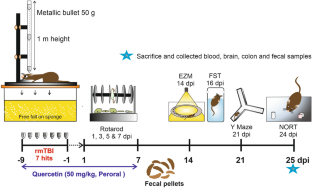
Repeated mild traumatic brain injury (rmTBI) poses adversity in the form of neurological deficits. The ignition of long-term neurological aberrations post-TBI is appended with the microbiota gut-brain axis perturbation. Herein, we examined whether quercetin, which is anti-inflammatory and antioxidant flavonoid, serves as a prebiotic and modifies the compromised microbiome gut-brain axis in rmTBI mouse model. Male C57BL/6 mice were subjected to rmTBI for 7 times. The quercetin (50 mg/kg) was administered peroral from the day1 of first injury till 7 days post-injury. The neurobehavioral assessments were performed using return of righting reflex (ROR), rotarod, forced swimming test (FST), elevated zero maze (EZM), novel object recognition test (NORT), and Y-maze. Mice fecal samples, brains, and intestines were collected for molecular studies. Mice underwent rmTBI showed significant neurological deficits in ROR and rotarod test and also exhibited long-term neuropsychiatric aberrations like anxiety- and depression-like phenotypes, and cognitive deficits in EZM, FST, and Y-maze assays, respectively. Repeated peroral administration of quercetin ameliorated these neuropsychiatric problems. Quercetin treatment also restored the increased expression of GFAP and decreased expression of occludin and doublecortin in the frontal cortex and hippocampus of rmTBI mice. The altered levels of acetate and propionate, and microbial phylum abundance in fecal samples were also normalized in the quercetin-treated group. We also noted an improved intestinal permeability indicated by reduced villi rupture, blunting, and mucosal thinning in quercetin-treated mice. We suggest that the neuroprotective effect of quercetin may be mediated via remodeling of the microbiome gut-brain axis in rmTBI mouse model.
期刊介绍:
NeuroMolecular Medicine publishes cutting-edge original research articles and critical reviews on the molecular and biochemical basis of neurological disorders. Studies range from genetic analyses of human populations to animal and cell culture models of neurological disorders. Emerging findings concerning the identification of genetic aberrancies and their pathogenic mechanisms at the molecular and cellular levels will be included. Also covered are experimental analyses of molecular cascades involved in the development and adult plasticity of the nervous system, in neurological dysfunction, and in neuronal degeneration and repair. NeuroMolecular Medicine encompasses basic research in the fields of molecular genetics, signal transduction, plasticity, and cell death. The information published in NEMM will provide a window into the future of molecular medicine for the nervous system.



 京公网安备 11010802042870号
京ICP备2023020795号-1
京公网安备 11010802042870号
京ICP备2023020795号-1

 分享
分享
 求助内容:
求助内容: 应助结果提醒方式:
 扫码关注我们
