‘Standing up for Myself’ (STORM): Development and qualitative evaluation of a psychosocial group intervention designed to increase the capacity of people with intellectual disabilities to manage and resist stigma
Katrina Scior, Rebecca Cooper, Kristina Fenn, Laurie Poole, Sophie Colman, Afia Ali, Sandra Baum, Jason Crabtree, Sophie Doswell, Andrew Jahoda, Richard Hastings, Lisa Richardson
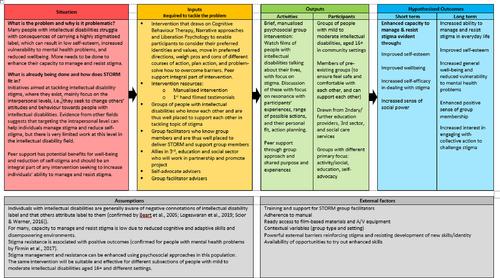
{"title":"‘Standing up for Myself’ (STORM): Development and qualitative evaluation of a psychosocial group intervention designed to increase the capacity of people with intellectual disabilities to manage and resist stigma","authors":"Katrina Scior, Rebecca Cooper, Kristina Fenn, Laurie Poole, Sophie Colman, Afia Ali, Sandra Baum, Jason Crabtree, Sophie Doswell, Andrew Jahoda, Richard Hastings, Lisa Richardson","doi":"10.1111/jar.13018","DOIUrl":null,"url":null,"abstract":"Abstract Background People with intellectual disabilities are at risk of experiencing stigma and require the skills and confidence to deal with stigma in their daily lives. Method Development and piloting of a 5‐session manualised psychosocial group intervention designed to increase the capacity of people with intellectual disabilities aged 16+ to manage and resist stigma. Ten pre‐existing groups (N = 67) in third sector and education settings participated. Interviews with participants (n = 26), facilitators (n = 9) and significant others (n = 7) 2–4 months after the intervention assessed perceived impact. Results Perceived benefits of the intervention for participants included increased understanding, improved connections with others, drive for advocacy, increased activity and self‐efficacy, and opportunity to process difficult events and emotions. Differential impact depending on individuals' pre‐existing self‐advocacy skills was noted. Conclusions This early‐stage study indicates that further evaluation is merited to examine feasibility and outcomes of the STORM intervention.","PeriodicalId":51403,"journal":{"name":"Journal of Applied Research in Intellectual Disabilities","volume":"35 6","pages":"1297-1306"},"PeriodicalIF":1.9000,"publicationDate":"2022-07-04","publicationTypes":"Journal Article","fieldsOfStudy":null,"isOpenAccess":false,"openAccessPdf":"https://ftp.ncbi.nlm.nih.gov/pub/pmc/oa_pdf/10/3b/JAR-35-1297.PMC9795919.pdf","citationCount":"5","resultStr":null,"platform":"Semanticscholar","paperid":null,"PeriodicalName":"Journal of Applied Research in Intellectual Disabilities","FirstCategoryId":"3","ListUrlMain":"https://onlinelibrary.wiley.com/doi/10.1111/jar.13018","RegionNum":3,"RegionCategory":"医学","ArticlePicture":[],"TitleCN":null,"AbstractTextCN":null,"PMCID":null,"EPubDate":"","PubModel":"","JCR":"Q2","JCRName":"PSYCHOLOGY, EDUCATIONAL","Score":null,"Total":0}
引用次数: 5
Abstract
Abstract Background People with intellectual disabilities are at risk of experiencing stigma and require the skills and confidence to deal with stigma in their daily lives. Method Development and piloting of a 5‐session manualised psychosocial group intervention designed to increase the capacity of people with intellectual disabilities aged 16+ to manage and resist stigma. Ten pre‐existing groups (N = 67) in third sector and education settings participated. Interviews with participants (n = 26), facilitators (n = 9) and significant others (n = 7) 2–4 months after the intervention assessed perceived impact. Results Perceived benefits of the intervention for participants included increased understanding, improved connections with others, drive for advocacy, increased activity and self‐efficacy, and opportunity to process difficult events and emotions. Differential impact depending on individuals' pre‐existing self‐advocacy skills was noted. Conclusions This early‐stage study indicates that further evaluation is merited to examine feasibility and outcomes of the STORM intervention.
期刊介绍:
JARID is an international, peer-reviewed journal which draws together findings derived from original applied research in intellectual disabilities. The journal is an important forum for the dissemination of ideas to promote valued lifestyles for people with intellectual disabilities. It reports on research from the UK and overseas by authors from all relevant professional disciplines. It is aimed at an international, multi-disciplinary readership. Topics covered include community living, quality of life, challenging behaviour, communication, sexuality, medication, ageing, supported employment, family issues, mental health, physical health, autism, economic issues, social networks, staff stress, staff training, epidemiology and service provision.



 京公网安备 11010802042870号
京ICP备2023020795号-1
京公网安备 11010802042870号
京ICP备2023020795号-1

 分享
分享

 求助内容:
求助内容: 应助结果提醒方式:
 扫码关注我们
