Rumination Mediates the Relationship Between Childhood Traumas with Cognitive Defusion, Acceptance, and Emotion Regulation: A Qualitative and Quantitative Study.
{"title":"Rumination Mediates the Relationship Between Childhood Traumas with Cognitive Defusion, Acceptance, and Emotion Regulation: A Qualitative and Quantitative Study.","authors":"Özge Erduran Tekin, Ahmet Şirin","doi":"10.1007/s10942-023-00503-4","DOIUrl":null,"url":null,"abstract":"<p><p>This study examines the intermediary role of rumination in the relationship between childhood traumas in young adults and cognitive defusion, psychological acceptance, and suppression which is one of the emotion regulation strategies. In the quantitative stage of the study formed according to the explanatory sequential design, the intermediary role of rumination by using a structural equation model while in the qualitative stage, the intermediary role of rumination was analyzed through interviews using the interpretive phenomenology design. Personal Information Form, Childhood Trauma Scale, Short Form Ruminative Response Scale, Acceptance and Action Form II, Drexel Defusion Scale, and Emotion Regulation Scale were used in the research. At the end of the research, it was determined that childhood traumas have a negative effect on cognitive defusion and acceptance, while they have a positive effect on suppression. It was seen that rumination has a partial intermediary role in the relationship of childhood traumas with cognitive defusion, acceptance, and suppression. As a result of the qualitative analysis, twelve themes such as \"Constantly thinking about the past, not being able to move away from childhood traumas, not being able to forgive their parents, inability to get rid of negative thoughts, living in the past, moving away from a value-driven life, false expression of emotion, suppression of emotions, emotions reflected in behavior, coping with negative emotions and desired emotion regulation\" emerged concerning participants' experiences of cognitive defusion, acceptance, and suppression. Although one of the purposes of using AAQ-II in the study was to support discussions about the scale via qualitative results, this was a limitation for the study. Therefore, although a high rate was obtained, it is not possible to infer that childhood traumas and rumination can explain acceptance behaviors. For this, much more quantitative and qualitative studies are needed. Other qualitative research findings are thought to support quantitative research findings.</p>","PeriodicalId":73926,"journal":{"name":"","volume":" ","pages":"1-28"},"PeriodicalIF":0.0,"publicationDate":"2023-04-08","publicationTypes":"Journal Article","fieldsOfStudy":null,"isOpenAccess":false,"openAccessPdf":"https://www.ncbi.nlm.nih.gov/pmc/articles/PMC10081932/pdf/","citationCount":"0","resultStr":null,"platform":"Semanticscholar","paperid":null,"PeriodicalName":"","FirstCategoryId":"102","ListUrlMain":"https://doi.org/10.1007/s10942-023-00503-4","RegionNum":0,"RegionCategory":null,"ArticlePicture":[],"TitleCN":null,"AbstractTextCN":null,"PMCID":null,"EPubDate":"","PubModel":"","JCR":"","JCRName":"","Score":null,"Total":0}
引用次数: 0
Abstract
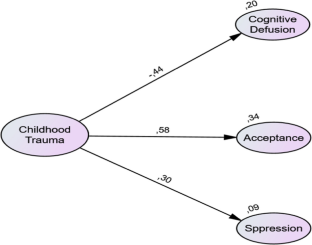
This study examines the intermediary role of rumination in the relationship between childhood traumas in young adults and cognitive defusion, psychological acceptance, and suppression which is one of the emotion regulation strategies. In the quantitative stage of the study formed according to the explanatory sequential design, the intermediary role of rumination by using a structural equation model while in the qualitative stage, the intermediary role of rumination was analyzed through interviews using the interpretive phenomenology design. Personal Information Form, Childhood Trauma Scale, Short Form Ruminative Response Scale, Acceptance and Action Form II, Drexel Defusion Scale, and Emotion Regulation Scale were used in the research. At the end of the research, it was determined that childhood traumas have a negative effect on cognitive defusion and acceptance, while they have a positive effect on suppression. It was seen that rumination has a partial intermediary role in the relationship of childhood traumas with cognitive defusion, acceptance, and suppression. As a result of the qualitative analysis, twelve themes such as "Constantly thinking about the past, not being able to move away from childhood traumas, not being able to forgive their parents, inability to get rid of negative thoughts, living in the past, moving away from a value-driven life, false expression of emotion, suppression of emotions, emotions reflected in behavior, coping with negative emotions and desired emotion regulation" emerged concerning participants' experiences of cognitive defusion, acceptance, and suppression. Although one of the purposes of using AAQ-II in the study was to support discussions about the scale via qualitative results, this was a limitation for the study. Therefore, although a high rate was obtained, it is not possible to infer that childhood traumas and rumination can explain acceptance behaviors. For this, much more quantitative and qualitative studies are needed. Other qualitative research findings are thought to support quantitative research findings.



 京公网安备 11010802042870号
京ICP备2023020795号-1
京公网安备 11010802042870号
京ICP备2023020795号-1

 分享
分享
 求助内容:
求助内容: 应助结果提醒方式:
 扫码关注我们
