M Ubaidilah Hasan, Kanthi Arum Widayati, Yamato Tsuji, Puji Rianti
{"title":"Feeding ecology of free-ranging long-tailed macaques in East Java, Indonesia: Relationship with human food availability.","authors":"M Ubaidilah Hasan, Kanthi Arum Widayati, Yamato Tsuji, Puji Rianti","doi":"10.1007/s10329-023-01062-z","DOIUrl":null,"url":null,"abstract":"<p><p>Food availability is an important factor affecting the feeding strategies of animals. Primate species living in habitats with high human activity have the potential to employ unique strategies to utilize human food resources. This study describes the feeding ecology of provisioned free-ranging long-tailed macaques (Macaca fascicularis) inhabiting Alas Purwo National Park, East Java, Indonesia. The activity budgets, dietary compositions, vertical usage, and ranging patterns of macaques were recorded between October 2021 and March 2022, and their relationships with the number of visitors (a proxy of human food availability) were examined. The macaques consumed more human food (mean ± SD: 53.9 ± 25.6%) than natural food (43.8 ± 25.5%), followed by unidentified food (2.3 ± 6.3%). Human food has several effects on the behavioral ecology of macaques, including reduced movement and increased social activity in response to the number of visitors, decreased consumption of natural food, frequent use of the ground and subcanopy strata, and decreased home range when the number of visitors increases. Thus, the relative importance of human food has substantially changed the essential behavioral ecology of provisioned macaque troops. Understanding the behavioral plasticity of macaques, particularly their responses to anthropogenic effects, could guide and contribute to the formulation of conservation policies and management plans.</p>","PeriodicalId":20468,"journal":{"name":"Primates","volume":"64 4","pages":"429-438"},"PeriodicalIF":1.5000,"publicationDate":"2023-07-01","publicationTypes":"Journal Article","fieldsOfStudy":null,"isOpenAccess":false,"openAccessPdf":"","citationCount":"0","resultStr":null,"platform":"Semanticscholar","paperid":null,"PeriodicalName":"Primates","FirstCategoryId":"99","ListUrlMain":"https://doi.org/10.1007/s10329-023-01062-z","RegionNum":4,"RegionCategory":"生物学","ArticlePicture":[],"TitleCN":null,"AbstractTextCN":null,"PMCID":null,"EPubDate":"","PubModel":"","JCR":"Q2","JCRName":"ZOOLOGY","Score":null,"Total":0}
引用次数: 0
Abstract
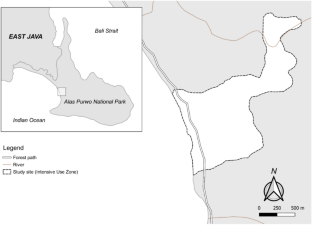
Food availability is an important factor affecting the feeding strategies of animals. Primate species living in habitats with high human activity have the potential to employ unique strategies to utilize human food resources. This study describes the feeding ecology of provisioned free-ranging long-tailed macaques (Macaca fascicularis) inhabiting Alas Purwo National Park, East Java, Indonesia. The activity budgets, dietary compositions, vertical usage, and ranging patterns of macaques were recorded between October 2021 and March 2022, and their relationships with the number of visitors (a proxy of human food availability) were examined. The macaques consumed more human food (mean ± SD: 53.9 ± 25.6%) than natural food (43.8 ± 25.5%), followed by unidentified food (2.3 ± 6.3%). Human food has several effects on the behavioral ecology of macaques, including reduced movement and increased social activity in response to the number of visitors, decreased consumption of natural food, frequent use of the ground and subcanopy strata, and decreased home range when the number of visitors increases. Thus, the relative importance of human food has substantially changed the essential behavioral ecology of provisioned macaque troops. Understanding the behavioral plasticity of macaques, particularly their responses to anthropogenic effects, could guide and contribute to the formulation of conservation policies and management plans.
期刊介绍:
Primates is an international journal of primatology whose aim is to provide a forum for the elucidation of all aspects of primates. The oldest primatological journal, Primates publishes original papers that advance the scientific study of primates, and its scope embraces work in diverse fields covering biological bases of behavior, socio-ecology, learning and cognition, social processes, systematics, evolution, and medicine. Contributions relevant to conservation of natural populations and welfare of captive primates are welcome. Studies focusing on nonprimate species may be considered if their relevance to primatology is clear. Original Articles as well as Review Articles, News and Perspectives, and Book Reviews are included. All manuscripts received are initially screened for suitability by members of the Editorial Board, taking into account style and ethical issues, leading to a swift decision about whether to send the manuscript for external review.



 京公网安备 11010802042870号
京ICP备2023020795号-1
京公网安备 11010802042870号
京ICP备2023020795号-1

 分享
分享
 求助内容:
求助内容: 应助结果提醒方式:
 扫码关注我们
