Ambar Moreno, Claudia González, Jessica Góndola, Oris Chavarría, Alma Ortiz, Jorge Castillo, Juan Castillo Mewa, Juan Miguel Pascale, Alexander Augusto Martínez
{"title":"HIV-1 Low-Frequency Variants Identified in Antiretroviral-Naïve Subjects with Virologic Failure after 12 Months of Follow-Up in Panama.","authors":"Ambar Moreno, Claudia González, Jessica Góndola, Oris Chavarría, Alma Ortiz, Jorge Castillo, Juan Castillo Mewa, Juan Miguel Pascale, Alexander Augusto Martínez","doi":"10.3390/idr15040044","DOIUrl":null,"url":null,"abstract":"<p><p>Low-frequency mutations associated with drug resistance have been related to virologic failure in subjects with no history of pre-treatment and recent HIV diagnosis. In total, 78 antiretroviral treatment (ART)-naïve subjects with a recent HIV diagnosis were selected and followed by CD4+ T lymphocytes and viral load tests to detect virologic failure. We sequenced the basal samples retrospectively using next-generation sequencing (NGS), looking for low-frequency mutations that had not been detected before using the Sanger sequencing method (SSM) and describing the response to ART. Twenty-two subjects developed virologic failure (VF), and thirteen of them had at least one drug-resistance mutation associated with Reverse Transcriptase Inhibitors (RTI) and Protease Inhibitors (PIs) at frequency levels ≤ 1%, not detected previously in their basal genotyping test. No resistance mutations were observed to Integrase Strand Transfer Inhibitors (INSTIs). We identified a possible cause of VF in ART-naïve subjects with low-frequency mutations detected. To our knowledge, this is the first evaluation of pre-existing drug resistance for HIV-1 minority variants carried out on ART-naïve people living with HIV/AIDS (PLWHA) by analyzing the HIV-1 <i>pol</i> gene using NGS in the country.</p>","PeriodicalId":13579,"journal":{"name":"Infectious Disease Reports","volume":"15 4","pages":"436-444"},"PeriodicalIF":2.4000,"publicationDate":"2023-08-01","publicationTypes":"Journal Article","fieldsOfStudy":null,"isOpenAccess":false,"openAccessPdf":"https://www.ncbi.nlm.nih.gov/pmc/articles/PMC10454674/pdf/","citationCount":"0","resultStr":null,"platform":"Semanticscholar","paperid":null,"PeriodicalName":"Infectious Disease Reports","FirstCategoryId":"1085","ListUrlMain":"https://doi.org/10.3390/idr15040044","RegionNum":0,"RegionCategory":null,"ArticlePicture":[],"TitleCN":null,"AbstractTextCN":null,"PMCID":null,"EPubDate":"","PubModel":"","JCR":"Q2","JCRName":"INFECTIOUS DISEASES","Score":null,"Total":0}
引用次数: 0
Abstract
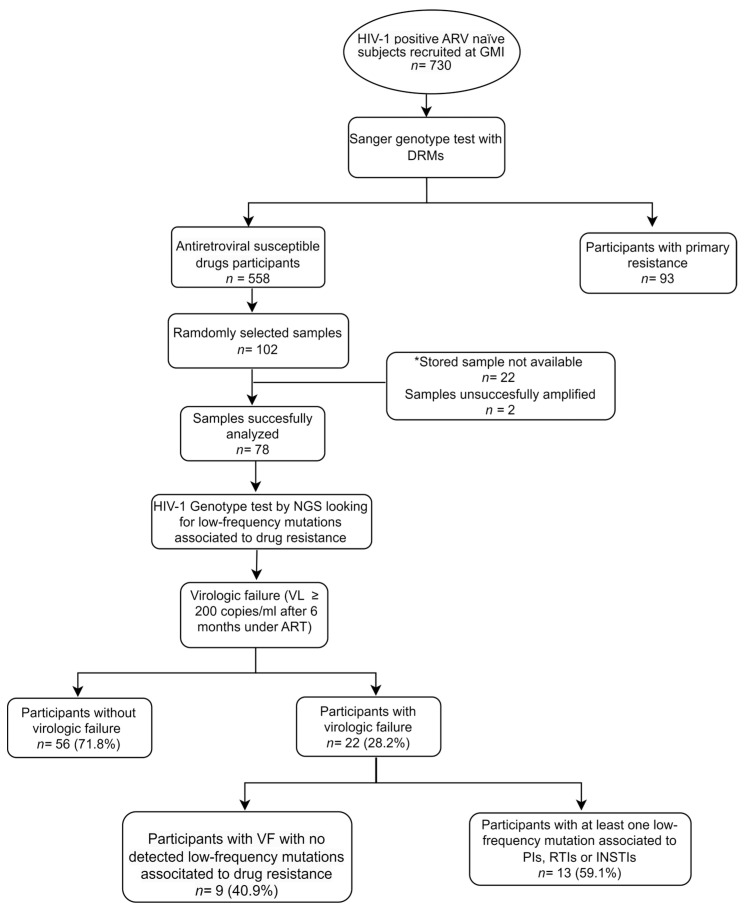
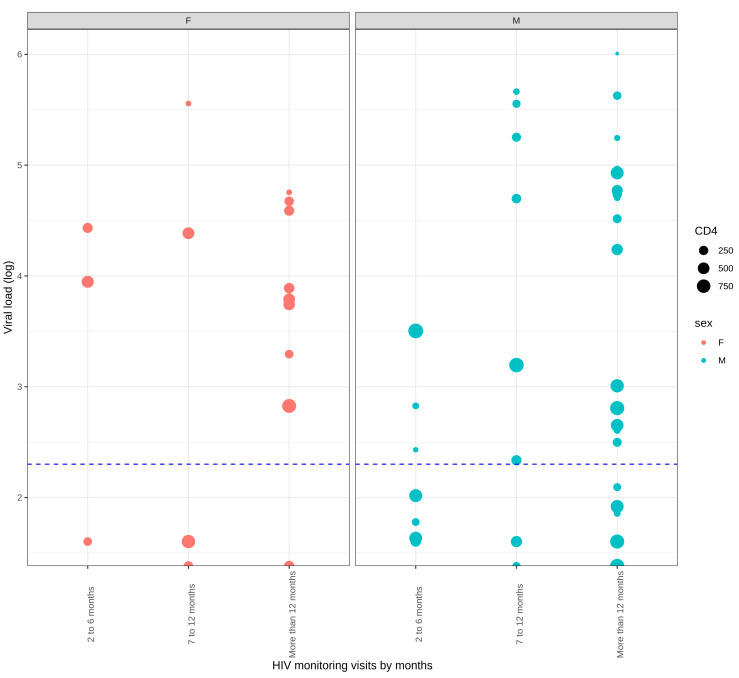
Low-frequency mutations associated with drug resistance have been related to virologic failure in subjects with no history of pre-treatment and recent HIV diagnosis. In total, 78 antiretroviral treatment (ART)-naïve subjects with a recent HIV diagnosis were selected and followed by CD4+ T lymphocytes and viral load tests to detect virologic failure. We sequenced the basal samples retrospectively using next-generation sequencing (NGS), looking for low-frequency mutations that had not been detected before using the Sanger sequencing method (SSM) and describing the response to ART. Twenty-two subjects developed virologic failure (VF), and thirteen of them had at least one drug-resistance mutation associated with Reverse Transcriptase Inhibitors (RTI) and Protease Inhibitors (PIs) at frequency levels ≤ 1%, not detected previously in their basal genotyping test. No resistance mutations were observed to Integrase Strand Transfer Inhibitors (INSTIs). We identified a possible cause of VF in ART-naïve subjects with low-frequency mutations detected. To our knowledge, this is the first evaluation of pre-existing drug resistance for HIV-1 minority variants carried out on ART-naïve people living with HIV/AIDS (PLWHA) by analyzing the HIV-1 pol gene using NGS in the country.




 京公网安备 11010802042870号
京ICP备2023020795号-1
京公网安备 11010802042870号
京ICP备2023020795号-1

 分享
分享
 求助内容:
求助内容: 应助结果提醒方式:
 扫码关注我们
