Georgia Pennarossa, Sharon Arcuri, Teresina De Iorio, Sergio Ledda, Fulvio Gandolfi, Tiziana A L Brevini
{"title":"Combination of epigenetic erasing and mechanical cues to generate human epiBlastoids from adult dermal fibroblasts.","authors":"Georgia Pennarossa, Sharon Arcuri, Teresina De Iorio, Sergio Ledda, Fulvio Gandolfi, Tiziana A L Brevini","doi":"10.1007/s10815-023-02773-4","DOIUrl":null,"url":null,"abstract":"<p><strong>Purpose: </strong>This study is to develop a new protocol that combines the use of epigenetic cues and mechanical stimuli to assemble 3D spherical structures, arbitrarily defined \"epiBlastoids,\" whose phenotype is remarkably similar to natural embryos.</p><p><strong>Methods: </strong>A 3-step approach is used to generate epiBlastoids. In the first step, adult dermal fibroblasts are converted into trophoblast (TR)-like cells, combining the use of 5-azacytidine, to erase the original phenotype, with an ad hoc induction protocol, to drive cells towards TR lineage. In the second step, epigenetic erasing is applied once again, in combination with mechanosensing-related cues, to generate inner cell mass (ICM)-like organoids. Specifically, erased cells are encapsulated into micro-bioreactors to promote 3D cell rearrangement and boost pluripotency. In the third step, TR-like cells are co-cultured with ICM-like spheroids in the same micro-bioreactors. Subsequently, the newly generated embryoids are transferred to microwells to favor epiBlastoid formation.</p><p><strong>Results: </strong>Adult dermal fibroblasts are successfully readdressed towards TR lineage. Cells subjected to epigenetic erasing and encapsulated into micro-bioreactors rearrange in 3D ICM-like structures. Co-culture of TR-like cells and ICM-like spheroids into micro-bioreactors and microwells induces the formation of single structures with uniform shape reminiscent in vivo embryos. CDX2<sup>+</sup> cells localized in the out layer of the spheroids, while OCT4<sup>+</sup> cells in the inner of the structures. TROP2<sup>+</sup> cells display YAP nuclear accumulation and actively transcribed for mature TR markers, while TROP2<sup>-</sup> cells showed YAP cytoplasmic compartmentalization and expressed pluripotency-related genes.</p><p><strong>Conclusion: </strong>We describe the generation of epiBlastoids that may find useful application in the assisted reproduction field.</p>","PeriodicalId":15246,"journal":{"name":"Journal of Assisted Reproduction and Genetics","volume":"40 5","pages":"1015-1027"},"PeriodicalIF":2.8000,"publicationDate":"2023-05-01","publicationTypes":"Journal Article","fieldsOfStudy":null,"isOpenAccess":false,"openAccessPdf":"https://www.ncbi.nlm.nih.gov/pmc/articles/PMC10024007/pdf/","citationCount":"0","resultStr":null,"platform":"Semanticscholar","paperid":null,"PeriodicalName":"Journal of Assisted Reproduction and Genetics","FirstCategoryId":"3","ListUrlMain":"https://doi.org/10.1007/s10815-023-02773-4","RegionNum":3,"RegionCategory":"医学","ArticlePicture":[],"TitleCN":null,"AbstractTextCN":null,"PMCID":null,"EPubDate":"","PubModel":"","JCR":"Q2","JCRName":"GENETICS & HEREDITY","Score":null,"Total":0}
引用次数: 0
Abstract
Purpose: This study is to develop a new protocol that combines the use of epigenetic cues and mechanical stimuli to assemble 3D spherical structures, arbitrarily defined "epiBlastoids," whose phenotype is remarkably similar to natural embryos.
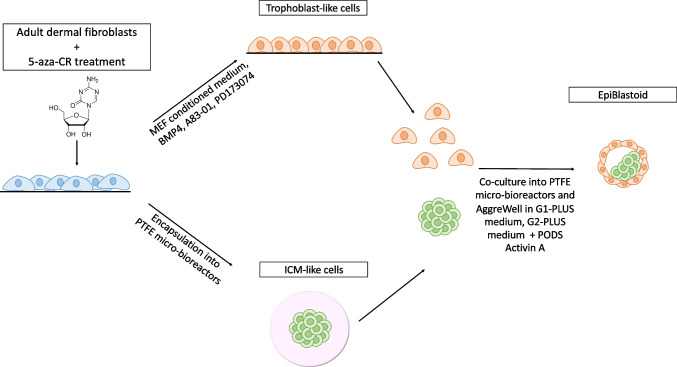
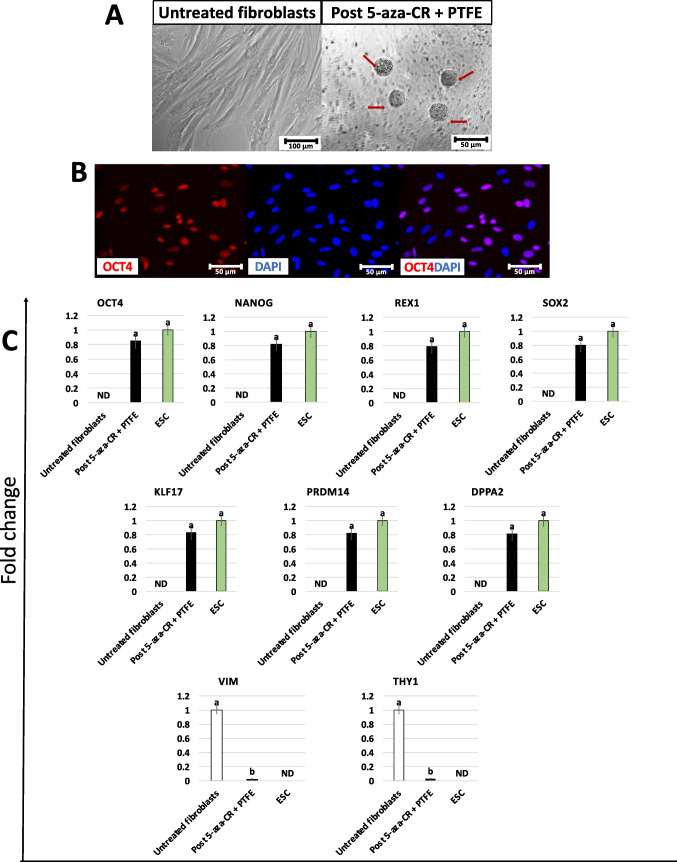
Methods: A 3-step approach is used to generate epiBlastoids. In the first step, adult dermal fibroblasts are converted into trophoblast (TR)-like cells, combining the use of 5-azacytidine, to erase the original phenotype, with an ad hoc induction protocol, to drive cells towards TR lineage. In the second step, epigenetic erasing is applied once again, in combination with mechanosensing-related cues, to generate inner cell mass (ICM)-like organoids. Specifically, erased cells are encapsulated into micro-bioreactors to promote 3D cell rearrangement and boost pluripotency. In the third step, TR-like cells are co-cultured with ICM-like spheroids in the same micro-bioreactors. Subsequently, the newly generated embryoids are transferred to microwells to favor epiBlastoid formation.
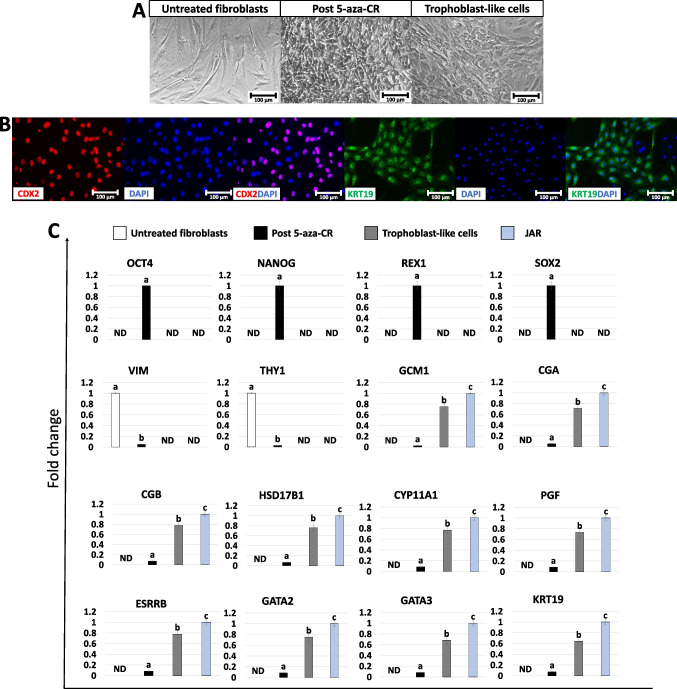
Results: Adult dermal fibroblasts are successfully readdressed towards TR lineage. Cells subjected to epigenetic erasing and encapsulated into micro-bioreactors rearrange in 3D ICM-like structures. Co-culture of TR-like cells and ICM-like spheroids into micro-bioreactors and microwells induces the formation of single structures with uniform shape reminiscent in vivo embryos. CDX2+ cells localized in the out layer of the spheroids, while OCT4+ cells in the inner of the structures. TROP2+ cells display YAP nuclear accumulation and actively transcribed for mature TR markers, while TROP2- cells showed YAP cytoplasmic compartmentalization and expressed pluripotency-related genes.
Conclusion: We describe the generation of epiBlastoids that may find useful application in the assisted reproduction field.
期刊介绍:
The Journal of Assisted Reproduction and Genetics publishes cellular, molecular, genetic, and epigenetic discoveries advancing our understanding of the biology and underlying mechanisms from gametogenesis to offspring health. Special emphasis is placed on the practice and evolution of assisted reproduction technologies (ARTs) with reference to the diagnosis and management of diseases affecting fertility. Our goal is to educate our readership in the translation of basic and clinical discoveries made from human or relevant animal models to the safe and efficacious practice of human ARTs. The scientific rigor and ethical standards embraced by the JARG editorial team ensures a broad international base of expertise guiding the marriage of contemporary clinical research paradigms with basic science discovery. JARG publishes original papers, minireviews, case reports, and opinion pieces often combined into special topic issues that will educate clinicians and scientists with interests in the mechanisms of human development that bear on the treatment of infertility and emerging innovations in human ARTs. The guiding principles of male and female reproductive health impacting pre- and post-conceptional viability and developmental potential are emphasized within the purview of human reproductive health in current and future generations of our species.
The journal is published in cooperation with the American Society for Reproductive Medicine, an organization of more than 8,000 physicians, researchers, nurses, technicians and other professionals dedicated to advancing knowledge and expertise in reproductive biology.




 京公网安备 11010802042870号
京ICP备2023020795号-1
京公网安备 11010802042870号
京ICP备2023020795号-1

 分享
分享
 求助内容:
求助内容: 应助结果提醒方式:
 扫码关注我们
