The effect of maternal position on placental blood flow and fetoplacental oxygenation in late gestation fetal growth restriction: a magnetic resonance imaging study
Devanshi Jani, Alys Clark, Sophie Couper, John M. D. Thompson, Anna L. David, Andrew Melbourne, Ali Mirjalili, Anna-Maria Lydon, Peter R. Stone
{"title":"The effect of maternal position on placental blood flow and fetoplacental oxygenation in late gestation fetal growth restriction: a magnetic resonance imaging study","authors":"Devanshi Jani, Alys Clark, Sophie Couper, John M. D. Thompson, Anna L. David, Andrew Melbourne, Ali Mirjalili, Anna-Maria Lydon, Peter R. Stone","doi":"10.1113/JP284269","DOIUrl":null,"url":null,"abstract":"<div>\n \n <section>\n \n \n <div>Fetal growth restriction (FGR) and maternal supine going-to-sleep position are both risk factors for late stillbirth. This study aimed to use magnetic resonance imaging (MRI) to quantify the effect of maternal supine position on maternal-placental and fetoplacental blood flow, placental oxygen transfer and fetal oxygenation in FGR and healthy pregnancies. Twelve women with FGR and 27 women with healthy pregnancies at 34–38 weeks’ gestation underwent MRI in both left lateral and supine positions. Phase-contrast MRI and a functional MRI technique (DECIDE) were used to measure blood flow in the maternal internal iliac arteries (IIAs) and umbilical vein (UV), placental oxygen transfer (placental flux), fetal oxygen saturation (FO<sub>2</sub>), and fetal oxygen delivery (delivery flux). The presence of FGR, compared to healthy pregnancies, was associated with a 7.8% lower FO<sub>2</sub> (<i>P</i> = 0.02), reduced placental flux, and reduced delivery flux. Maternal supine positioning caused a 3.8% reduction in FO<sub>2</sub> (<i>P</i> = 0.001), and significant reductions in total IIA flow, placental flux, UV flow and delivery flux compared to maternal left lateral position. The effect of maternal supine position on fetal oxygen delivery was independent of FGR pregnancy, meaning that supine positioning has an additive effect of reducing fetal oxygenation further in women with FGR, compared to women with appropriately grown for age pregnancies. Meanwhile, the effect of maternal supine positioning on placental oxygen transfer was not independent of the effect of FGR. Therefore, growth-restricted fetuses, which are chronically hypoxaemic, experience a relatively greater decline in oxygen transfer when mothers lie supine in late gestation compared to appropriately growing fetuses.\n\n <figure>\n <div><picture>\n <source></source></picture><p></p>\n </div>\n </figure>\n </div>\n </section>\n \n <section>\n \n <h3> Key points</h3>\n \n <div>\n <ul>\n \n <li>Fetal growth restriction (FGR) is the most common risk factor associated with stillbirth, and early recognition and timely delivery is vital to reduce this risk.</li>\n \n <li>Maternal supine going-to-sleep position is found to increase the risk of late stillbirth but when combined with having a FGR pregnancy, maternal supine position leads to 15 times greater odds of stillbirth compared to supine sleeping with appropriately grown for age (AGA) pregnancies.</li>\n \n <li>Using MRI, this study quantifies the chronic hypoxaemia experienced by growth-restricted fetuses due to 13.5% lower placental oxygen transfer and 26% lower fetal oxygen delivery compared to AGA fetuses.</li>\n \n <li>With maternal supine positioning, there is a 23% reduction in maternal-placental blood flow and a further 14% reduction in fetal oxygen delivery for both FGR and AGA pregnancies, but this effect is proportionally greater for growth-restricted fetuses.</li>\n \n <li>This knowledge emphasises the importance of avoiding supine positioning in late pregnancy, particularly for vulnerable FGR pregnancies.</li>\n </ul>\n </div>\n </section>\n </div>","PeriodicalId":50088,"journal":{"name":"Journal of Physiology-London","volume":"601 23","pages":"5391-5411"},"PeriodicalIF":4.4000,"publicationDate":"2023-07-19","publicationTypes":"Journal Article","fieldsOfStudy":null,"isOpenAccess":false,"openAccessPdf":"https://physoc.onlinelibrary.wiley.com/doi/epdf/10.1113/JP284269","citationCount":"1","resultStr":null,"platform":"Semanticscholar","paperid":null,"PeriodicalName":"Journal of Physiology-London","FirstCategoryId":"3","ListUrlMain":"https://onlinelibrary.wiley.com/doi/10.1113/JP284269","RegionNum":2,"RegionCategory":"医学","ArticlePicture":[],"TitleCN":null,"AbstractTextCN":null,"PMCID":null,"EPubDate":"","PubModel":"","JCR":"Q1","JCRName":"NEUROSCIENCES","Score":null,"Total":0}
引用次数: 1
Abstract
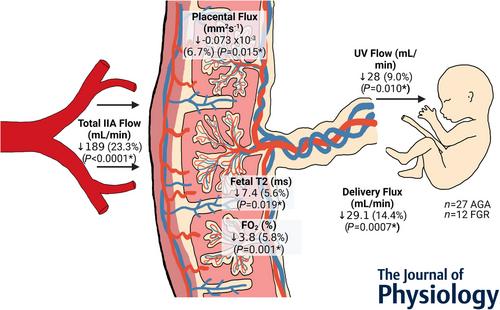
Fetal growth restriction (FGR) and maternal supine going-to-sleep position are both risk factors for late stillbirth. This study aimed to use magnetic resonance imaging (MRI) to quantify the effect of maternal supine position on maternal-placental and fetoplacental blood flow, placental oxygen transfer and fetal oxygenation in FGR and healthy pregnancies. Twelve women with FGR and 27 women with healthy pregnancies at 34–38 weeks’ gestation underwent MRI in both left lateral and supine positions. Phase-contrast MRI and a functional MRI technique (DECIDE) were used to measure blood flow in the maternal internal iliac arteries (IIAs) and umbilical vein (UV), placental oxygen transfer (placental flux), fetal oxygen saturation (FO2), and fetal oxygen delivery (delivery flux). The presence of FGR, compared to healthy pregnancies, was associated with a 7.8% lower FO2 (P = 0.02), reduced placental flux, and reduced delivery flux. Maternal supine positioning caused a 3.8% reduction in FO2 (P = 0.001), and significant reductions in total IIA flow, placental flux, UV flow and delivery flux compared to maternal left lateral position. The effect of maternal supine position on fetal oxygen delivery was independent of FGR pregnancy, meaning that supine positioning has an additive effect of reducing fetal oxygenation further in women with FGR, compared to women with appropriately grown for age pregnancies. Meanwhile, the effect of maternal supine positioning on placental oxygen transfer was not independent of the effect of FGR. Therefore, growth-restricted fetuses, which are chronically hypoxaemic, experience a relatively greater decline in oxygen transfer when mothers lie supine in late gestation compared to appropriately growing fetuses.
Key points
Fetal growth restriction (FGR) is the most common risk factor associated with stillbirth, and early recognition and timely delivery is vital to reduce this risk.
Maternal supine going-to-sleep position is found to increase the risk of late stillbirth but when combined with having a FGR pregnancy, maternal supine position leads to 15 times greater odds of stillbirth compared to supine sleeping with appropriately grown for age (AGA) pregnancies.
Using MRI, this study quantifies the chronic hypoxaemia experienced by growth-restricted fetuses due to 13.5% lower placental oxygen transfer and 26% lower fetal oxygen delivery compared to AGA fetuses.
With maternal supine positioning, there is a 23% reduction in maternal-placental blood flow and a further 14% reduction in fetal oxygen delivery for both FGR and AGA pregnancies, but this effect is proportionally greater for growth-restricted fetuses.
This knowledge emphasises the importance of avoiding supine positioning in late pregnancy, particularly for vulnerable FGR pregnancies.
期刊介绍:
The Journal of Physiology publishes full-length original Research Papers and Techniques for Physiology, which are short papers aimed at disseminating new techniques for physiological research. Articles solicited by the Editorial Board include Perspectives, Symposium Reports and Topical Reviews, which highlight areas of special physiological interest. CrossTalk articles are short editorial-style invited articles framing a debate between experts in the field on controversial topics. Letters to the Editor and Journal Club articles are also published. All categories of papers are subjected to peer reivew.
The Journal of Physiology welcomes submitted research papers in all areas of physiology. Authors should present original work that illustrates new physiological principles or mechanisms. Papers on work at the molecular level, at the level of the cell membrane, single cells, tissues or organs and on systems physiology are all acceptable. Theoretical papers and papers that use computational models to further our understanding of physiological processes will be considered if based on experimentally derived data and if the hypothesis advanced is directly amenable to experimental testing. While emphasis is on human and mammalian physiology, work on lower vertebrate or invertebrate preparations may be suitable if it furthers the understanding of the functioning of other organisms including mammals.



 京公网安备 11010802042870号
京ICP备2023020795号-1
京公网安备 11010802042870号
京ICP备2023020795号-1

 分享
分享
 求助内容:
求助内容: 应助结果提醒方式:
 扫码关注我们
