Trends in prostate cancer mortality in the United States of America, by state and race, from 1999 to 2019: estimates from the centers for disease control WONDER database
Chinmay Jani, Christian Mouchati, Nour Abdallah, Melissa Mariano, Ruchi Jani, Justin D. Salciccioli, Dominic C. Marshall, Harpreet Singh, Iris Sheng, Joseph Shalhoub, Rana R. McKay
{"title":"Trends in prostate cancer mortality in the United States of America, by state and race, from 1999 to 2019: estimates from the centers for disease control WONDER database","authors":"Chinmay Jani, Christian Mouchati, Nour Abdallah, Melissa Mariano, Ruchi Jani, Justin D. Salciccioli, Dominic C. Marshall, Harpreet Singh, Iris Sheng, Joseph Shalhoub, Rana R. McKay","doi":"10.1038/s41391-022-00628-0","DOIUrl":null,"url":null,"abstract":"In the United States of America (USA), prostate cancer (PC) is the most common cancer in men and the second cause of cancer mortality. Black men (BM) have a higher incidence and worse mortality when compared to white men (WM). We compared trends in PC mortality in the USA by race and state from 1999 to 2019. We extracted PC mortality data from the Centers for Disease Control (CDC) WONDER database using the International Classification of Diseases (ICD) 10 code C61. Age-Standardized Mortality Rates (ASMR) were divided into racial groups and reported by year and state. Due to the lack of available data in many states, analyses were conducted only for WM and BM using Joinpoint regression for trend comparisons. Between 1999–2019, ASMR decreased at the national level in Black (−44.6%), Asian (−44.8%), White (−31.8%), and American Indian or Alaskan native men (−19.0%). ASMR decreased in all states for both races. The greatest drop in ASMR was in Kentucky (−47.0%) for WM and Delaware (−57.8%) for BM. In 2019, ASMRs in BM (13.4/100 000) were significantly higher than WM (7.3/100 000), American Indian or Alaskan Native (3.2/100 000), and Asian men (3.2/100 000) (p < 0.001). The highest ASMRs were in Nebraska (33.5/100 000) for BM and Alaska (11/100 000) for WM. During the last 20 years, the PC mortality rate dropped in all states for all races, suggesting an advancement in management strategies. Although a higher decrease in ASMR was observed in BM, ASMR remain higher among BM. ASMRs were also found to be increasing in many states post USPSTF guideline change (2012), indicating a need for more education around optimized prostate cancer screening.","PeriodicalId":20727,"journal":{"name":"Prostate Cancer and Prostatic Diseases","volume":"26 3","pages":"552-562"},"PeriodicalIF":5.8000,"publicationDate":"2022-12-16","publicationTypes":"Journal Article","fieldsOfStudy":null,"isOpenAccess":false,"openAccessPdf":"","citationCount":"2","resultStr":null,"platform":"Semanticscholar","paperid":null,"PeriodicalName":"Prostate Cancer and Prostatic Diseases","FirstCategoryId":"3","ListUrlMain":"https://www.nature.com/articles/s41391-022-00628-0","RegionNum":2,"RegionCategory":"医学","ArticlePicture":[],"TitleCN":null,"AbstractTextCN":null,"PMCID":null,"EPubDate":"","PubModel":"","JCR":"Q1","JCRName":"ONCOLOGY","Score":null,"Total":0}
引用次数: 2
Abstract
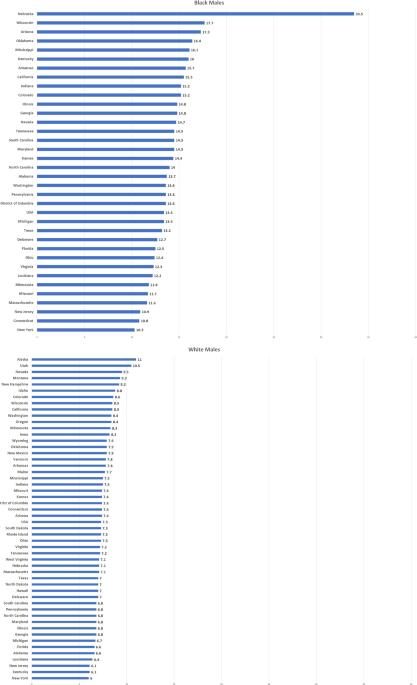
In the United States of America (USA), prostate cancer (PC) is the most common cancer in men and the second cause of cancer mortality. Black men (BM) have a higher incidence and worse mortality when compared to white men (WM). We compared trends in PC mortality in the USA by race and state from 1999 to 2019. We extracted PC mortality data from the Centers for Disease Control (CDC) WONDER database using the International Classification of Diseases (ICD) 10 code C61. Age-Standardized Mortality Rates (ASMR) were divided into racial groups and reported by year and state. Due to the lack of available data in many states, analyses were conducted only for WM and BM using Joinpoint regression for trend comparisons. Between 1999–2019, ASMR decreased at the national level in Black (−44.6%), Asian (−44.8%), White (−31.8%), and American Indian or Alaskan native men (−19.0%). ASMR decreased in all states for both races. The greatest drop in ASMR was in Kentucky (−47.0%) for WM and Delaware (−57.8%) for BM. In 2019, ASMRs in BM (13.4/100 000) were significantly higher than WM (7.3/100 000), American Indian or Alaskan Native (3.2/100 000), and Asian men (3.2/100 000) (p < 0.001). The highest ASMRs were in Nebraska (33.5/100 000) for BM and Alaska (11/100 000) for WM. During the last 20 years, the PC mortality rate dropped in all states for all races, suggesting an advancement in management strategies. Although a higher decrease in ASMR was observed in BM, ASMR remain higher among BM. ASMRs were also found to be increasing in many states post USPSTF guideline change (2012), indicating a need for more education around optimized prostate cancer screening.
期刊介绍:
Prostate Cancer and Prostatic Diseases covers all aspects of prostatic diseases, in particular prostate cancer, the subject of intensive basic and clinical research world-wide. The journal also reports on exciting new developments being made in diagnosis, surgery, radiotherapy, drug discovery and medical management.
Prostate Cancer and Prostatic Diseases is of interest to surgeons, oncologists and clinicians treating patients and to those involved in research into diseases of the prostate. The journal covers the three main areas - prostate cancer, male LUTS and prostatitis.
Prostate Cancer and Prostatic Diseases publishes original research articles, reviews, topical comment and critical appraisals of scientific meetings and the latest books. The journal also contains a calendar of forthcoming scientific meetings. The Editors and a distinguished Editorial Board ensure that submitted articles receive fast and efficient attention and are refereed to the highest possible scientific standard. A fast track system is available for topical articles of particular significance.



 京公网安备 11010802042870号
京ICP备2023020795号-1
京公网安备 11010802042870号
京ICP备2023020795号-1

 分享
分享
 求助内容:
求助内容: 应助结果提醒方式:
 扫码关注我们
