{"title":"Analysis of risk factors for severe acute kidney injury in patients with acute myocardial infarction: A retrospective study.","authors":"Yuxin Nong, Xuebiao Wei, Hongrui Qiu, Honghao Yang, Jiale Yang, Junquan Lu, Jianfeng Cao, Yanbin Fu, Danqing Yu","doi":"10.3389/fneph.2023.1047249","DOIUrl":null,"url":null,"abstract":"<p><strong>Background: </strong>Patients with acute myocardial infarction (AMI) complicated by acute kidney injury (AKI) tend to have a poor prognosis. However, the exact mechanism of the co-occurrence of the two diseases is unknown. Therefore, this study aims to determine the risk factors for severe AKI in patients with AMI.</p><p><strong>Methods: </strong>A total of 2022 patients were included in the Medical Information Mart for Intensive Care. Variables were identified <i>via</i> univariate logistic regression, and the variables were corrected <i>via</i> multivariate logistic regression. Restricted cubic splines were used to examine the risks associated with the variables. The Kaplan-Meier method was used to compare the risk of severe AKI among the patients.</p><p><strong>Results: </strong>Patients with severe AKI had a higher in-hospital mortality rate (28.6% vs. 9.0%, P < 0.001) and a longer duration of intensive care (6.5 days vs. 2.9 days, P < 0.001). In patients with AMI, the mean systolic blood pressure (SBP); international normalized ratio (INR); the levels of blood urea nitrogen (BUN), glucose, and calcium; and a history of liver disease were found to be the independent risk factors for developing severe AKI after their admission. Increased levels of BUN and blood glucose and a high INR increased the risk of severe AKI; however, increased levels of calcium decreased the risk; SBP presented a U-shaped curve relationship.</p><p><strong>Conclusions: </strong>Patients with severe AKI have a poor prognosis following an episode of AMI. Furthermore, in patients with AMI, SBP; INR; a history of liver disease; and the levels of BUN, glucose, and calcium are the independent risk factors for developing severe AKI after their admission.</p>","PeriodicalId":73091,"journal":{"name":"Frontiers in nephrology","volume":"3 ","pages":"1047249"},"PeriodicalIF":0.0000,"publicationDate":"2023-01-01","publicationTypes":"Journal Article","fieldsOfStudy":null,"isOpenAccess":false,"openAccessPdf":"https://www.ncbi.nlm.nih.gov/pmc/articles/PMC10479598/pdf/","citationCount":"1","resultStr":null,"platform":"Semanticscholar","paperid":null,"PeriodicalName":"Frontiers in nephrology","FirstCategoryId":"1085","ListUrlMain":"https://doi.org/10.3389/fneph.2023.1047249","RegionNum":0,"RegionCategory":null,"ArticlePicture":[],"TitleCN":null,"AbstractTextCN":null,"PMCID":null,"EPubDate":"","PubModel":"","JCR":"","JCRName":"","Score":null,"Total":0}
引用次数: 1
Abstract
Background: Patients with acute myocardial infarction (AMI) complicated by acute kidney injury (AKI) tend to have a poor prognosis. However, the exact mechanism of the co-occurrence of the two diseases is unknown. Therefore, this study aims to determine the risk factors for severe AKI in patients with AMI.
Methods: A total of 2022 patients were included in the Medical Information Mart for Intensive Care. Variables were identified via univariate logistic regression, and the variables were corrected via multivariate logistic regression. Restricted cubic splines were used to examine the risks associated with the variables. The Kaplan-Meier method was used to compare the risk of severe AKI among the patients.
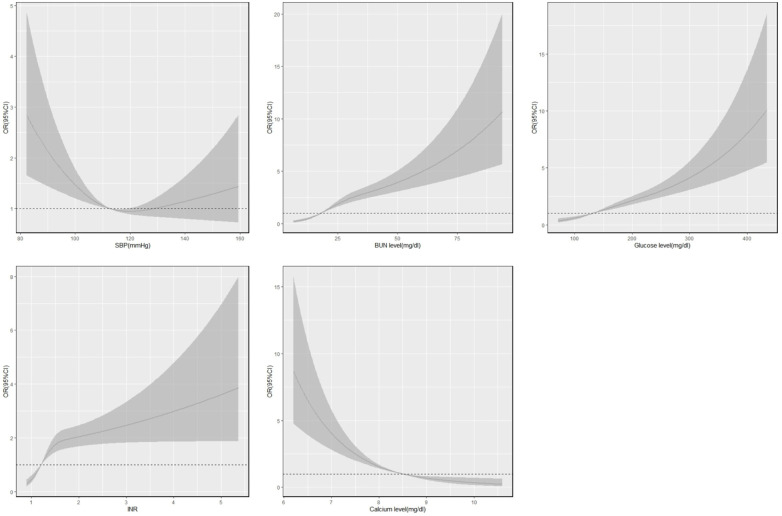
Results: Patients with severe AKI had a higher in-hospital mortality rate (28.6% vs. 9.0%, P < 0.001) and a longer duration of intensive care (6.5 days vs. 2.9 days, P < 0.001). In patients with AMI, the mean systolic blood pressure (SBP); international normalized ratio (INR); the levels of blood urea nitrogen (BUN), glucose, and calcium; and a history of liver disease were found to be the independent risk factors for developing severe AKI after their admission. Increased levels of BUN and blood glucose and a high INR increased the risk of severe AKI; however, increased levels of calcium decreased the risk; SBP presented a U-shaped curve relationship.
Conclusions: Patients with severe AKI have a poor prognosis following an episode of AMI. Furthermore, in patients with AMI, SBP; INR; a history of liver disease; and the levels of BUN, glucose, and calcium are the independent risk factors for developing severe AKI after their admission.





 京公网安备 11010802042870号
京ICP备2023020795号-1
京公网安备 11010802042870号
京ICP备2023020795号-1

 分享
分享

 求助内容:
求助内容: 应助结果提醒方式:
 扫码关注我们
