{"title":"A report of stillbirth and subsequent maternal cannibalism observed in a free-ranging group of Japanese macaques at Awajishima, Japan.","authors":"Yu Kaigaishi, Shinya Yamamoto","doi":"10.1007/s10329-023-01091-8","DOIUrl":null,"url":null,"abstract":"<p><p>How primate mothers interact with their dead infants has attracted much attention from primatologists. In particular, the care given to infant corpses has been well documented, and some researchers have employed quantitative analyses to explore the underlying mechanisms of this behavior. In contrast, instances of maternal cannibalism, another striking response to dead infants, are relatively uncommon and the factors contributing to this phenomenon remain unclear among primates. Here, we report a new case of stillbirth and subsequent maternal cannibalism that occurred in a free-ranging group of Japanese macaques residing on Awajishima Island, Japan. In the observed case, a multiparous female gave a stillbirth in the winter of 2022. The newborn appeared premature due to the lack of hair and unformed limbs, and the unseasonal birth. Initially, the mother cared for the newborn by licking and holding the body, but she suddenly began consuming the entire corpse, except for the parts around the head. This is the first case of maternal cannibalism by a multiparous mother of free-ranging Japanese macaque. We compared this case with those previously reported in Old World monkeys, and discussed the possible link between stillbirth, maternal care, and cannibalization towards deceased infants. In order to understand how primates comprehend the concepts of \"death\" and how their maternal relationships have evolved, it would be important to focus not only on maternal care toward dead infants but also cannibalism that could occur at the end of the caregiving.</p>","PeriodicalId":20468,"journal":{"name":"Primates","volume":" ","pages":"573-578"},"PeriodicalIF":1.5000,"publicationDate":"2023-11-01","publicationTypes":"Journal Article","fieldsOfStudy":null,"isOpenAccess":false,"openAccessPdf":"","citationCount":"0","resultStr":null,"platform":"Semanticscholar","paperid":null,"PeriodicalName":"Primates","FirstCategoryId":"99","ListUrlMain":"https://doi.org/10.1007/s10329-023-01091-8","RegionNum":4,"RegionCategory":"生物学","ArticlePicture":[],"TitleCN":null,"AbstractTextCN":null,"PMCID":null,"EPubDate":"2023/8/21 0:00:00","PubModel":"Epub","JCR":"Q2","JCRName":"ZOOLOGY","Score":null,"Total":0}
引用次数: 0
Abstract
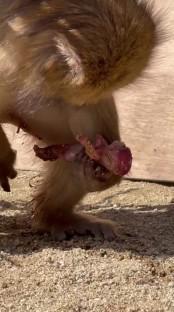
How primate mothers interact with their dead infants has attracted much attention from primatologists. In particular, the care given to infant corpses has been well documented, and some researchers have employed quantitative analyses to explore the underlying mechanisms of this behavior. In contrast, instances of maternal cannibalism, another striking response to dead infants, are relatively uncommon and the factors contributing to this phenomenon remain unclear among primates. Here, we report a new case of stillbirth and subsequent maternal cannibalism that occurred in a free-ranging group of Japanese macaques residing on Awajishima Island, Japan. In the observed case, a multiparous female gave a stillbirth in the winter of 2022. The newborn appeared premature due to the lack of hair and unformed limbs, and the unseasonal birth. Initially, the mother cared for the newborn by licking and holding the body, but she suddenly began consuming the entire corpse, except for the parts around the head. This is the first case of maternal cannibalism by a multiparous mother of free-ranging Japanese macaque. We compared this case with those previously reported in Old World monkeys, and discussed the possible link between stillbirth, maternal care, and cannibalization towards deceased infants. In order to understand how primates comprehend the concepts of "death" and how their maternal relationships have evolved, it would be important to focus not only on maternal care toward dead infants but also cannibalism that could occur at the end of the caregiving.
期刊介绍:
Primates is an international journal of primatology whose aim is to provide a forum for the elucidation of all aspects of primates. The oldest primatological journal, Primates publishes original papers that advance the scientific study of primates, and its scope embraces work in diverse fields covering biological bases of behavior, socio-ecology, learning and cognition, social processes, systematics, evolution, and medicine. Contributions relevant to conservation of natural populations and welfare of captive primates are welcome. Studies focusing on nonprimate species may be considered if their relevance to primatology is clear. Original Articles as well as Review Articles, News and Perspectives, and Book Reviews are included. All manuscripts received are initially screened for suitability by members of the Editorial Board, taking into account style and ethical issues, leading to a swift decision about whether to send the manuscript for external review.



 京公网安备 11010802042870号
京ICP备2023020795号-1
京公网安备 11010802042870号
京ICP备2023020795号-1

 分享
分享
 求助内容:
求助内容: 应助结果提醒方式:
 扫码关注我们
