Filippos Triposkiadis, Alexandros Briasoulis, Takeshi Kitai, Dimitrios Magouliotis, Thanos Athanasiou, John Skoularigis, Andrew Xanthopoulos
{"title":"The sympathetic nervous system in heart failure revisited.","authors":"Filippos Triposkiadis, Alexandros Briasoulis, Takeshi Kitai, Dimitrios Magouliotis, Thanos Athanasiou, John Skoularigis, Andrew Xanthopoulos","doi":"10.1007/s10741-023-10345-y","DOIUrl":null,"url":null,"abstract":"<p><p>Several attempts have been made, by the scientific community, to develop a unifying hypothesis that explains the clinical syndrome of heart failure (HF). The currently widely accepted neurohormonal model has substituted the cardiorenal and the cardiocirculatory models, which focused on salt-water retention and low cardiac output/peripheral vasoconstriction, respectively. According to the neurohormonal model, HF with eccentric left ventricular (LV) hypertrophy (LVH) (systolic HF or HF with reduced LV ejection fraction [LVEF] or HFrEF) develops and progresses because endogenous neurohormonal systems, predominantly the sympathetic nervous system (SNS) and the renin-angiotensin-aldosterone system (RAAS), exhibit prolonged activation following the initial heart injury exerting deleterious hemodynamic and direct nonhemodynamic cardiovascular effects. However, there is evidence to suggest that SNS overactivity often preexists HF development due to its association with HF risk factors, is also present in HF with preserved LVEF (diastolic HF or HFpEF), and that it is linked to immune/inflammatory factors. Furthermore, SNS activity in HF may be augmented by coexisting noncardiac morbidities and modified by genetic factors and demographics. The purpose of this paper is to provide a contemporary overview of the complex associations between SNS overactivity and the development and progression of HF, summarize the underlying mechanisms, and discuss the clinical implications as they relate to therapeutic interventions mitigating SNS overactivity.</p>","PeriodicalId":12950,"journal":{"name":"Heart Failure Reviews","volume":" ","pages":"355-365"},"PeriodicalIF":4.2000,"publicationDate":"2024-03-01","publicationTypes":"Journal Article","fieldsOfStudy":null,"isOpenAccess":false,"openAccessPdf":"","citationCount":"0","resultStr":null,"platform":"Semanticscholar","paperid":null,"PeriodicalName":"Heart Failure Reviews","FirstCategoryId":"3","ListUrlMain":"https://doi.org/10.1007/s10741-023-10345-y","RegionNum":2,"RegionCategory":"医学","ArticlePicture":[],"TitleCN":null,"AbstractTextCN":null,"PMCID":null,"EPubDate":"2023/9/14 0:00:00","PubModel":"Epub","JCR":"Q1","JCRName":"CARDIAC & CARDIOVASCULAR SYSTEMS","Score":null,"Total":0}
引用次数: 0
Abstract
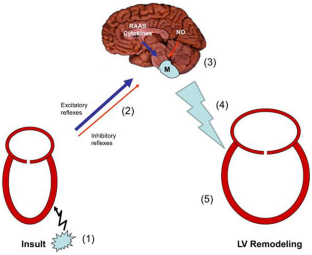
Several attempts have been made, by the scientific community, to develop a unifying hypothesis that explains the clinical syndrome of heart failure (HF). The currently widely accepted neurohormonal model has substituted the cardiorenal and the cardiocirculatory models, which focused on salt-water retention and low cardiac output/peripheral vasoconstriction, respectively. According to the neurohormonal model, HF with eccentric left ventricular (LV) hypertrophy (LVH) (systolic HF or HF with reduced LV ejection fraction [LVEF] or HFrEF) develops and progresses because endogenous neurohormonal systems, predominantly the sympathetic nervous system (SNS) and the renin-angiotensin-aldosterone system (RAAS), exhibit prolonged activation following the initial heart injury exerting deleterious hemodynamic and direct nonhemodynamic cardiovascular effects. However, there is evidence to suggest that SNS overactivity often preexists HF development due to its association with HF risk factors, is also present in HF with preserved LVEF (diastolic HF or HFpEF), and that it is linked to immune/inflammatory factors. Furthermore, SNS activity in HF may be augmented by coexisting noncardiac morbidities and modified by genetic factors and demographics. The purpose of this paper is to provide a contemporary overview of the complex associations between SNS overactivity and the development and progression of HF, summarize the underlying mechanisms, and discuss the clinical implications as they relate to therapeutic interventions mitigating SNS overactivity.
期刊介绍:
Heart Failure Reviews is an international journal which develops links between basic scientists and clinical investigators, creating a unique, interdisciplinary dialogue focused on heart failure, its pathogenesis and treatment. The journal accordingly publishes papers in both basic and clinical research fields. Topics covered include clinical and surgical approaches to therapy, basic pharmacology, biochemistry, molecular biology, pathology, and electrophysiology.
The reviews are comprehensive, expanding the reader''s knowledge base and awareness of current research and new findings in this rapidly growing field of cardiovascular medicine. All reviews are thoroughly peer-reviewed before publication.



 京公网安备 11010802042870号
京ICP备2023020795号-1
京公网安备 11010802042870号
京ICP备2023020795号-1

 分享
分享
 求助内容:
求助内容: 应助结果提醒方式:
 扫码关注我们
