{"title":"Therapeutic potentialities of green tea (Camellia sinensis) in ischemic stroke: biochemical and molecular evidence.","authors":"Shakiba Azami, Fatemeh Forouzanfar","doi":"10.1007/s11011-023-01294-4","DOIUrl":null,"url":null,"abstract":"<p><p>Ischemic stroke is a leading cause of disability and death in patients. Despite considerable recent advances in the treatment of ischemic stroke, only a limited number of effective neuroprotective agents are available for stroke. Green tea (Camellia sinensis) is a popular herbal plant, and numerous studies have indicated its health benefits for several diseases. Green tea is of interest due to its high content of catechin derivatives, including epicatechin, gallocatechin, epicatechin gallate, epigallocatechin, and epigallocatechin-3-gallate. This review tried to develop a feasible background for the potential effects of green tea and its bioactive derivatives concerning protection against ischemic stroke. Green tea's antioxidants, anti-inflammatory, anti-apoptotic, and neuroprotective effects are believed to be efficacious in stroke treatment. Evidence supports the idea that green tea can be used to assist in treating ischemic stroke.</p>","PeriodicalId":18685,"journal":{"name":"Metabolic brain disease","volume":" ","pages":"347-357"},"PeriodicalIF":3.5000,"publicationDate":"2024-02-01","publicationTypes":"Journal Article","fieldsOfStudy":null,"isOpenAccess":false,"openAccessPdf":"","citationCount":"0","resultStr":null,"platform":"Semanticscholar","paperid":null,"PeriodicalName":"Metabolic brain disease","FirstCategoryId":"3","ListUrlMain":"https://doi.org/10.1007/s11011-023-01294-4","RegionNum":3,"RegionCategory":"医学","ArticlePicture":[],"TitleCN":null,"AbstractTextCN":null,"PMCID":null,"EPubDate":"2023/9/18 0:00:00","PubModel":"Epub","JCR":"Q2","JCRName":"ENDOCRINOLOGY & METABOLISM","Score":null,"Total":0}
引用次数: 0
Abstract
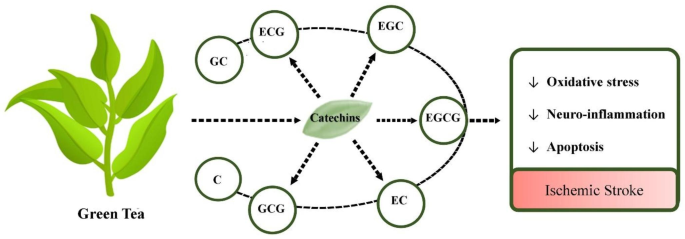
Ischemic stroke is a leading cause of disability and death in patients. Despite considerable recent advances in the treatment of ischemic stroke, only a limited number of effective neuroprotective agents are available for stroke. Green tea (Camellia sinensis) is a popular herbal plant, and numerous studies have indicated its health benefits for several diseases. Green tea is of interest due to its high content of catechin derivatives, including epicatechin, gallocatechin, epicatechin gallate, epigallocatechin, and epigallocatechin-3-gallate. This review tried to develop a feasible background for the potential effects of green tea and its bioactive derivatives concerning protection against ischemic stroke. Green tea's antioxidants, anti-inflammatory, anti-apoptotic, and neuroprotective effects are believed to be efficacious in stroke treatment. Evidence supports the idea that green tea can be used to assist in treating ischemic stroke.
期刊介绍:
Metabolic Brain Disease serves as a forum for the publication of outstanding basic and clinical papers on all metabolic brain disease, including both human and animal studies. The journal publishes papers on the fundamental pathogenesis of these disorders and on related experimental and clinical techniques and methodologies. Metabolic Brain Disease is directed to physicians, neuroscientists, internists, psychiatrists, neurologists, pathologists, and others involved in the research and treatment of a broad range of metabolic brain disorders.



 京公网安备 11010802042870号
京ICP备2023020795号-1
京公网安备 11010802042870号
京ICP备2023020795号-1

 分享
分享
 求助内容:
求助内容: 应助结果提醒方式:
 扫码关注我们
