Kortney Floyd James PhD, PNP, RN, Megan Hicks PhD, Kristen R. Choi PhD, RN, FAAN, Courtney S. Thomas Tobin PhD
{"title":"Discrimination during childbirth and postpartum care utilization among Black birthing people in California, United States","authors":"Kortney Floyd James PhD, PNP, RN, Megan Hicks PhD, Kristen R. Choi PhD, RN, FAAN, Courtney S. Thomas Tobin PhD","doi":"10.1111/birt.12755","DOIUrl":null,"url":null,"abstract":"<div>\n \n \n <section>\n \n <h3> Background</h3>\n \n <p>The purpose of this study was to investigate the relationship between discrimination during childbirth hospitalization and postpartum care utilization among Black birthing people in California, United States.</p>\n </section>\n \n <section>\n \n <h3> Methods</h3>\n \n <p>This was a secondary analysis of data from the <i>Listening to Mothers in California</i> survey, a population-based survey of individuals with a singleton hospital-based birth in California in 2016. The primary outcome was number of postpartum care visits. The primary exposures were racial, language, and insurance discrimination. A multiple linear regression model was used to estimate associations between discrimination and postpartum care use, adjusting for sociodemographic covariates.</p>\n </section>\n \n <section>\n \n <h3> Results</h3>\n \n <p>Black birthing people in the sample had an average of two postpartum visits. Almost 15% of the sample reported one or more forms of discrimination during hospital-based childbirth. In adjusted models, racial discrimination (β = 0.09, 95% CI = 0.04–0.14, <i>p</i> < 0.01) and language discrimination (β = 1.03, 95% CI = 0.98–1.07, <i>p</i> < 0.01) were associated with increased postpartum visits, while insurance discrimination was linked to decreased postpartum visits (β = −0.96, 95% CI = −1.04 to −0.89, <i>p</i> < 0.01).</p>\n </section>\n \n <section>\n \n <h3> Conclusion</h3>\n \n <p>Among Black birthing people in California, the drivers of postpartum care utilization after childbirth are complex. There are multiple negative drivers (e.g., experiencing racial and language discrimination and unmet needs), barriers (e.g., insurance discrimination), and positive drivers (e.g., clinician type and education) that affect postpartum care utilization among Black birthing people.</p>\n </section>\n </div>","PeriodicalId":55350,"journal":{"name":"Birth-Issues in Perinatal Care","volume":"50 4","pages":"1018-1024"},"PeriodicalIF":2.5000,"publicationDate":"2023-08-07","publicationTypes":"Journal Article","fieldsOfStudy":null,"isOpenAccess":false,"openAccessPdf":"https://onlinelibrary.wiley.com/doi/epdf/10.1111/birt.12755","citationCount":"0","resultStr":null,"platform":"Semanticscholar","paperid":null,"PeriodicalName":"Birth-Issues in Perinatal Care","FirstCategoryId":"3","ListUrlMain":"https://onlinelibrary.wiley.com/doi/10.1111/birt.12755","RegionNum":3,"RegionCategory":"医学","ArticlePicture":[],"TitleCN":null,"AbstractTextCN":null,"PMCID":null,"EPubDate":"","PubModel":"","JCR":"Q1","JCRName":"NURSING","Score":null,"Total":0}
引用次数: 0
Abstract
Background
The purpose of this study was to investigate the relationship between discrimination during childbirth hospitalization and postpartum care utilization among Black birthing people in California, United States.
Methods
This was a secondary analysis of data from the Listening to Mothers in California survey, a population-based survey of individuals with a singleton hospital-based birth in California in 2016. The primary outcome was number of postpartum care visits. The primary exposures were racial, language, and insurance discrimination. A multiple linear regression model was used to estimate associations between discrimination and postpartum care use, adjusting for sociodemographic covariates.
Results
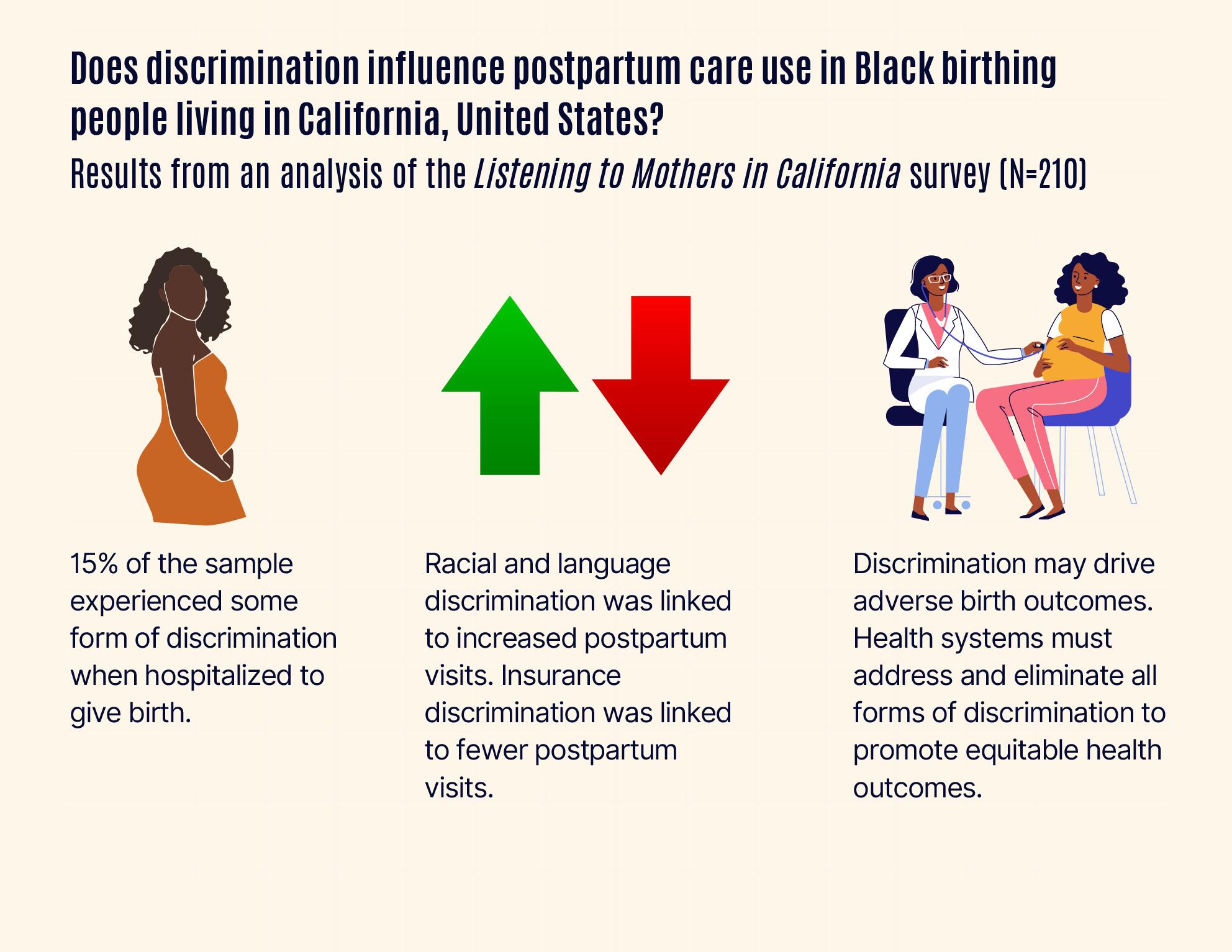
Black birthing people in the sample had an average of two postpartum visits. Almost 15% of the sample reported one or more forms of discrimination during hospital-based childbirth. In adjusted models, racial discrimination (β = 0.09, 95% CI = 0.04–0.14, p < 0.01) and language discrimination (β = 1.03, 95% CI = 0.98–1.07, p < 0.01) were associated with increased postpartum visits, while insurance discrimination was linked to decreased postpartum visits (β = −0.96, 95% CI = −1.04 to −0.89, p < 0.01).
Conclusion
Among Black birthing people in California, the drivers of postpartum care utilization after childbirth are complex. There are multiple negative drivers (e.g., experiencing racial and language discrimination and unmet needs), barriers (e.g., insurance discrimination), and positive drivers (e.g., clinician type and education) that affect postpartum care utilization among Black birthing people.
期刊介绍:
Birth: Issues in Perinatal Care is a multidisciplinary, refereed journal devoted to issues and practices in the care of childbearing women, infants, and families. It is written by and for professionals in maternal and neonatal health, nurses, midwives, physicians, public health workers, doulas, social scientists, childbirth educators, lactation counselors, epidemiologists, and other health caregivers and policymakers in perinatal care.