So-Hee Kim, Jihye Lee, Ye Lin Jung, Aerum Hong, Sang-Jip Nam, Byung-Kwan Lim
{"title":"Salvianolic Acid B Inhibits Hand-Foot-Mouth Disease Enterovirus 71 Replication through Enhancement of AKT Signaling Pathway.","authors":"So-Hee Kim, Jihye Lee, Ye Lin Jung, Aerum Hong, Sang-Jip Nam, Byung-Kwan Lim","doi":"10.4014/jmb.1907.07079","DOIUrl":null,"url":null,"abstract":"<p><p>Hand, foot, and mouth disease (HFMD) is caused by enterovirus 71 (EV71) in infants and children under six years of age. HFMD is characterized by fever, mouth ulcers, and vesicular rashes on the palms and feet. EV71 also causes severe neurological manifestations, such as brainstem encephalitis and aseptic meningitis. Recently, frequent outbreaks of EV71 have occurred in the Asia-Pacific region, but currently, no effective antiviral drugs have been developed to treat the disease. In this study, we investigated the antiviral effect of salvianolic acid B (SalB) on EV71. SalB is a major component of the <i>Salvia miltiorrhiza</i> root and has been shown to be an effective treatment for subarachnoid hemorrhages and myocardial infarctions. HeLa cells were cultured in 12-well plates and treated with SalB (100 or 10 µg/ml) and 10<sup>6</sup> PFU/ml of EV71. SalB treatment (100 µg/ml) significantly decreased the cleavage of the eukaryotic eIF4G1 protein and reduced the expression of the EV71 capsid protein VP1. In addition, SalB treatment showed a dramatic decrease in viral infection, measured by immunofluorescence staining. The Akt signaling pathway, a key component of cell survival and proliferation, was significantly increased in EV71-infected HeLa cells treated with 100 µg/ml SalB. RT-PCR results showed that the mRNA for anti-apoptotic protein Bcl-2 and the cell cycle regulator Cyclin-D1 were significantly increased by SalB treatment. These results indicate that SalB activates Akt/PKB signaling and inhibits apoptosis in infected HeLa cells. Taken together, these results suggest that SalB could be used to develop a new therapeutic drug for EV71-induced HFMD.</p>","PeriodicalId":16481,"journal":{"name":"Journal of microbiology and biotechnology","volume":"30 1","pages":"38-43"},"PeriodicalIF":3.1000,"publicationDate":"2020-01-28","publicationTypes":"Journal Article","fieldsOfStudy":null,"isOpenAccess":false,"openAccessPdf":"https://www.ncbi.nlm.nih.gov/pmc/articles/PMC9728356/pdf/","citationCount":"9","resultStr":null,"platform":"Semanticscholar","paperid":null,"PeriodicalName":"Journal of microbiology and biotechnology","FirstCategoryId":"5","ListUrlMain":"https://doi.org/10.4014/jmb.1907.07079","RegionNum":4,"RegionCategory":"生物学","ArticlePicture":[],"TitleCN":null,"AbstractTextCN":null,"PMCID":null,"EPubDate":"","PubModel":"","JCR":"Q3","JCRName":"BIOTECHNOLOGY & APPLIED MICROBIOLOGY","Score":null,"Total":0}
引用次数: 9
Abstract
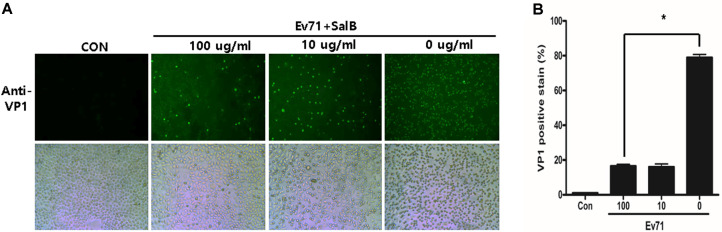
Hand, foot, and mouth disease (HFMD) is caused by enterovirus 71 (EV71) in infants and children under six years of age. HFMD is characterized by fever, mouth ulcers, and vesicular rashes on the palms and feet. EV71 also causes severe neurological manifestations, such as brainstem encephalitis and aseptic meningitis. Recently, frequent outbreaks of EV71 have occurred in the Asia-Pacific region, but currently, no effective antiviral drugs have been developed to treat the disease. In this study, we investigated the antiviral effect of salvianolic acid B (SalB) on EV71. SalB is a major component of the Salvia miltiorrhiza root and has been shown to be an effective treatment for subarachnoid hemorrhages and myocardial infarctions. HeLa cells were cultured in 12-well plates and treated with SalB (100 or 10 µg/ml) and 106 PFU/ml of EV71. SalB treatment (100 µg/ml) significantly decreased the cleavage of the eukaryotic eIF4G1 protein and reduced the expression of the EV71 capsid protein VP1. In addition, SalB treatment showed a dramatic decrease in viral infection, measured by immunofluorescence staining. The Akt signaling pathway, a key component of cell survival and proliferation, was significantly increased in EV71-infected HeLa cells treated with 100 µg/ml SalB. RT-PCR results showed that the mRNA for anti-apoptotic protein Bcl-2 and the cell cycle regulator Cyclin-D1 were significantly increased by SalB treatment. These results indicate that SalB activates Akt/PKB signaling and inhibits apoptosis in infected HeLa cells. Taken together, these results suggest that SalB could be used to develop a new therapeutic drug for EV71-induced HFMD.
期刊介绍:
The Journal of Microbiology and Biotechnology (JMB) is a monthly international journal devoted to the advancement and dissemination of scientific knowledge pertaining to microbiology, biotechnology, and related academic disciplines. It covers various scientific and technological aspects of Molecular and Cellular Microbiology, Environmental Microbiology and Biotechnology, Food Biotechnology, and Biotechnology and Bioengineering (subcategories are listed below). Launched in March 1991, the JMB is published by the Korean Society for Microbiology and Biotechnology (KMB) and distributed worldwide.





 京公网安备 11010802042870号
京ICP备2023020795号-1
京公网安备 11010802042870号
京ICP备2023020795号-1

 分享
分享
 求助内容:
求助内容: 应助结果提醒方式:
 扫码关注我们
