Involvement of the spinal γ-aminobutyric acid receptor in the analgesic effects of intrathecally injected hypertonic saline in spinal nerve-ligated rats.
Myong-Hwan Karm, Hyun-Jung Kwon, Euiyong Shin, Honggyoon Bae, Young Ki Kim, Seong-Soo Choi
{"title":"Involvement of the spinal γ-aminobutyric acid receptor in the analgesic effects of intrathecally injected hypertonic saline in spinal nerve-ligated rats.","authors":"Myong-Hwan Karm, Hyun-Jung Kwon, Euiyong Shin, Honggyoon Bae, Young Ki Kim, Seong-Soo Choi","doi":"10.3344/kjp.23162","DOIUrl":null,"url":null,"abstract":"<p><strong>Background: </strong>: Hypertonic saline is used for treating chronic pain; however, clinical studies that aid in optimizing therapeutic protocols are lacking. We aimed to determine the concentration of intrathecally injected hypertonic saline at which the effect reaches its peak as well as the underlying γ-aminobutyric acid (GABA) receptor-related antinociceptive mechanism.</p><p><strong>Methods: </strong>: Spinal nerve ligation (SNL; left L5 and L6) was performed to induce neuropathic pain in rats weighing 250-300 g. Experiment 1: one week after implanting the intrathecal catheter, 60 rats were assigned randomly to intrathecal injection with 0.45%, 0.9%, 2.5%, 5%, 10%, and 20% NaCl, followed by behavioral testing at baseline and after 30 minutes, 2 hours, 1 day, and 1 week to determine the minimal concentration which produced maximal analgesia. Experiment 2: after determining the optimal intrathecal hypertonic saline concentration, 60 rats were randomly divided into four groups: Sham, hypertonic saline without pretreatment, and hypertonic saline after pretreatment with one of two GABA receptor antagonists (GABA<sub>A</sub> [bicuculline], or GABA<sub>B</sub> [phaclofen]). Behavioral tests were performed at weeks 1 and 3 following each treatment.</p><p><strong>Results: </strong>: Hypertonic saline at concentrations greater than 5% alleviated SNL-induced mechanical allodynia and had a significant therapeutic effect, while showing a partial time- and dose-dependent antinociceptive effect on thermal and cold hyperalgesia. However, pretreatment with GABA receptor antagonists inhibited the antinociceptive effect of 5% NaCl.</p><p><strong>Conclusions: </strong>: This study indicates that the optimal concentration of hypertonic saline for controlling mechanical allodynia in neuropathic pain is 5%, and that its analgesic effect is related to GABA<sub>A</sub> and GABA<sub>B</sub> receptors.</p>","PeriodicalId":56252,"journal":{"name":"Korean Journal of Pain","volume":" ","pages":"441-449"},"PeriodicalIF":3.1000,"publicationDate":"2023-10-01","publicationTypes":"Journal Article","fieldsOfStudy":null,"isOpenAccess":false,"openAccessPdf":"https://ftp.ncbi.nlm.nih.gov/pub/pmc/oa_pdf/47/d4/kjp-36-4-441.PMC10551396.pdf","citationCount":"0","resultStr":null,"platform":"Semanticscholar","paperid":null,"PeriodicalName":"Korean Journal of Pain","FirstCategoryId":"3","ListUrlMain":"https://doi.org/10.3344/kjp.23162","RegionNum":3,"RegionCategory":"医学","ArticlePicture":[],"TitleCN":null,"AbstractTextCN":null,"PMCID":null,"EPubDate":"2023/9/19 0:00:00","PubModel":"Epub","JCR":"Q2","JCRName":"CLINICAL NEUROLOGY","Score":null,"Total":0}
引用次数: 0
Abstract
Background: : Hypertonic saline is used for treating chronic pain; however, clinical studies that aid in optimizing therapeutic protocols are lacking. We aimed to determine the concentration of intrathecally injected hypertonic saline at which the effect reaches its peak as well as the underlying γ-aminobutyric acid (GABA) receptor-related antinociceptive mechanism.
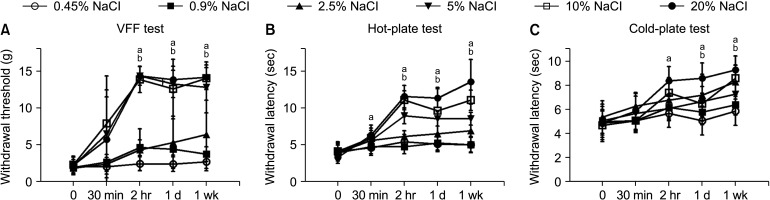
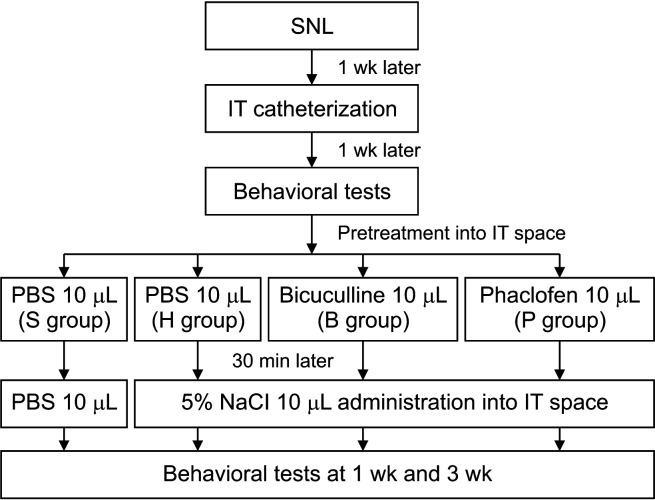
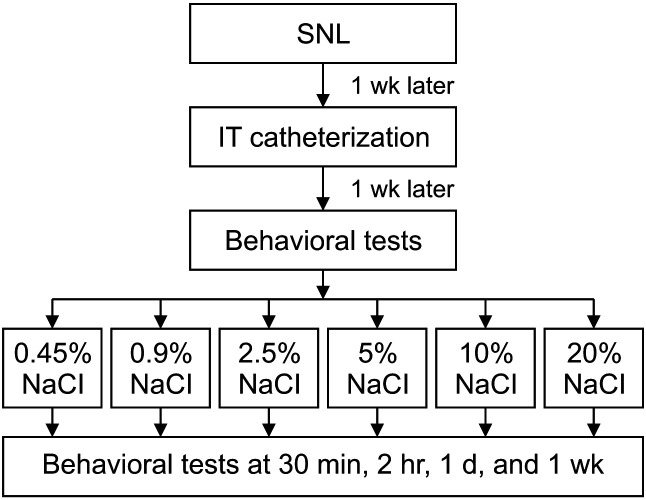
Methods: : Spinal nerve ligation (SNL; left L5 and L6) was performed to induce neuropathic pain in rats weighing 250-300 g. Experiment 1: one week after implanting the intrathecal catheter, 60 rats were assigned randomly to intrathecal injection with 0.45%, 0.9%, 2.5%, 5%, 10%, and 20% NaCl, followed by behavioral testing at baseline and after 30 minutes, 2 hours, 1 day, and 1 week to determine the minimal concentration which produced maximal analgesia. Experiment 2: after determining the optimal intrathecal hypertonic saline concentration, 60 rats were randomly divided into four groups: Sham, hypertonic saline without pretreatment, and hypertonic saline after pretreatment with one of two GABA receptor antagonists (GABAA [bicuculline], or GABAB [phaclofen]). Behavioral tests were performed at weeks 1 and 3 following each treatment.
Results: : Hypertonic saline at concentrations greater than 5% alleviated SNL-induced mechanical allodynia and had a significant therapeutic effect, while showing a partial time- and dose-dependent antinociceptive effect on thermal and cold hyperalgesia. However, pretreatment with GABA receptor antagonists inhibited the antinociceptive effect of 5% NaCl.
Conclusions: : This study indicates that the optimal concentration of hypertonic saline for controlling mechanical allodynia in neuropathic pain is 5%, and that its analgesic effect is related to GABAA and GABAB receptors.
期刊介绍:
Korean Journal of Pain (Korean J Pain, KJP) is the official journal of the Korean Pain Society, founded in 1986. It has been published since 1988. It publishes peer reviewed original articles related to all aspects of pain, including clinical and basic research, patient care, education, and health policy. It has been published quarterly in English since 2009 (on the first day of January, April, July, and October). In addition, it has also become the official journal of the International Spinal Pain Society since 2016. The mission of the Journal is to improve the care of patients in pain by providing a forum for clinical researchers, basic scientists, clinicians, and other health professionals. The circulation number per issue is 50.



 京公网安备 11010802042870号
京ICP备2023020795号-1
京公网安备 11010802042870号
京ICP备2023020795号-1

 分享
分享
 求助内容:
求助内容: 应助结果提醒方式:
 扫码关注我们
