{"title":"Managing uncertainty in forecasting health workforce demand using the Robust Workforce Planning Framework: the example of midwives in Belgium.","authors":"Nadia Benahmed, Mélanie Lefèvre, Sabine Stordeur","doi":"10.1186/s12960-023-00861-1","DOIUrl":null,"url":null,"abstract":"<p><strong>Background: </strong>In Belgium, the Planning Commission for Medical Supply is responsible for monitoring human resources for health (HRH) and ultimately proposing workforce quotas. It is supported by the Planning Unit for the Supply of the Health Professions. This Unit quantifies and forecasts the workforce in the healthcare professions on the basis of a stock and flow model, based on trends observed in the past. In 2019, the Planning Unit asked the KCE (Belgian Health Care Knowledge Centre) to develop additional forecasting scenarios for the midwifery workforce, to complement the standard historical trend approach. The aim of this paper is to present the development of such forecasting scenarios.</p><p><strong>Methods: </strong>The Robust Workforce Planning Framework, developed by the Centre for Workforce Intelligence in the UK was used to develop alternative midwifery workforce scenarios. The framework consists of four steps (Horizon scanning, Scenario generation, Workforce modelling, and Policy analysis), the first two of which were undertaken by KCE, using two online surveys and five workshops with stakeholders.</p><p><strong>Results: </strong>Three alternative scenarios are proposed. The first scenario (close to the current situation) envisages pregnancy and maternity care centred on gynaecologists working either in a hospital or in private practice. The second scenario describes an organisation of midwife-led care in hospitals. In the third scenario, care is primarily organised by primary care practitioners (midwives and general practitioners) in outpatient settings.</p><p><strong>Conclusions: </strong>The Robust Workforce Planning Framework provides an opportunity to adjust the modelling of the health workforce and inform decision-makers about the impact of their future decisions on the health workforce.</p>","PeriodicalId":39823,"journal":{"name":"Human Resources for Health","volume":"21 1","pages":"75"},"PeriodicalIF":4.3000,"publicationDate":"2023-09-18","publicationTypes":"Journal Article","fieldsOfStudy":null,"isOpenAccess":false,"openAccessPdf":"https://www.ncbi.nlm.nih.gov/pmc/articles/PMC10506318/pdf/","citationCount":"0","resultStr":null,"platform":"Semanticscholar","paperid":null,"PeriodicalName":"Human Resources for Health","FirstCategoryId":"3","ListUrlMain":"https://doi.org/10.1186/s12960-023-00861-1","RegionNum":2,"RegionCategory":"医学","ArticlePicture":[],"TitleCN":null,"AbstractTextCN":null,"PMCID":null,"EPubDate":"","PubModel":"","JCR":"Q1","JCRName":"HEALTH POLICY & SERVICES","Score":null,"Total":0}
引用次数: 0
Abstract
Background: In Belgium, the Planning Commission for Medical Supply is responsible for monitoring human resources for health (HRH) and ultimately proposing workforce quotas. It is supported by the Planning Unit for the Supply of the Health Professions. This Unit quantifies and forecasts the workforce in the healthcare professions on the basis of a stock and flow model, based on trends observed in the past. In 2019, the Planning Unit asked the KCE (Belgian Health Care Knowledge Centre) to develop additional forecasting scenarios for the midwifery workforce, to complement the standard historical trend approach. The aim of this paper is to present the development of such forecasting scenarios.
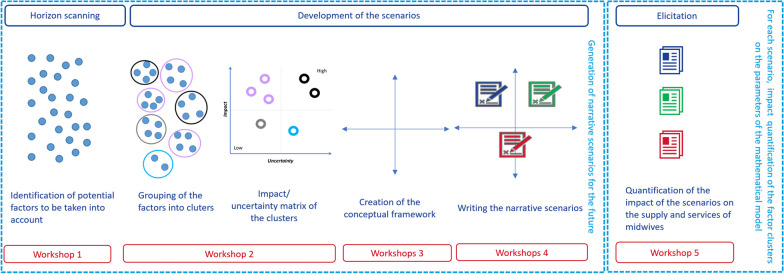
Methods: The Robust Workforce Planning Framework, developed by the Centre for Workforce Intelligence in the UK was used to develop alternative midwifery workforce scenarios. The framework consists of four steps (Horizon scanning, Scenario generation, Workforce modelling, and Policy analysis), the first two of which were undertaken by KCE, using two online surveys and five workshops with stakeholders.
Results: Three alternative scenarios are proposed. The first scenario (close to the current situation) envisages pregnancy and maternity care centred on gynaecologists working either in a hospital or in private practice. The second scenario describes an organisation of midwife-led care in hospitals. In the third scenario, care is primarily organised by primary care practitioners (midwives and general practitioners) in outpatient settings.
Conclusions: The Robust Workforce Planning Framework provides an opportunity to adjust the modelling of the health workforce and inform decision-makers about the impact of their future decisions on the health workforce.
期刊介绍:
Human Resources for Health is an open access, peer-reviewed, online journal covering all aspects of planning, producing and managing the health workforce - all those who provide health services worldwide. Human Resources for Health aims to disseminate research on health workforce policy, the health labour market, health workforce practice, development of knowledge tools and implementation mechanisms nationally and internationally; as well as specific features of the health workforce, such as the impact of management of health workers" performance and its link with health outcomes. The journal encourages debate on health sector reforms and their link with human resources issues, a hitherto-neglected area.



 京公网安备 11010802042870号
京ICP备2023020795号-1
京公网安备 11010802042870号
京ICP备2023020795号-1

 分享
分享
 求助内容:
求助内容: 应助结果提醒方式:
 扫码关注我们
