Accurate quantification of lattice temperature dynamics from ultrafast electron diffraction of single-crystal films using dynamical scattering simulations.
Daniel B Durham, Colin Ophus, Khalid M Siddiqui, Andrew M Minor, Daniele Filippetto
{"title":"Accurate quantification of lattice temperature dynamics from ultrafast electron diffraction of single-crystal films using dynamical scattering simulations.","authors":"Daniel B Durham, Colin Ophus, Khalid M Siddiqui, Andrew M Minor, Daniele Filippetto","doi":"10.1063/4.0000170","DOIUrl":null,"url":null,"abstract":"<p><p>In ultrafast electron diffraction (UED) experiments, accurate retrieval of time-resolved structural parameters, such as atomic coordinates and thermal displacement parameters, requires an accurate scattering model. Unfortunately, kinematical models are often inaccurate even for relativistic electron probes, especially for dense, oriented single crystals where strong channeling and multiple scattering effects are present. This article introduces and demonstrates dynamical scattering models tailored for quantitative analysis of UED experiments performed on single-crystal films. As a case study, we examine ultrafast laser heating of single-crystal gold films. Comparison of kinematical and dynamical models reveals the strong effects of dynamical scattering within nm-scale films and their dependence on sample topography and probe kinetic energy. Applying to UED experiments on an 11 nm thick film using 750 keV electron probe pulses, the dynamical models provide a tenfold improvement over a comparable kinematical model in matching the measured UED patterns. Also, the retrieved lattice temperature rise is in very good agreement with predictions based on previously measured optical constants of gold, whereas fitting the Debye-Waller factor retrieves values that are more than three times lower. Altogether, these results show the importance of a dynamical scattering theory for quantitative analysis of UED and demonstrate models that can be practically applied to single-crystal materials and heterostructures.</p>","PeriodicalId":74877,"journal":{"name":"","volume":"9 6","pages":"064302"},"PeriodicalIF":0.0,"publicationDate":"2022-12-05","publicationTypes":"Journal Article","fieldsOfStudy":null,"isOpenAccess":false,"openAccessPdf":"https://www.ncbi.nlm.nih.gov/pmc/articles/PMC9726223/pdf/","citationCount":"0","resultStr":null,"platform":"Semanticscholar","paperid":null,"PeriodicalName":"","FirstCategoryId":"101","ListUrlMain":"https://doi.org/10.1063/4.0000170","RegionNum":0,"RegionCategory":null,"ArticlePicture":[],"TitleCN":null,"AbstractTextCN":null,"PMCID":null,"EPubDate":"2022/11/1 0:00:00","PubModel":"eCollection","JCR":"","JCRName":"","Score":null,"Total":0}
引用次数: 0
Abstract
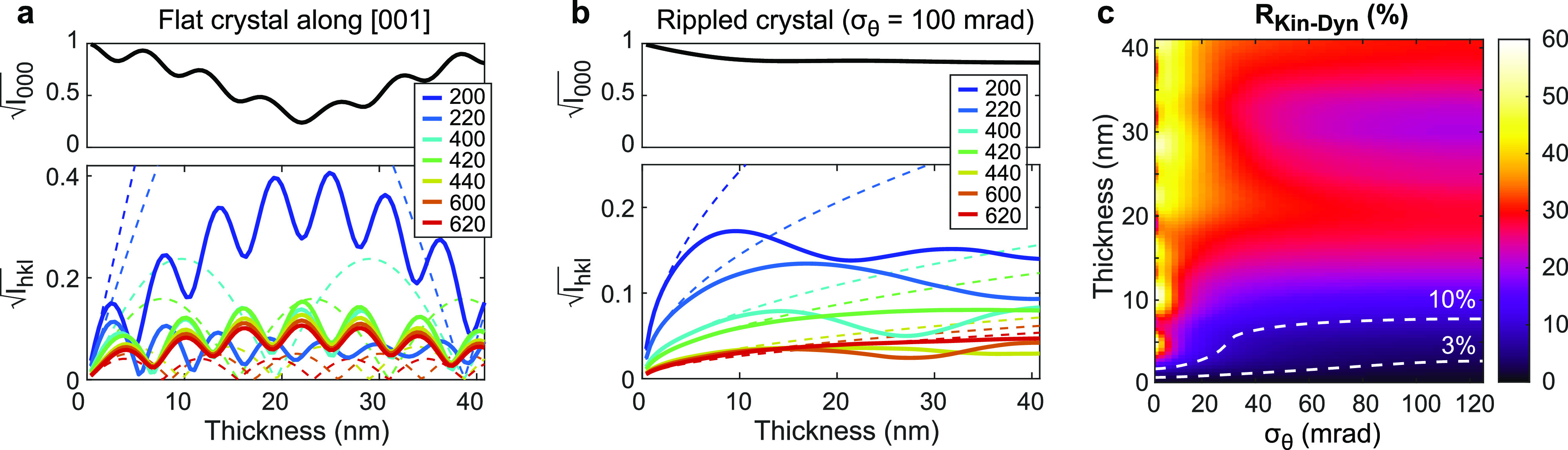
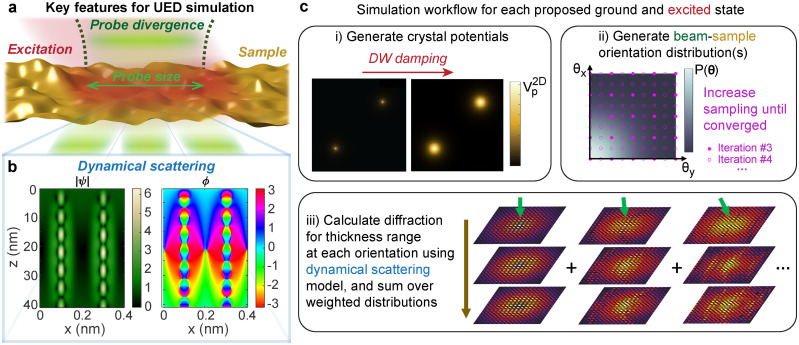
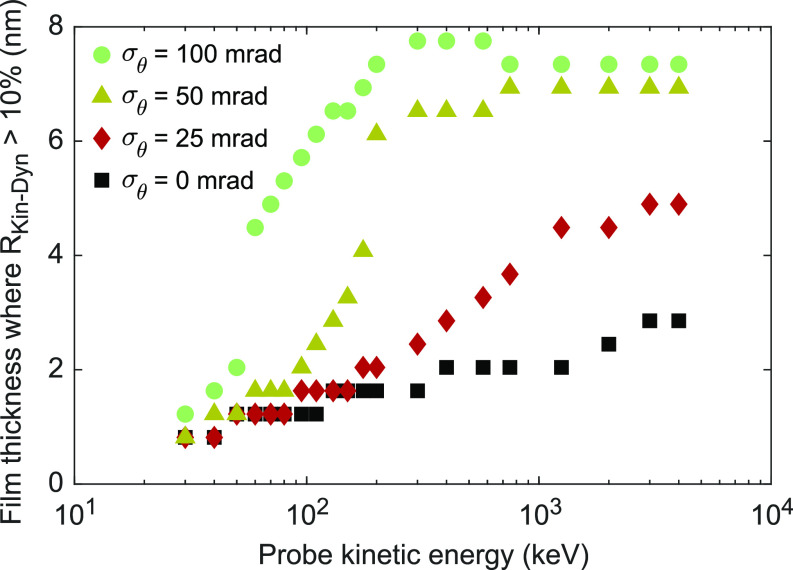
In ultrafast electron diffraction (UED) experiments, accurate retrieval of time-resolved structural parameters, such as atomic coordinates and thermal displacement parameters, requires an accurate scattering model. Unfortunately, kinematical models are often inaccurate even for relativistic electron probes, especially for dense, oriented single crystals where strong channeling and multiple scattering effects are present. This article introduces and demonstrates dynamical scattering models tailored for quantitative analysis of UED experiments performed on single-crystal films. As a case study, we examine ultrafast laser heating of single-crystal gold films. Comparison of kinematical and dynamical models reveals the strong effects of dynamical scattering within nm-scale films and their dependence on sample topography and probe kinetic energy. Applying to UED experiments on an 11 nm thick film using 750 keV electron probe pulses, the dynamical models provide a tenfold improvement over a comparable kinematical model in matching the measured UED patterns. Also, the retrieved lattice temperature rise is in very good agreement with predictions based on previously measured optical constants of gold, whereas fitting the Debye-Waller factor retrieves values that are more than three times lower. Altogether, these results show the importance of a dynamical scattering theory for quantitative analysis of UED and demonstrate models that can be practically applied to single-crystal materials and heterostructures.



 京公网安备 11010802042870号
京ICP备2023020795号-1
京公网安备 11010802042870号
京ICP备2023020795号-1

 分享
分享
 求助内容:
求助内容: 应助结果提醒方式:
 扫码关注我们
