Bioremediation of Cu and Zn by guinea fowl feather wastes and biodegradation of Cu- and Zn-polluted feathers by free and immobilized heavy-metal-tolerant bacterium Pseudochrobactrum sp. IY-BUK1.
{"title":"Bioremediation of Cu and Zn by guinea fowl feather wastes and biodegradation of Cu- and Zn-polluted feathers by free and immobilized heavy-metal-tolerant bacterium <i>Pseudochrobactrum</i> sp. IY-BUK1.","authors":"Ibrahim Yusuf, Amina M Sharu","doi":"10.5114/bta.2022.118665","DOIUrl":null,"url":null,"abstract":"<p><p>One of the major pollutants generated from guinea fowl farms and slaughterhouses is guinea fowl feather (GFF) wastes. Chicken feathers are an important substrate for removing aqueous pollutants due to their structural characteristics, but the application of GFFs for such purposes has not been elucidated. This study was carried out to determine the potential of raw as well as chemically and physically pretreated GFFs in the bioremediation of copper (Cu) and zinc (Zn) from aqueous solutions and the subsequent biodegradation of Cu- and Zn-laden GFFs using free and immobilized heavy-metal-tolerant bacteria. Using atomic adsorption spectrometry, the ability of treated and untreated GFFs to adsorb Cu and Zn was determined, and the generated heavy-metal-laden GFFs were degraded using <i>Pseudochrobactrum</i> sp. IY-BUK1. The results revealed that under optimized conditions, acetone and autoclave pretreatment enhanced Cu and Zn removal by 40% within 6 h when compared with raw GFFs. Similarly, complete biodegradation of Cu- and Zn-laden GFFs was achieved at pH 8, with 2% inoculum size, and at 25°C using IY-BUK1 in 7 days. Upon optimization of physical and nutritional conditions, using one factor at a time and response surface methodology, the maximum keratinase activity was achieved at 30°C, with 3% inoculum size and 3.5% polluted GFF concentration in 3 h. The degradation and keratinase activity were further enhanced by 50% by the immobilization of <i>Pseudochrobactrum</i> sp. IY-BUK1 cells compared with free cells. Thus, GFFs can act as good biosorbents, and together with IY-BUK1, the use of GFFs can be an alternative approach to dispose of GFFs, thus preventing environmental pollution via bioremediation.</p>","PeriodicalId":8999,"journal":{"name":"BioTechnologia","volume":"103 3","pages":"221-234"},"PeriodicalIF":0.0000,"publicationDate":"2022-01-01","publicationTypes":"Journal Article","fieldsOfStudy":null,"isOpenAccess":false,"openAccessPdf":"https://ftp.ncbi.nlm.nih.gov/pub/pmc/oa_pdf/ab/70/BTA-103-3-47607.PMC9642955.pdf","citationCount":"0","resultStr":null,"platform":"Semanticscholar","paperid":null,"PeriodicalName":"BioTechnologia","FirstCategoryId":"1085","ListUrlMain":"https://doi.org/10.5114/bta.2022.118665","RegionNum":0,"RegionCategory":null,"ArticlePicture":[],"TitleCN":null,"AbstractTextCN":null,"PMCID":null,"EPubDate":"","PubModel":"","JCR":"Q3","JCRName":"Agricultural and Biological Sciences","Score":null,"Total":0}
引用次数: 0
Abstract
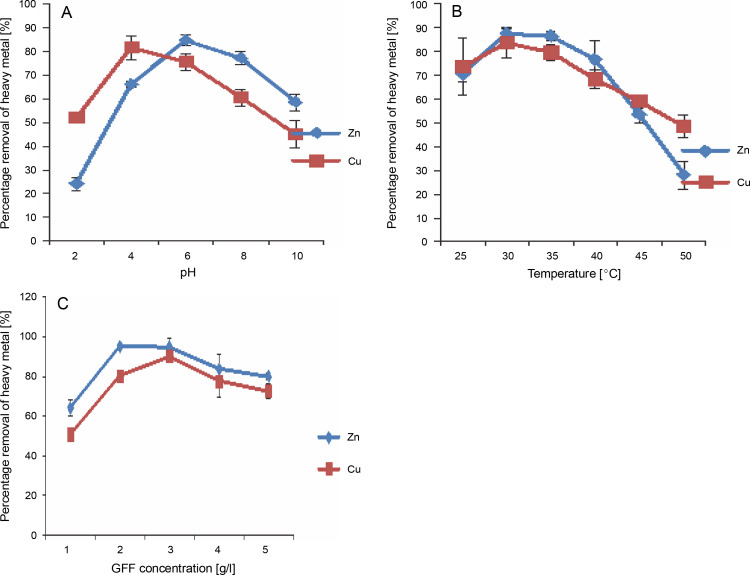
One of the major pollutants generated from guinea fowl farms and slaughterhouses is guinea fowl feather (GFF) wastes. Chicken feathers are an important substrate for removing aqueous pollutants due to their structural characteristics, but the application of GFFs for such purposes has not been elucidated. This study was carried out to determine the potential of raw as well as chemically and physically pretreated GFFs in the bioremediation of copper (Cu) and zinc (Zn) from aqueous solutions and the subsequent biodegradation of Cu- and Zn-laden GFFs using free and immobilized heavy-metal-tolerant bacteria. Using atomic adsorption spectrometry, the ability of treated and untreated GFFs to adsorb Cu and Zn was determined, and the generated heavy-metal-laden GFFs were degraded using Pseudochrobactrum sp. IY-BUK1. The results revealed that under optimized conditions, acetone and autoclave pretreatment enhanced Cu and Zn removal by 40% within 6 h when compared with raw GFFs. Similarly, complete biodegradation of Cu- and Zn-laden GFFs was achieved at pH 8, with 2% inoculum size, and at 25°C using IY-BUK1 in 7 days. Upon optimization of physical and nutritional conditions, using one factor at a time and response surface methodology, the maximum keratinase activity was achieved at 30°C, with 3% inoculum size and 3.5% polluted GFF concentration in 3 h. The degradation and keratinase activity were further enhanced by 50% by the immobilization of Pseudochrobactrum sp. IY-BUK1 cells compared with free cells. Thus, GFFs can act as good biosorbents, and together with IY-BUK1, the use of GFFs can be an alternative approach to dispose of GFFs, thus preventing environmental pollution via bioremediation.
BioTechnologiaAgricultural and Biological Sciences-Plant Science
CiteScore
1.60
自引率
0.00%
发文量
8
审稿时长
8 weeks
期刊介绍:
BIOTECHNOLOGIA – a high standard, peer-reviewed, quarterly magazine, providing a medium for the rapid publication of research reports and review articles on novel and innovative aspects of biotechnology, computational biology and bionanotechnology.






 京公网安备 11010802042870号
京ICP备2023020795号-1
京公网安备 11010802042870号
京ICP备2023020795号-1

 分享
分享
 求助内容:
求助内容: 应助结果提醒方式:
 扫码关注我们
