{"title":"<i>Inula viscosa</i> phenolic extract suppresses colon cancer cell proliferation and ulcerative colitis by modulating oxidative stress biomarkers.","authors":"Naoual Kheyar, Yuva Bellik, Ana Teresa Serra, Farida Kheyar, Fatiha Bedjou","doi":"10.5114/bta.2022.118670","DOIUrl":null,"url":null,"abstract":"<p><p><i>Inula viscosa</i> is a perennial herbaceous plant native to the Mediterranean Basin, which is used topically for the treatment of various diseases in folk medicine. This study aimed to evaluate the <i>in vivo</i> intestinal anti-inflammatory activity of the ethanolic extract of <i>I. viscosa</i> (EEIV) and to test its effect on a colorectal cancer cell line. EEIV was administered to rats orally and daily at 100 and 200 mg/kg body weight for 7 days, and then colitis was induced by intrarectal instillation of 2 ml of 4% (v/v) acetic acid (AA) solution. At the end of the experiment, clinical examinations of the rats were conducted by evaluating macroscopic and histological signs of colonic tissues and measuring erythrocyte sedimentation rate (ESR) and the levels of C-reactive protein, fibrinogen, myeloperoxidase (MPO), malondialdehyde (MDA) and nitric oxide (NO). Using MTS assay, the antiproliferative effect of EEIV against human colon carcinoma HT29 cells and cytotoxicity on nondifferentiated Caco-2 cell line was evaluated. EEIV significantly decreased the ESR and fibrinogen levels as compared to control colitic rats (<i>P</i> < 0.001). It also significantly decreased the NO, MDA, and MPO levels in the colon tissue compared with the untreated colitic group (<i>P</i> < 0.001). These results were confirmed by macroscopic and histological examination, which showed significant protection against AA-induced ulcerative colitis. Furthermore, EEIV at a concentration of 369.88 μg/ml did not show cytotoxicity on confluent Caco-2 cells, with significant inhibition of colorectal cancer cell (HT29) growth (EC<sub>50</sub> = 62.39 μg/ml). These results demonstrate that EEIV plays a potential role as a pharmacological tool in the management of inflammatory bowel disease and prevention of colorectal cancer.</p>","PeriodicalId":8999,"journal":{"name":"BioTechnologia","volume":"103 3","pages":"269-281"},"PeriodicalIF":0.0000,"publicationDate":"2022-01-01","publicationTypes":"Journal Article","fieldsOfStudy":null,"isOpenAccess":false,"openAccessPdf":"https://ftp.ncbi.nlm.nih.gov/pub/pmc/oa_pdf/29/aa/BTA-103-3-47612.PMC9642959.pdf","citationCount":"3","resultStr":null,"platform":"Semanticscholar","paperid":null,"PeriodicalName":"BioTechnologia","FirstCategoryId":"1085","ListUrlMain":"https://doi.org/10.5114/bta.2022.118670","RegionNum":0,"RegionCategory":null,"ArticlePicture":[],"TitleCN":null,"AbstractTextCN":null,"PMCID":null,"EPubDate":"","PubModel":"","JCR":"Q3","JCRName":"Agricultural and Biological Sciences","Score":null,"Total":0}
引用次数: 3
Abstract
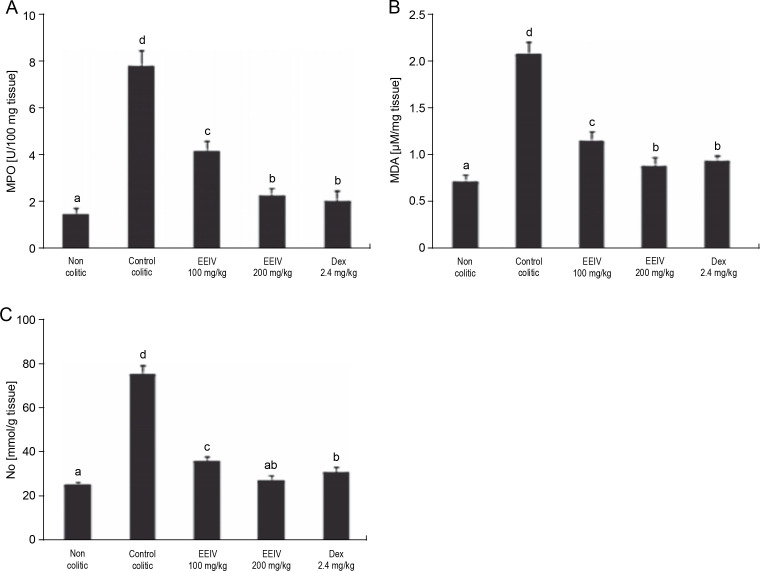
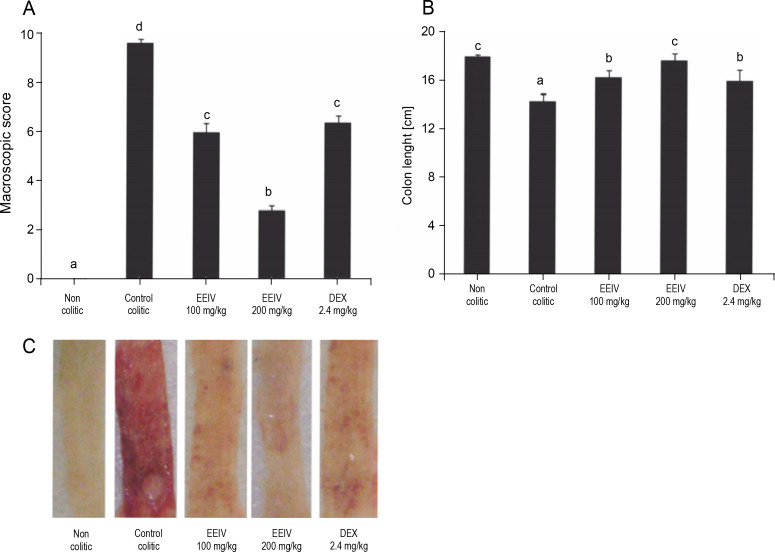
Inula viscosa is a perennial herbaceous plant native to the Mediterranean Basin, which is used topically for the treatment of various diseases in folk medicine. This study aimed to evaluate the in vivo intestinal anti-inflammatory activity of the ethanolic extract of I. viscosa (EEIV) and to test its effect on a colorectal cancer cell line. EEIV was administered to rats orally and daily at 100 and 200 mg/kg body weight for 7 days, and then colitis was induced by intrarectal instillation of 2 ml of 4% (v/v) acetic acid (AA) solution. At the end of the experiment, clinical examinations of the rats were conducted by evaluating macroscopic and histological signs of colonic tissues and measuring erythrocyte sedimentation rate (ESR) and the levels of C-reactive protein, fibrinogen, myeloperoxidase (MPO), malondialdehyde (MDA) and nitric oxide (NO). Using MTS assay, the antiproliferative effect of EEIV against human colon carcinoma HT29 cells and cytotoxicity on nondifferentiated Caco-2 cell line was evaluated. EEIV significantly decreased the ESR and fibrinogen levels as compared to control colitic rats (P < 0.001). It also significantly decreased the NO, MDA, and MPO levels in the colon tissue compared with the untreated colitic group (P < 0.001). These results were confirmed by macroscopic and histological examination, which showed significant protection against AA-induced ulcerative colitis. Furthermore, EEIV at a concentration of 369.88 μg/ml did not show cytotoxicity on confluent Caco-2 cells, with significant inhibition of colorectal cancer cell (HT29) growth (EC50 = 62.39 μg/ml). These results demonstrate that EEIV plays a potential role as a pharmacological tool in the management of inflammatory bowel disease and prevention of colorectal cancer.
BioTechnologiaAgricultural and Biological Sciences-Plant Science
CiteScore
1.60
自引率
0.00%
发文量
8
审稿时长
8 weeks
期刊介绍:
BIOTECHNOLOGIA – a high standard, peer-reviewed, quarterly magazine, providing a medium for the rapid publication of research reports and review articles on novel and innovative aspects of biotechnology, computational biology and bionanotechnology.





 京公网安备 11010802042870号
京ICP备2023020795号-1
京公网安备 11010802042870号
京ICP备2023020795号-1

 分享
分享
 求助内容:
求助内容: 应助结果提醒方式:
 扫码关注我们
