{"title":"Serum Hepatocyte Growth Factor Is Probably Associated With 3-Month Prognosis of Acute Ischemic Stroke.","authors":"Zhengbao Zhu, Tan Xu, Daoxia Guo, Xinfeng Huangfu, Chongke Zhong, Jingyuan Yang, Aili Wang, Chung-Shiuan Chen, Yanbo Peng, Tian Xu, Jinchao Wang, Yingxian Sun, Hao Peng, Qunwei Li, Zhong Ju, Deqin Geng, Jing Chen, Yonghong Zhang, Jiang He","doi":"10.1161/STROKEAHA.117.019476","DOIUrl":null,"url":null,"abstract":"<p><strong>Background and purpose: </strong>Serum hepatocyte growth factor (HGF) is positively associated with poor prognosis of heart failure and myocardial infarction, and it can also predict the risk of ischemic stroke in population. The goal of this study was to investigate the association between serum HGF and prognosis of ischemic stroke.</p><p><strong>Methods: </strong>A total of 3027 acute ischemic stroke patients were included in this post hoc analysis of the CATIS (China Antihypertensive Trial in Acute Ischemic Stroke). The primary outcome was composite outcome of death or major disability (modified Rankin Scale score ≥3) within 3 months.</p><p><strong>Results: </strong>After multivariate adjustment, elevated HGF levels were associated with an increased risk of primary outcome (odds ratio, 1.50; 95% confidence interval, 1.10-2.03; <i>P</i><sub>trend</sub>=0.015) when 2 extreme quartiles were compared. Each SD increase of log-transformed HGF was associated with 14% (95% confidence interval, 2%-27%) increased risk of primary outcome. Adding HGF quartiles to a model containing conventional risk factors improved the predictive power for primary outcome (net reclassification improvement: 17.50%, <i>P</i><0.001; integrated discrimination index: 0.23%, <i>P</i>=0.022). The association between serum HGF and primary outcome could be modified by heparin pre-treatment (<i>P</i><sub>interaction</sub>=0.001), and a positive linear dose-response relationship between HGF and primary outcome was observed in patients without heparin pre-treatment (<i>P</i><sub>linearity</sub><0.001) but not in those with heparin pre-treatment.</p><p><strong>Conclusions: </strong>Serum HGF levels were higher in the more severe stroke at baseline, and elevated HGF levels were probably associated with 3-month poor prognosis independently of stroke severity among ischemic stroke patients, especially in those without heparin pre-treatment. Further studies from other samples of ischemic stroke patients are needed to validate our findings.</p>","PeriodicalId":21989,"journal":{"name":"Stroke","volume":"49 2","pages":"377-383"},"PeriodicalIF":8.9000,"publicationDate":"2018-02-01","publicationTypes":"Journal Article","fieldsOfStudy":null,"isOpenAccess":false,"openAccessPdf":"https://sci-hub-pdf.com/10.1161/STROKEAHA.117.019476","citationCount":"21","resultStr":null,"platform":"Semanticscholar","paperid":null,"PeriodicalName":"Stroke","FirstCategoryId":"3","ListUrlMain":"https://doi.org/10.1161/STROKEAHA.117.019476","RegionNum":1,"RegionCategory":"医学","ArticlePicture":[],"TitleCN":null,"AbstractTextCN":null,"PMCID":null,"EPubDate":"","PubModel":"","JCR":"Q1","JCRName":"CLINICAL NEUROLOGY","Score":null,"Total":0}
引用次数: 21
Abstract
Background and purpose: Serum hepatocyte growth factor (HGF) is positively associated with poor prognosis of heart failure and myocardial infarction, and it can also predict the risk of ischemic stroke in population. The goal of this study was to investigate the association between serum HGF and prognosis of ischemic stroke.
Methods: A total of 3027 acute ischemic stroke patients were included in this post hoc analysis of the CATIS (China Antihypertensive Trial in Acute Ischemic Stroke). The primary outcome was composite outcome of death or major disability (modified Rankin Scale score ≥3) within 3 months.
Results: After multivariate adjustment, elevated HGF levels were associated with an increased risk of primary outcome (odds ratio, 1.50; 95% confidence interval, 1.10-2.03; Ptrend=0.015) when 2 extreme quartiles were compared. Each SD increase of log-transformed HGF was associated with 14% (95% confidence interval, 2%-27%) increased risk of primary outcome. Adding HGF quartiles to a model containing conventional risk factors improved the predictive power for primary outcome (net reclassification improvement: 17.50%, P<0.001; integrated discrimination index: 0.23%, P=0.022). The association between serum HGF and primary outcome could be modified by heparin pre-treatment (Pinteraction=0.001), and a positive linear dose-response relationship between HGF and primary outcome was observed in patients without heparin pre-treatment (Plinearity<0.001) but not in those with heparin pre-treatment.
Conclusions: Serum HGF levels were higher in the more severe stroke at baseline, and elevated HGF levels were probably associated with 3-month poor prognosis independently of stroke severity among ischemic stroke patients, especially in those without heparin pre-treatment. Further studies from other samples of ischemic stroke patients are needed to validate our findings.
期刊介绍:
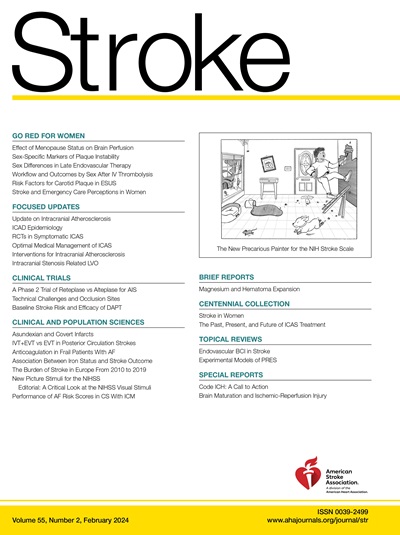
Stroke is a monthly publication that collates reports of clinical and basic investigation of any aspect of the cerebral circulation and its diseases. The publication covers a wide range of disciplines including anesthesiology, critical care medicine, epidemiology, internal medicine, neurology, neuro-ophthalmology, neuropathology, neuropsychology, neurosurgery, nuclear medicine, nursing, radiology, rehabilitation, speech pathology, vascular physiology, and vascular surgery.
The audience of Stroke includes neurologists, basic scientists, cardiologists, vascular surgeons, internists, interventionalists, neurosurgeons, nurses, and physiatrists.
Stroke is indexed in Biological Abstracts, BIOSIS, CAB Abstracts, Chemical Abstracts, CINAHL, Current Contents, Embase, MEDLINE, and Science Citation Index Expanded.





 京公网安备 11010802042870号
京ICP备2023020795号-1
京公网安备 11010802042870号
京ICP备2023020795号-1

 分享
分享
 求助内容:
求助内容: 应助结果提醒方式:
 扫码关注我们
