Charline Fagnen, Johanna Giovannini, Marco Catto, Anne Sophie Voisin-Chiret* and Jana Sopkova-de Oliveira Santos*,
{"title":"On the Tracks of the Aggregation Mechanism of the PHF6 Peptide from Tau Protein: Molecular Dynamics, Energy, and Interaction Network Investigations","authors":"Charline Fagnen, Johanna Giovannini, Marco Catto, Anne Sophie Voisin-Chiret* and Jana Sopkova-de Oliveira Santos*, ","doi":"10.1021/acschemneuro.2c00314","DOIUrl":null,"url":null,"abstract":"<p >The formation of neurofibrillary tangles (NFTs), composed of tau protein aggregates, is a hallmark of some neurodegenerative diseases called tauopathies. NFTs are composed of paired helical filaments (PHFs) of tau protein with a dominant β-sheet secondary structuration. The NFT formation mechanism is not known yet. This study focuses on PHF6, a crucial hexapeptide responsible for tau aggregation. A 2 μs molecular dynamics simulation was launched to determine the keys of the PHF6 aggregation mechanism. Hydrogen bonding, van der Waals, and other non-covalent interactions as π-stacking were investigated. Parallel aggregation was slightly preferred due to its adaptability, but antiparallel aggregation remained widely present during the PHF6 aggregation. The analysis highlighted the leading role of hydrogen bonds identified at the atomic level for each aggregation process. The aggregation study emphasized the importance of Tyr310 during the β-sheets’ complexation through π-stacking.</p>","PeriodicalId":13,"journal":{"name":"ACS Chemical Neuroscience","volume":"13 19","pages":"2874–2887"},"PeriodicalIF":3.9000,"publicationDate":"2022-09-26","publicationTypes":"Journal Article","fieldsOfStudy":null,"isOpenAccess":false,"openAccessPdf":"","citationCount":"3","resultStr":null,"platform":"Semanticscholar","paperid":null,"PeriodicalName":"ACS Chemical Neuroscience","FirstCategoryId":"3","ListUrlMain":"https://pubs.acs.org/doi/10.1021/acschemneuro.2c00314","RegionNum":3,"RegionCategory":"医学","ArticlePicture":[],"TitleCN":null,"AbstractTextCN":null,"PMCID":null,"EPubDate":"","PubModel":"","JCR":"Q2","JCRName":"BIOCHEMISTRY & MOLECULAR BIOLOGY","Score":null,"Total":0}
引用次数: 3
Abstract
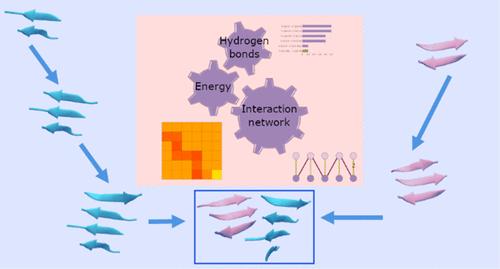
The formation of neurofibrillary tangles (NFTs), composed of tau protein aggregates, is a hallmark of some neurodegenerative diseases called tauopathies. NFTs are composed of paired helical filaments (PHFs) of tau protein with a dominant β-sheet secondary structuration. The NFT formation mechanism is not known yet. This study focuses on PHF6, a crucial hexapeptide responsible for tau aggregation. A 2 μs molecular dynamics simulation was launched to determine the keys of the PHF6 aggregation mechanism. Hydrogen bonding, van der Waals, and other non-covalent interactions as π-stacking were investigated. Parallel aggregation was slightly preferred due to its adaptability, but antiparallel aggregation remained widely present during the PHF6 aggregation. The analysis highlighted the leading role of hydrogen bonds identified at the atomic level for each aggregation process. The aggregation study emphasized the importance of Tyr310 during the β-sheets’ complexation through π-stacking.
期刊介绍:
ACS Chemical Neuroscience publishes high-quality research articles and reviews that showcase chemical, quantitative biological, biophysical and bioengineering approaches to the understanding of the nervous system and to the development of new treatments for neurological disorders. Research in the journal focuses on aspects of chemical neurobiology and bio-neurochemistry such as the following:
Neurotransmitters and receptors
Neuropharmaceuticals and therapeutics
Neural development—Plasticity, and degeneration
Chemical, physical, and computational methods in neuroscience
Neuronal diseases—basis, detection, and treatment
Mechanism of aging, learning, memory and behavior
Pain and sensory processing
Neurotoxins
Neuroscience-inspired bioengineering
Development of methods in chemical neurobiology
Neuroimaging agents and technologies
Animal models for central nervous system diseases
Behavioral research



 京公网安备 11010802042870号
京ICP备2023020795号-1
京公网安备 11010802042870号
京ICP备2023020795号-1

 分享
分享
 求助内容:
求助内容: 应助结果提醒方式:
 扫码关注我们
