{"title":"Failed shrimp vaccination attempt with yellow head virus (YHV) attenuated in an immortal insect cell line","authors":"Warachin Gangnonngiw , Nipaporn Kanthong","doi":"10.1016/j.fsirep.2023.100084","DOIUrl":null,"url":null,"abstract":"<div><p>This short paper on yellow head virus Type-1 (YHV-1) of shrimp describes preliminary research on the potential for using YHV-1 attenuated in insect cells to protect shrimp against yellow head disease (YHD). YHV-1 can cause severe mortality in the cultivated shrimp <em>Penaeus (Penaeus) monodon</em> and <em>Penaeus (Litopenaeus) vannamei</em>. No practical vaccination has been reported. The C6/36 mosquito cell cultures inoculated with YHV-1 become positive by PCR and by immunocytochemistry (immunopositive) for up to 30 split-cell passages. Shrimp injected with homogenates from low-passage cultures die from typical YHV-1 disease while shrimp injected with homogenates from high passage cultures do not, even though they become PCR positive and immunopositive for YHV-1. This suggested that viral attenuation had occurred during insect-cell passaging, and it opened the possibility of using homogenates from high-passage insect cultures as a vaccine against YHV-1. To test this hypothesis, homogenates from 30th-passage, YHV-positive cultures were injected into shrimp followed by challenge with virulent YHV-1. Controls were injected with homogenate from 30th-passage, naive (normal stock) insect-cell cultures. No shrimp mortality occurred following injection of either homogenate, but shrimp injected with the YHV-1 homogenate became both RT-PCR positive and immunopositive. Upon challenge 10 days later with YHV-1, mortality in shrimp injected with naive insect-cell homogenate was 100% within 7 days post-challenge while 100% mortality in the YHV-1 homogenate group did not occur until day 9 post-challenge. Kaplan-Meier log-rank survival analysis revealed that survival curves for the two groups were significantly different (<em>p</em> < 0.001). The cause of delay in mortality may be worthy of further investigation.</p></div>","PeriodicalId":73029,"journal":{"name":"Fish and shellfish immunology reports","volume":"4 ","pages":"Article 100084"},"PeriodicalIF":2.8000,"publicationDate":"2023-12-01","publicationTypes":"Journal Article","fieldsOfStudy":null,"isOpenAccess":false,"openAccessPdf":"https://ftp.ncbi.nlm.nih.gov/pub/pmc/oa_pdf/b5/3e/main.PMC9852278.pdf","citationCount":"2","resultStr":null,"platform":"Semanticscholar","paperid":null,"PeriodicalName":"Fish and shellfish immunology reports","FirstCategoryId":"1085","ListUrlMain":"https://www.sciencedirect.com/science/article/pii/S266701192300004X","RegionNum":0,"RegionCategory":null,"ArticlePicture":[],"TitleCN":null,"AbstractTextCN":null,"PMCID":null,"EPubDate":"2023/1/7 0:00:00","PubModel":"Epub","JCR":"Q2","JCRName":"FISHERIES","Score":null,"Total":0}
引用次数: 2
Abstract
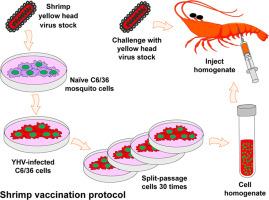
This short paper on yellow head virus Type-1 (YHV-1) of shrimp describes preliminary research on the potential for using YHV-1 attenuated in insect cells to protect shrimp against yellow head disease (YHD). YHV-1 can cause severe mortality in the cultivated shrimp Penaeus (Penaeus) monodon and Penaeus (Litopenaeus) vannamei. No practical vaccination has been reported. The C6/36 mosquito cell cultures inoculated with YHV-1 become positive by PCR and by immunocytochemistry (immunopositive) for up to 30 split-cell passages. Shrimp injected with homogenates from low-passage cultures die from typical YHV-1 disease while shrimp injected with homogenates from high passage cultures do not, even though they become PCR positive and immunopositive for YHV-1. This suggested that viral attenuation had occurred during insect-cell passaging, and it opened the possibility of using homogenates from high-passage insect cultures as a vaccine against YHV-1. To test this hypothesis, homogenates from 30th-passage, YHV-positive cultures were injected into shrimp followed by challenge with virulent YHV-1. Controls were injected with homogenate from 30th-passage, naive (normal stock) insect-cell cultures. No shrimp mortality occurred following injection of either homogenate, but shrimp injected with the YHV-1 homogenate became both RT-PCR positive and immunopositive. Upon challenge 10 days later with YHV-1, mortality in shrimp injected with naive insect-cell homogenate was 100% within 7 days post-challenge while 100% mortality in the YHV-1 homogenate group did not occur until day 9 post-challenge. Kaplan-Meier log-rank survival analysis revealed that survival curves for the two groups were significantly different (p < 0.001). The cause of delay in mortality may be worthy of further investigation.



 京公网安备 11010802042870号
京ICP备2023020795号-1
京公网安备 11010802042870号
京ICP备2023020795号-1

 分享
分享

 求助内容:
求助内容: 应助结果提醒方式:
 扫码关注我们
