Samar Bou Assi, Anthony Macari, Antoine Hanna, Josephine Aybout, Ziad Salameh
{"title":"Comparison between Pre and Posttreatment Inclination of Maxillary Incisors in Adults: Association with Facial and Growth Axes.","authors":"Samar Bou Assi, Anthony Macari, Antoine Hanna, Josephine Aybout, Ziad Salameh","doi":"10.4103/ccd.ccd_158_21","DOIUrl":null,"url":null,"abstract":"<p><strong>Objective: </strong>The objective of the study is to evaluate the orthodontic treatment effect on maxillary incisors' inclination relative to facial and growth axes in adult subjects.</p><p><strong>Materials and methods: </strong>Hundred consecutive nongrowing orthodontic patients with an average age of 26.24 ± 9.29 years were selected, and their T1 (initial) and T2 (final) lateral cephalograms were digitized. Cephalometric maxillary incisors' (I) inclination was measured to SN, PP, NA, NBa, and true horizontal (H). Facial and growth axes' inclinations were measured relative to NBa and H. Associations were tested using Chi-square tests for categorical data. Paired sample <i>t</i>-tests and Pearson's correlation were computed for continuous data.</p><p><strong>Results: </strong>Maxillary incisors' inclination, MP/SN, and ANB angle did not show statistically significant differences between T1 and T2, while mandibular incisors' inclination and interincisal angle increased significantly (<i>P</i> = 0.01 and <i>P</i> = 0.02, respectively). Facial and growth axes increased at T2 but changes were not statistically significant among the two groups. At T1, correlations between maxillary incisors' inclination and facial/growth axes were not statistically significant. Similarly, correlations between MP/SN and ANB angles on the one hand and facial/growth axes on the another hand were not statistically significant. At T2, I/PP correlated significantly with facial axis (FA)/NBa (<i>r</i> = 0.308; <i>P</i> = 0.002) and with FA/H (<i>r</i> = 0.268; <i>P</i> = 0.007). Similarly, I/SN and I/NBa correlated significantly with FA/NBa (<i>r</i> = 0.399; <i>P</i> < 0.0001 and <i>r</i> = 0.422; <i>P</i> < 0.0001 correspondingly) and with FA/H (<i>r</i> = 0.305; <i>P</i> = 0.002 and <i>r</i> = 0.325; <i>P</i> = 0.001 correspondingly). Statistically significant negative correlations existed between MP/SN angle and facial/growth axes at T2 (r values ranging -0.704 to -0.409 at <i>P</i> < 0.0001).</p><p><strong>Conclusions: </strong>While there was no correlation between I and facial/growth axes at pretreatment, significant and higher correlations existed at the end of the orthodontic treatment. This association reflects the connection between the corrected posttreatment position of maxillary incisors relative to the corresponding vertical pattern. Therefore, orthodontists should evaluate the position of the maxillary incisors to FA and may consider it in their treatment objectives.</p>","PeriodicalId":10632,"journal":{"name":"Contemporary Clinical Dentistry","volume":"13 4","pages":"344-348"},"PeriodicalIF":1.1000,"publicationDate":"2022-10-01","publicationTypes":"Journal Article","fieldsOfStudy":null,"isOpenAccess":false,"openAccessPdf":"https://ftp.ncbi.nlm.nih.gov/pub/pmc/oa_pdf/45/4b/CCD-13-344.PMC9855265.pdf","citationCount":"0","resultStr":null,"platform":"Semanticscholar","paperid":null,"PeriodicalName":"Contemporary Clinical Dentistry","FirstCategoryId":"1085","ListUrlMain":"https://doi.org/10.4103/ccd.ccd_158_21","RegionNum":0,"RegionCategory":null,"ArticlePicture":[],"TitleCN":null,"AbstractTextCN":null,"PMCID":null,"EPubDate":"2022/11/3 0:00:00","PubModel":"Epub","JCR":"Q3","JCRName":"DENTISTRY, ORAL SURGERY & MEDICINE","Score":null,"Total":0}
引用次数: 0
Abstract
Objective: The objective of the study is to evaluate the orthodontic treatment effect on maxillary incisors' inclination relative to facial and growth axes in adult subjects.
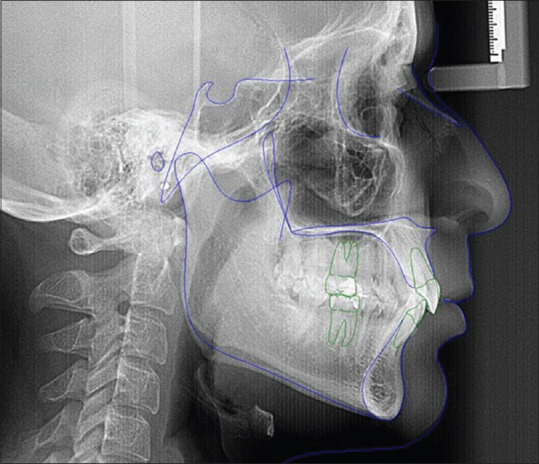
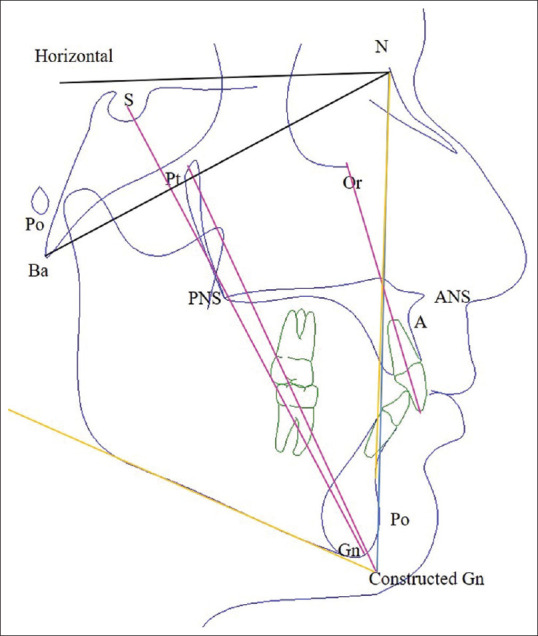
Materials and methods: Hundred consecutive nongrowing orthodontic patients with an average age of 26.24 ± 9.29 years were selected, and their T1 (initial) and T2 (final) lateral cephalograms were digitized. Cephalometric maxillary incisors' (I) inclination was measured to SN, PP, NA, NBa, and true horizontal (H). Facial and growth axes' inclinations were measured relative to NBa and H. Associations were tested using Chi-square tests for categorical data. Paired sample t-tests and Pearson's correlation were computed for continuous data.
Results: Maxillary incisors' inclination, MP/SN, and ANB angle did not show statistically significant differences between T1 and T2, while mandibular incisors' inclination and interincisal angle increased significantly (P = 0.01 and P = 0.02, respectively). Facial and growth axes increased at T2 but changes were not statistically significant among the two groups. At T1, correlations between maxillary incisors' inclination and facial/growth axes were not statistically significant. Similarly, correlations between MP/SN and ANB angles on the one hand and facial/growth axes on the another hand were not statistically significant. At T2, I/PP correlated significantly with facial axis (FA)/NBa (r = 0.308; P = 0.002) and with FA/H (r = 0.268; P = 0.007). Similarly, I/SN and I/NBa correlated significantly with FA/NBa (r = 0.399; P < 0.0001 and r = 0.422; P < 0.0001 correspondingly) and with FA/H (r = 0.305; P = 0.002 and r = 0.325; P = 0.001 correspondingly). Statistically significant negative correlations existed between MP/SN angle and facial/growth axes at T2 (r values ranging -0.704 to -0.409 at P < 0.0001).
Conclusions: While there was no correlation between I and facial/growth axes at pretreatment, significant and higher correlations existed at the end of the orthodontic treatment. This association reflects the connection between the corrected posttreatment position of maxillary incisors relative to the corresponding vertical pattern. Therefore, orthodontists should evaluate the position of the maxillary incisors to FA and may consider it in their treatment objectives.
期刊介绍:
The journal Contemporary Clinical Dentistry (CCD) (Print ISSN: 0976-237X, E-ISSN:0976- 2361) is peer-reviewed journal published on behalf of Maharishi Markandeshwar University and issues are published quarterly in the last week of March, June, September and December. The Journal publishes Original research papers, clinical studies, case series strictly of clinical interest. Manuscripts are invited from all specialties of Dentistry i.e. Conservative dentistry and Endodontics, Dentofacial orthopedics and Orthodontics, Oral medicine and Radiology, Oral pathology, Oral surgery, Orodental diseases, Pediatric Dentistry, Periodontics, Clinical aspects of Public Health dentistry and Prosthodontics. Review articles are not accepted. Review, if published, will only be by invitation from eminent scholars and academicians of National and International repute in the field of Medical/Dental education.




 京公网安备 11010802042870号
京ICP备2023020795号-1
京公网安备 11010802042870号
京ICP备2023020795号-1

 分享
分享
 求助内容:
求助内容: 应助结果提醒方式:
 扫码关注我们
