Wenjiang Deng, Tian Mou, Krishna R Kalari, Nifang Niu, Liewei Wang, Yudi Pawitan, Trung Nghia Vu
{"title":"Alternating EM algorithm for a bilinear model in isoform quantification from RNA-seq data.","authors":"Wenjiang Deng, Tian Mou, Krishna R Kalari, Nifang Niu, Liewei Wang, Yudi Pawitan, Trung Nghia Vu","doi":"10.1093/bioinformatics/btz640","DOIUrl":null,"url":null,"abstract":"<p><strong>Motivation: </strong>Estimation of isoform-level gene expression from RNA-seq data depends on simplifying assumptions, such as uniform read distribution, that are easily violated in real data. Such violations typically lead to biased estimates. Most existing methods provide bias correction step(s), which is based on biological considerations-such as GC content-and applied in single samples separately. The main problem is that not all biases are known.</p><p><strong>Results: </strong>We have developed a novel method called XAEM based on a more flexible and robust statistical model. Existing methods are essentially based on a linear model Xβ, where the design matrix X is known and is computed based on the simplifying assumptions. In contrast XAEM considers Xβ as a bilinear model with both X and β unknown. Joint estimation of X and β is made possible by a simultaneous analysis of multi-sample RNA-seq data. Compared to existing methods, XAEM automatically performs empirical correction of potentially unknown biases. We use an alternating expectation-maximization (AEM) algorithm, alternating between estimation of X and β. For speed XAEM utilizes quasi-mapping for read alignment, thus leading to a fast algorithm. Overall XAEM performs favorably compared to recent advanced methods. For simulated datasets, XAEM obtains higher accuracy for multiple-isoform genes. In a differential-expression analysis of a real single-cell RNA-seq dataset, XAEM achieves substantially better rediscovery rates in independent validation sets.</p><p><strong>Availability and implementation: </strong>The method and pipeline are implemented as a tool and freely available for use at http://fafner.meb.ki.se/biostatwiki/xaem/.</p><p><strong>Supplementary information: </strong>Supplementary data are available at Bioinformatics online.</p>","PeriodicalId":8903,"journal":{"name":"Bioinformatics","volume":"36 3","pages":"805-812"},"PeriodicalIF":5.4000,"publicationDate":"2020-02-01","publicationTypes":"Journal Article","fieldsOfStudy":null,"isOpenAccess":false,"openAccessPdf":"https://sci-hub-pdf.com/10.1093/bioinformatics/btz640","citationCount":"9","resultStr":null,"platform":"Semanticscholar","paperid":null,"PeriodicalName":"Bioinformatics","FirstCategoryId":"99","ListUrlMain":"https://doi.org/10.1093/bioinformatics/btz640","RegionNum":3,"RegionCategory":"生物学","ArticlePicture":[],"TitleCN":null,"AbstractTextCN":null,"PMCID":null,"EPubDate":"","PubModel":"","JCR":"Q1","JCRName":"BIOCHEMICAL RESEARCH METHODS","Score":null,"Total":0}
引用次数: 9
Abstract
Motivation: Estimation of isoform-level gene expression from RNA-seq data depends on simplifying assumptions, such as uniform read distribution, that are easily violated in real data. Such violations typically lead to biased estimates. Most existing methods provide bias correction step(s), which is based on biological considerations-such as GC content-and applied in single samples separately. The main problem is that not all biases are known.
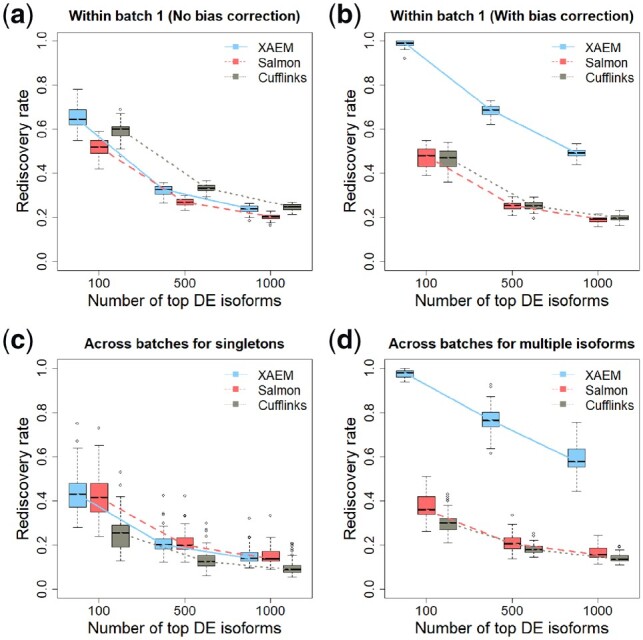
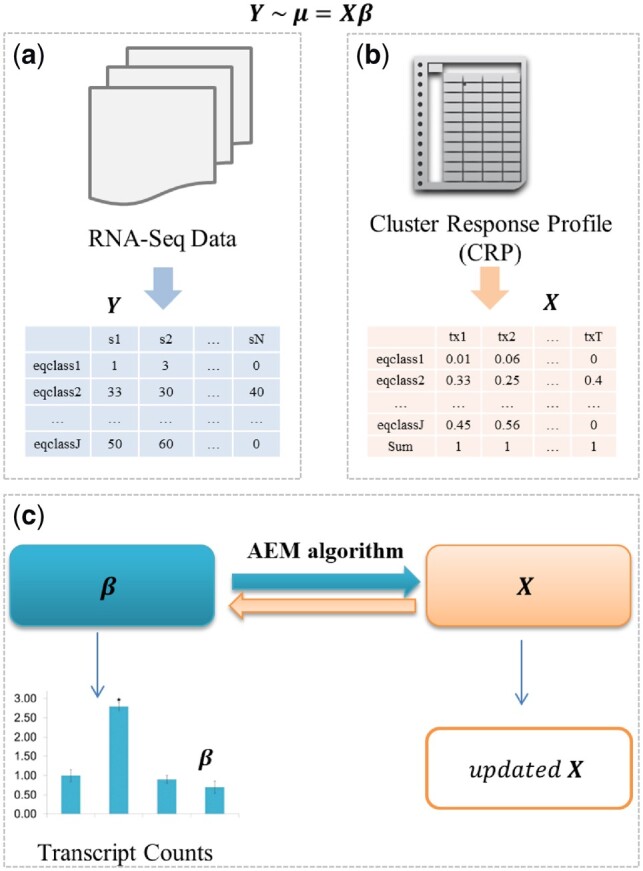
Results: We have developed a novel method called XAEM based on a more flexible and robust statistical model. Existing methods are essentially based on a linear model Xβ, where the design matrix X is known and is computed based on the simplifying assumptions. In contrast XAEM considers Xβ as a bilinear model with both X and β unknown. Joint estimation of X and β is made possible by a simultaneous analysis of multi-sample RNA-seq data. Compared to existing methods, XAEM automatically performs empirical correction of potentially unknown biases. We use an alternating expectation-maximization (AEM) algorithm, alternating between estimation of X and β. For speed XAEM utilizes quasi-mapping for read alignment, thus leading to a fast algorithm. Overall XAEM performs favorably compared to recent advanced methods. For simulated datasets, XAEM obtains higher accuracy for multiple-isoform genes. In a differential-expression analysis of a real single-cell RNA-seq dataset, XAEM achieves substantially better rediscovery rates in independent validation sets.
Availability and implementation: The method and pipeline are implemented as a tool and freely available for use at http://fafner.meb.ki.se/biostatwiki/xaem/.
Supplementary information: Supplementary data are available at Bioinformatics online.
期刊介绍:
The leading journal in its field, Bioinformatics publishes the highest quality scientific papers and review articles of interest to academic and industrial researchers. Its main focus is on new developments in genome bioinformatics and computational biology. Two distinct sections within the journal - Discovery Notes and Application Notes- focus on shorter papers; the former reporting biologically interesting discoveries using computational methods, the latter exploring the applications used for experiments.



 京公网安备 11010802042870号
京ICP备2023020795号-1
京公网安备 11010802042870号
京ICP备2023020795号-1

 分享
分享
 求助内容:
求助内容: 应助结果提醒方式:
 扫码关注我们
