Mariane S Fontes, Fabio A Schutz, Murilo de Almeida Luz, Giovanni Bomfim, Luciana Tarbes Mattana Saturnino, Sarah Carolina Goncalves, Roberto Soler
{"title":"Treatment Patterns Among Patients With Advanced Prostate Cancer in Brazil: An Analysis of a Private Healthcare System Database.","authors":"Mariane S Fontes, Fabio A Schutz, Murilo de Almeida Luz, Giovanni Bomfim, Luciana Tarbes Mattana Saturnino, Sarah Carolina Goncalves, Roberto Soler","doi":"10.14740/wjon1476","DOIUrl":null,"url":null,"abstract":"<p><strong>Background: </strong>With the ongoing expansion of life-prolonging therapies approved to treat advanced prostate cancer, there is currently an unmet need to better understand real-world treatment patterns and identify optimal treatment sequencing for men with metastatic castration-resistant prostate cancer (mCRPC).</p><p><strong>Methods: </strong>In this retrospective, observational cohort analysis, patients with confirmed mCRPC were identified in the Auditron claims database and used to describe mCRPC treatment patterns and trends in the Brazilian private healthcare system from 2014 to 2019. Demographics and clinical characteristics, prostate cancer stage at diagnosis, and type and number of treatment lines were evaluated. The primary endpoint was identification of the drugs used in first-line therapies in mCRPC, and the secondary endpoint included a description of sequential lines of therapy (second and third lines) in mCRPC.</p><p><strong>Results: </strong>A total of 168 electronic patient records were reviewed. Docetaxel was the most frequently used first-line treatment (35.7%), followed by abiraterone (33.3%) and enzalutamide (13.1%). Docetaxel, abiraterone, and enzalutamide also accounted for 34.6%, 28.0%, and 15.0%, respectively, of second-line therapies. In third-line therapies, cabazitaxel (26.1%), enzalutamide (23.9%), docetaxel (15.2%), and abiraterone (15.2%) were most commonly prescribed. Irrespective of stage at diagnosis, treatment patterns were similar once the disease progressed to the metastatic castration-resistance stage.</p><p><strong>Conclusions: </strong>Docetaxel was the most frequently utilized therapy for mCRPC treatment, followed by abiraterone and enzalutamide. Although the current analyses provide real-world insights into treatment patterns for patients with mCRPC in Brazil, additional real-world data are needed to further validate and expand on these findings.</p>","PeriodicalId":46797,"journal":{"name":"World Journal of Oncology","volume":"13 6","pages":"350-358"},"PeriodicalIF":2.2000,"publicationDate":"2022-12-01","publicationTypes":"Journal Article","fieldsOfStudy":null,"isOpenAccess":false,"openAccessPdf":"https://ftp.ncbi.nlm.nih.gov/pub/pmc/oa_pdf/7c/c3/wjon-13-350.PMC9822688.pdf","citationCount":"0","resultStr":null,"platform":"Semanticscholar","paperid":null,"PeriodicalName":"World Journal of Oncology","FirstCategoryId":"1085","ListUrlMain":"https://doi.org/10.14740/wjon1476","RegionNum":0,"RegionCategory":null,"ArticlePicture":[],"TitleCN":null,"AbstractTextCN":null,"PMCID":null,"EPubDate":"","PubModel":"","JCR":"Q3","JCRName":"ONCOLOGY","Score":null,"Total":0}
引用次数: 0
Abstract
Background: With the ongoing expansion of life-prolonging therapies approved to treat advanced prostate cancer, there is currently an unmet need to better understand real-world treatment patterns and identify optimal treatment sequencing for men with metastatic castration-resistant prostate cancer (mCRPC).
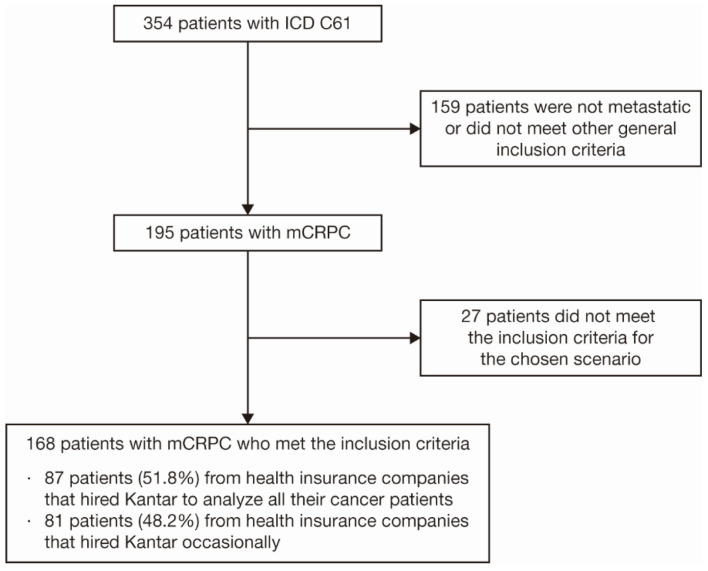
Methods: In this retrospective, observational cohort analysis, patients with confirmed mCRPC were identified in the Auditron claims database and used to describe mCRPC treatment patterns and trends in the Brazilian private healthcare system from 2014 to 2019. Demographics and clinical characteristics, prostate cancer stage at diagnosis, and type and number of treatment lines were evaluated. The primary endpoint was identification of the drugs used in first-line therapies in mCRPC, and the secondary endpoint included a description of sequential lines of therapy (second and third lines) in mCRPC.
Results: A total of 168 electronic patient records were reviewed. Docetaxel was the most frequently used first-line treatment (35.7%), followed by abiraterone (33.3%) and enzalutamide (13.1%). Docetaxel, abiraterone, and enzalutamide also accounted for 34.6%, 28.0%, and 15.0%, respectively, of second-line therapies. In third-line therapies, cabazitaxel (26.1%), enzalutamide (23.9%), docetaxel (15.2%), and abiraterone (15.2%) were most commonly prescribed. Irrespective of stage at diagnosis, treatment patterns were similar once the disease progressed to the metastatic castration-resistance stage.
Conclusions: Docetaxel was the most frequently utilized therapy for mCRPC treatment, followed by abiraterone and enzalutamide. Although the current analyses provide real-world insights into treatment patterns for patients with mCRPC in Brazil, additional real-world data are needed to further validate and expand on these findings.
期刊介绍:
World Journal of Oncology, bimonthly, publishes original contributions describing basic research and clinical investigation of cancer, on the cellular, molecular, prevention, diagnosis, therapy and prognosis aspects. The submissions can be basic research or clinical investigation oriented. This journal welcomes those submissions focused on the clinical trials of new treatment modalities for cancer, and those submissions focused on molecular or cellular research of the oncology pathogenesis. Case reports submitted for consideration of publication should explore either a novel genomic event/description or a new safety signal from an oncolytic agent. The areas of interested manuscripts are these disciplines: tumor immunology and immunotherapy; cancer molecular pharmacology and chemotherapy; drug sensitivity and resistance; cancer epidemiology; clinical trials; cancer pathology; radiobiology and radiation oncology; solid tumor oncology; hematological malignancies; surgical oncology; pediatric oncology; molecular oncology and cancer genes; gene therapy; cancer endocrinology; cancer metastasis; prevention and diagnosis of cancer; other cancer related subjects. The types of manuscripts accepted are original article, review, editorial, short communication, case report, letter to the editor, book review.





 京公网安备 11010802042870号
京ICP备2023020795号-1
京公网安备 11010802042870号
京ICP备2023020795号-1

 分享
分享
 求助内容:
求助内容: 应助结果提醒方式:
 扫码关注我们
