A V Semenova, G F Sivolobova, A A Grazhdantseva, A P Agafonov, G V Kochneva
{"title":"Reporter Transgenes for Monitoring the Antitumor Efficacy of Recombinant Oncolytic Viruses.","authors":"A V Semenova, G F Sivolobova, A A Grazhdantseva, A P Agafonov, G V Kochneva","doi":"10.32607/actanaturae.11719","DOIUrl":null,"url":null,"abstract":"<p><p>Accurate measurement of tumor size and margins is crucial for successful oncotherapy. In the last decade, non-invasive imaging modalities, including optical imaging using non-radioactive substrates, deep-tissue imaging with radioactive substrates, and magnetic resonance imaging have been developed. Reporter genes play the most important role among visualization tools; their expression in tumors and metastases makes it possible to track changes in the tumor growth and gauge therapy effectiveness. Oncolytic viruses are often chosen as a vector for delivering reporter genes into tumor cells, since oncolytic viruses are tumor-specific, meaning that they infect and lyse tumor cells without damaging normal cells. The choice of reporter transgenes for genetic modification of oncolytic viruses depends on the study objectives and imaging methods used. Optical imaging techniques are suitable for in vitro studies and small animal models, while deep-tissue imaging techniques are used to evaluate virotherapy in large animals and humans. For optical imaging, transgenes of fluorescent proteins, luciferases, and tyrosinases are used; for deep-tissue imaging, the most promising transgene is the sodium/iodide symporter (NIS), which ensures an accumulation of radioactive isotopes in virus-infected tumor cells. Currently, NIS is the only reporter transgene that has been shown to be effective in monitoring tumor virotherapy not only in preclinical but also in clinical studies.</p>","PeriodicalId":6989,"journal":{"name":"Acta Naturae","volume":"14 3","pages":"46-56"},"PeriodicalIF":2.0000,"publicationDate":"2022-07-01","publicationTypes":"Journal Article","fieldsOfStudy":null,"isOpenAccess":false,"openAccessPdf":"https://www.ncbi.nlm.nih.gov/pmc/articles/PMC9611865/pdf/","citationCount":"0","resultStr":null,"platform":"Semanticscholar","paperid":null,"PeriodicalName":"Acta Naturae","FirstCategoryId":"99","ListUrlMain":"https://doi.org/10.32607/actanaturae.11719","RegionNum":4,"RegionCategory":"生物学","ArticlePicture":[],"TitleCN":null,"AbstractTextCN":null,"PMCID":null,"EPubDate":"","PubModel":"","JCR":"Q4","JCRName":"CELL BIOLOGY","Score":null,"Total":0}
引用次数: 0
Abstract
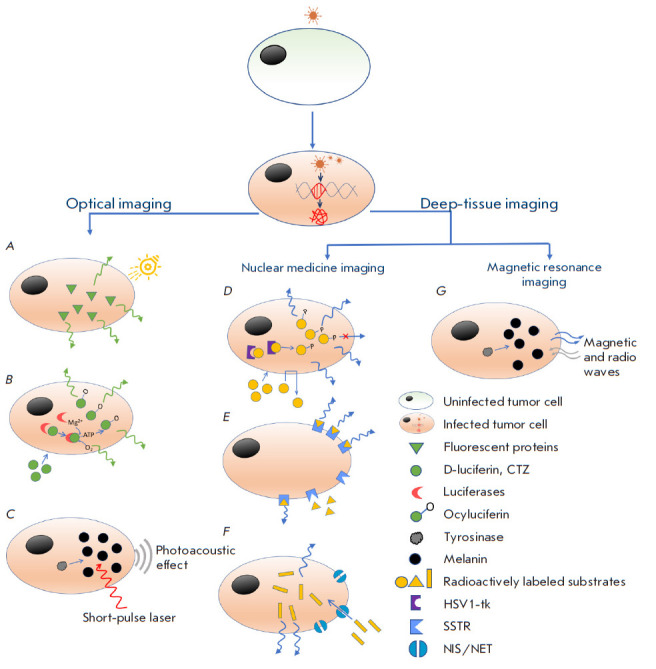
Accurate measurement of tumor size and margins is crucial for successful oncotherapy. In the last decade, non-invasive imaging modalities, including optical imaging using non-radioactive substrates, deep-tissue imaging with radioactive substrates, and magnetic resonance imaging have been developed. Reporter genes play the most important role among visualization tools; their expression in tumors and metastases makes it possible to track changes in the tumor growth and gauge therapy effectiveness. Oncolytic viruses are often chosen as a vector for delivering reporter genes into tumor cells, since oncolytic viruses are tumor-specific, meaning that they infect and lyse tumor cells without damaging normal cells. The choice of reporter transgenes for genetic modification of oncolytic viruses depends on the study objectives and imaging methods used. Optical imaging techniques are suitable for in vitro studies and small animal models, while deep-tissue imaging techniques are used to evaluate virotherapy in large animals and humans. For optical imaging, transgenes of fluorescent proteins, luciferases, and tyrosinases are used; for deep-tissue imaging, the most promising transgene is the sodium/iodide symporter (NIS), which ensures an accumulation of radioactive isotopes in virus-infected tumor cells. Currently, NIS is the only reporter transgene that has been shown to be effective in monitoring tumor virotherapy not only in preclinical but also in clinical studies.
期刊介绍:
Acta Naturae is an international journal on life sciences based in Moscow, Russia.
Our goal is to present scientific work and discovery in molecular biology, biochemistry, biomedical disciplines and biotechnology. These fields represent the most important priorities for the research and engineering development both in Russia and worldwide. Acta Naturae is also a periodical for those who are curious in various aspects of biotechnological business, innovations in pharmaceutical areas, intellectual property protection and social consequences of scientific progress. The journal publishes analytical industrial surveys focused on the development of different spheres of modern life science and technology.
Being a radically new and totally unique journal in Russia, Acta Naturae is useful to both representatives of fundamental research and experts in applied sciences.



 京公网安备 11010802042870号
京ICP备2023020795号-1
京公网安备 11010802042870号
京ICP备2023020795号-1

 分享
分享
 求助内容:
求助内容: 应助结果提醒方式:
 扫码关注我们
