Rachel A. Perez-Udell, Andrew T. Udell, Shu-Mei Chang
{"title":"An automated pipeline for supervised classification of petal color from citizen science photographs","authors":"Rachel A. Perez-Udell, Andrew T. Udell, Shu-Mei Chang","doi":"10.1002/aps3.11505","DOIUrl":null,"url":null,"abstract":"<div>\n \n \n <section>\n \n <h3> Premise</h3>\n \n <p>Petal color is an ecologically important trait, and uncovering color variation over a geographic range, particularly in species with large distributions and/or short bloom times, requires extensive fieldwork. We have developed an alternative method that segments images from citizen science repositories using Python and <i>k</i>-means clustering in the hue-saturation-value (HSV) color space.</p>\n </section>\n \n <section>\n \n <h3> Methods</h3>\n \n <p>Our method uses <i>k</i>-means clustering to aggregate like-color pixels in sample images to generate the HSV color space encapsulating the color range of petals. Using the HSV values, our method isolates photographs containing clusters in that range and bins them into a classification scheme based on user-defined categories.</p>\n </section>\n \n <section>\n \n <h3> Results</h3>\n \n <p>We demonstrate the application of this method using two species: one with a continuous range of variation of pink-purple petals in <i>Geranium maculatum</i>, and one with a binary classification of white versus blue in <i>Linanthus parryae</i>. We demonstrate results that are repeatable and accurate.</p>\n </section>\n \n <section>\n \n <h3> Discussion</h3>\n \n <p>This method provides a flexible, robust, and easily adjustable approach for the classification of color images from citizen science repositories. By using color to classify images, this pipeline sidesteps many of the issues encountered using more traditional computer vision applications. This approach provides a tool for making use of large citizen scientist data sets.</p>\n </section>\n </div>","PeriodicalId":8022,"journal":{"name":"Applications in Plant Sciences","volume":"11 1","pages":""},"PeriodicalIF":2.4000,"publicationDate":"2023-01-16","publicationTypes":"Journal Article","fieldsOfStudy":null,"isOpenAccess":false,"openAccessPdf":"https://ftp.ncbi.nlm.nih.gov/pub/pmc/oa_pdf/5c/78/APS3-11-e11505.PMC9934523.pdf","citationCount":"2","resultStr":null,"platform":"Semanticscholar","paperid":null,"PeriodicalName":"Applications in Plant Sciences","FirstCategoryId":"99","ListUrlMain":"https://onlinelibrary.wiley.com/doi/10.1002/aps3.11505","RegionNum":3,"RegionCategory":"生物学","ArticlePicture":[],"TitleCN":null,"AbstractTextCN":null,"PMCID":null,"EPubDate":"","PubModel":"","JCR":"Q2","JCRName":"PLANT SCIENCES","Score":null,"Total":0}
引用次数: 2
Abstract
Premise
Petal color is an ecologically important trait, and uncovering color variation over a geographic range, particularly in species with large distributions and/or short bloom times, requires extensive fieldwork. We have developed an alternative method that segments images from citizen science repositories using Python and k-means clustering in the hue-saturation-value (HSV) color space.
Methods
Our method uses k-means clustering to aggregate like-color pixels in sample images to generate the HSV color space encapsulating the color range of petals. Using the HSV values, our method isolates photographs containing clusters in that range and bins them into a classification scheme based on user-defined categories.
Results
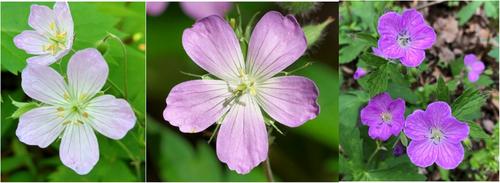
We demonstrate the application of this method using two species: one with a continuous range of variation of pink-purple petals in Geranium maculatum, and one with a binary classification of white versus blue in Linanthus parryae. We demonstrate results that are repeatable and accurate.
Discussion
This method provides a flexible, robust, and easily adjustable approach for the classification of color images from citizen science repositories. By using color to classify images, this pipeline sidesteps many of the issues encountered using more traditional computer vision applications. This approach provides a tool for making use of large citizen scientist data sets.
期刊介绍:
Applications in Plant Sciences (APPS) is a monthly, peer-reviewed, open access journal promoting the rapid dissemination of newly developed, innovative tools and protocols in all areas of the plant sciences, including genetics, structure, function, development, evolution, systematics, and ecology. Given the rapid progress today in technology and its application in the plant sciences, the goal of APPS is to foster communication within the plant science community to advance scientific research. APPS is a publication of the Botanical Society of America, originating in 2009 as the American Journal of Botany''s online-only section, AJB Primer Notes & Protocols in the Plant Sciences.
APPS publishes the following types of articles: (1) Protocol Notes describe new methods and technological advancements; (2) Genomic Resources Articles characterize the development and demonstrate the usefulness of newly developed genomic resources, including transcriptomes; (3) Software Notes detail new software applications; (4) Application Articles illustrate the application of a new protocol, method, or software application within the context of a larger study; (5) Review Articles evaluate available techniques, methods, or protocols; (6) Primer Notes report novel genetic markers with evidence of wide applicability.



 京公网安备 11010802042870号
京ICP备2023020795号-1
京公网安备 11010802042870号
京ICP备2023020795号-1

 分享
分享
 求助内容:
求助内容: 应助结果提醒方式:
 扫码关注我们
