Amal M El Afifi, Alia M Saeed, Gihad H Fekry, Mariam A Mostafa, Reham A Elmetwally, Inas M Hamed, Aliaa N Hussein, Gomaa M Hasanien
{"title":"Successful Management of Severe Hyperhaemolysis with Combined Tocilizumab and Rituximab in Non-Transfusion-Dependent Thalassaemia: A Case Report.","authors":"Amal M El Afifi, Alia M Saeed, Gihad H Fekry, Mariam A Mostafa, Reham A Elmetwally, Inas M Hamed, Aliaa N Hussein, Gomaa M Hasanien","doi":"10.1159/000524743","DOIUrl":null,"url":null,"abstract":"<p><strong>Introduction: </strong>This is the fourth case reporting the administration of tocilizumab to control hyperhaemolysis. It was administered with rituximab to stop hyperhaemolysis refractory to frontline therapy. Hyperhaemolysis is a rare life-threatening subtype of delayed haemolytic transfusion reaction. Refractory cases pose a clinical challenge with no standard of care to date.</p><p><strong>Case presentation: </strong>A 29-year-old lady with non-transfusion-dependent thalassaemia presented with refractory hyperhaemolysis necessitating the administration of rituximab. This was complicated with anaemic heart failure and altered sensorium exacerbated with further transfusions. A nadir haemoglobin of 2.1 g/dL was reached after the initiation of rituximab, and her condition was too critical to wait for the slow expected improvement. Hence, tocilizumab was given as a bridging therapy to block haemolysis till the delayed onset of radical treatment.</p><p><strong>Conclusion: </strong>Tocilizumab can be effectively combined with rituximab to stop hyperhaemolytic episode refractory to first-line treatment when a prompt response is needed.</p>","PeriodicalId":75241,"journal":{"name":"","volume":"50 1","pages":"66-70"},"PeriodicalIF":0.0,"publicationDate":"2023-02-01","publicationTypes":"Journal Article","fieldsOfStudy":null,"isOpenAccess":false,"openAccessPdf":"https://ftp.ncbi.nlm.nih.gov/pub/pmc/oa_pdf/5e/4d/tmh-0050-0066.PMC9911996.pdf","citationCount":"1","resultStr":null,"platform":"Semanticscholar","paperid":null,"PeriodicalName":"","FirstCategoryId":"3","ListUrlMain":"https://doi.org/10.1159/000524743","RegionNum":0,"RegionCategory":null,"ArticlePicture":[],"TitleCN":null,"AbstractTextCN":null,"PMCID":null,"EPubDate":"","PubModel":"","JCR":"","JCRName":"","Score":null,"Total":0}
引用次数: 1
Abstract
Introduction: This is the fourth case reporting the administration of tocilizumab to control hyperhaemolysis. It was administered with rituximab to stop hyperhaemolysis refractory to frontline therapy. Hyperhaemolysis is a rare life-threatening subtype of delayed haemolytic transfusion reaction. Refractory cases pose a clinical challenge with no standard of care to date.
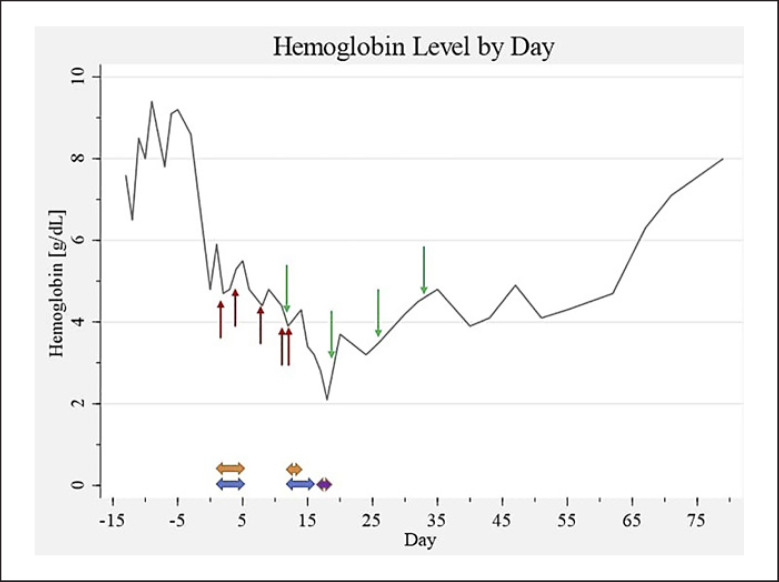
Case presentation: A 29-year-old lady with non-transfusion-dependent thalassaemia presented with refractory hyperhaemolysis necessitating the administration of rituximab. This was complicated with anaemic heart failure and altered sensorium exacerbated with further transfusions. A nadir haemoglobin of 2.1 g/dL was reached after the initiation of rituximab, and her condition was too critical to wait for the slow expected improvement. Hence, tocilizumab was given as a bridging therapy to block haemolysis till the delayed onset of radical treatment.
Conclusion: Tocilizumab can be effectively combined with rituximab to stop hyperhaemolytic episode refractory to first-line treatment when a prompt response is needed.



 京公网安备 11010802042870号
京ICP备2023020795号-1
京公网安备 11010802042870号
京ICP备2023020795号-1

 分享
分享
 求助内容:
求助内容: 应助结果提醒方式:
 扫码关注我们
