{"title":"Spatial Co-Clustering of Tuberculosis and HIV in Ethiopia.","authors":"Leta Lencha Gemechu, Legesse Kassa Debusho","doi":"10.3390/diseases10040106","DOIUrl":null,"url":null,"abstract":"<p><p>Background: Tuberculosis (TB) and HIV are epidemiologically associated, and their co-dynamics suggest that the two diseases are directly related at the population level and within the host. However, there is no or little information on the joint spatial patterns of the two diseases in Ethiopia. The main objective of the current study was to assess the spatial co-clustering of TB and HIV cases simultaneously in Ethiopia at the district level. Methods: District-level aggregated data collected from the national Health Management Information System (HMIS) for the years 2015 to 2018 on the number of TB cases enrolled in directly observed therapy, short course (DOTS) who were tested for HIV and the number of HIV patients enrolled in HIV care who were screened for TB during their last visit to health care facilities were used in this study. The univariate and bivariate global and local Moran’s I indices were applied to assess the spatial clustering of TB and HIV separately and jointly. Results: The results of this study show that the two diseases were significantly (p-value <0.001) spatially autocorrelated at the district level with minimum and maximum global Moran’s I values of 0.407 and 0.432 for TB, 0.102 and 0.247 for HIV, and 0.152 and 0.251 for joint TB/HIV. The district-level TB/HIV spatial co-clustering patterns in Ethiopia in most cases overlapped with the hot spots of TB and HIV. The TB/HIV hot-spot clusters may appear due to the observed high TB and HIV prevalence rates in the hot-spot districts. Our results also show that there were low-low TB/HIV co-clusters or cold spots in most of the Afar and Somali regions, which consistently appeared for the period 2015−2018. This may be due to very low notifications of both diseases in the regions. Conclusions: This study expanded knowledge about TB and HIV co-clustering in Ethiopia at the district level. The findings provide information to health policymakers in the country to plan geographically targeted and integrated interventions to jointly control TB and HIV.</p>","PeriodicalId":72832,"journal":{"name":"Diseases (Basel, Switzerland)","volume":"10 4","pages":""},"PeriodicalIF":3.0000,"publicationDate":"2022-11-17","publicationTypes":"Journal Article","fieldsOfStudy":null,"isOpenAccess":false,"openAccessPdf":"https://www.ncbi.nlm.nih.gov/pmc/articles/PMC9680430/pdf/","citationCount":"2","resultStr":null,"platform":"Semanticscholar","paperid":null,"PeriodicalName":"Diseases (Basel, Switzerland)","FirstCategoryId":"1085","ListUrlMain":"https://doi.org/10.3390/diseases10040106","RegionNum":0,"RegionCategory":null,"ArticlePicture":[],"TitleCN":null,"AbstractTextCN":null,"PMCID":null,"EPubDate":"","PubModel":"","JCR":"Q2","JCRName":"MEDICINE, RESEARCH & EXPERIMENTAL","Score":null,"Total":0}
引用次数: 2
Abstract
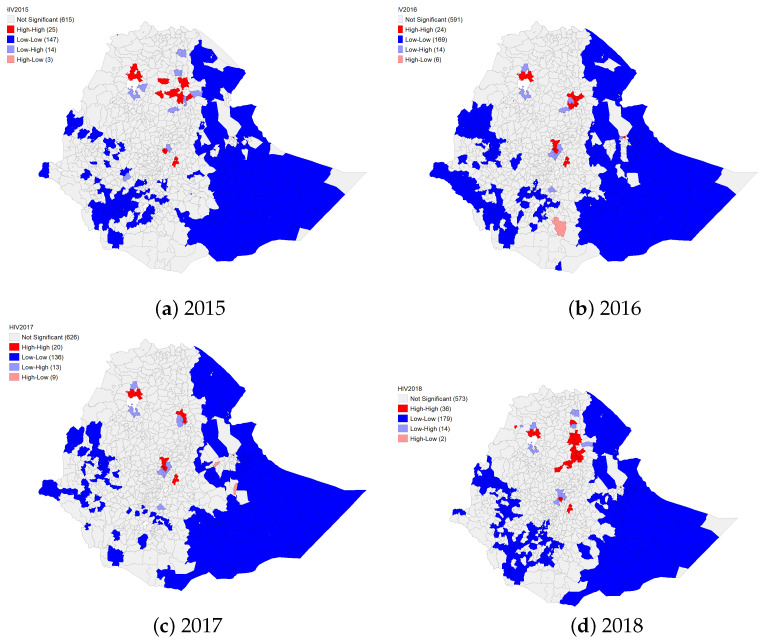
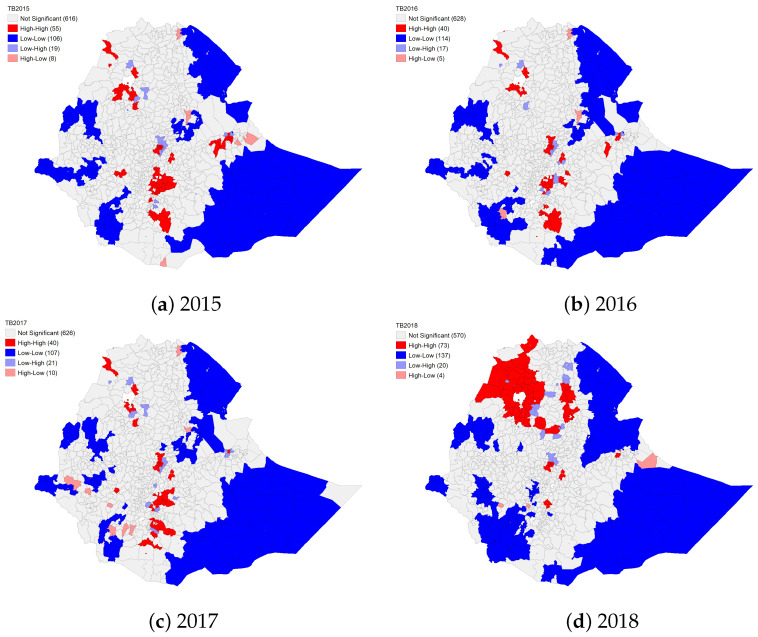
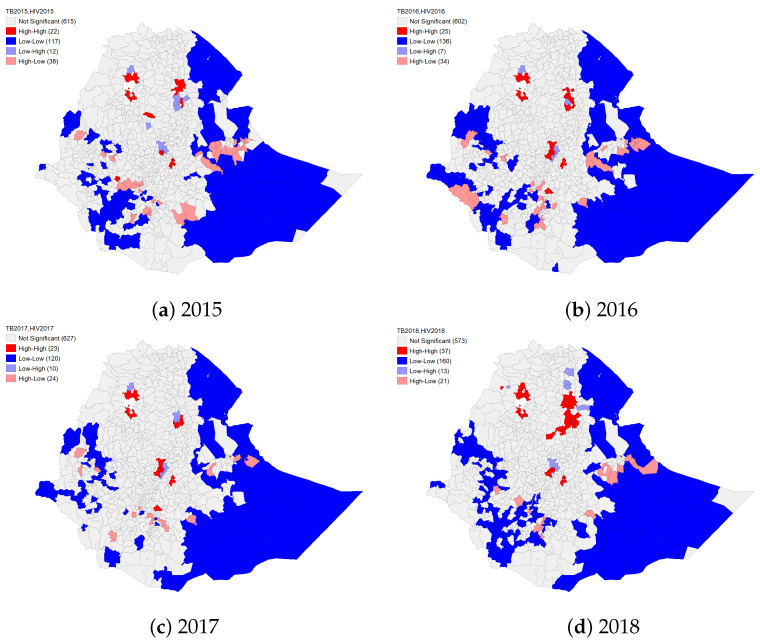
Background: Tuberculosis (TB) and HIV are epidemiologically associated, and their co-dynamics suggest that the two diseases are directly related at the population level and within the host. However, there is no or little information on the joint spatial patterns of the two diseases in Ethiopia. The main objective of the current study was to assess the spatial co-clustering of TB and HIV cases simultaneously in Ethiopia at the district level. Methods: District-level aggregated data collected from the national Health Management Information System (HMIS) for the years 2015 to 2018 on the number of TB cases enrolled in directly observed therapy, short course (DOTS) who were tested for HIV and the number of HIV patients enrolled in HIV care who were screened for TB during their last visit to health care facilities were used in this study. The univariate and bivariate global and local Moran’s I indices were applied to assess the spatial clustering of TB and HIV separately and jointly. Results: The results of this study show that the two diseases were significantly (p-value <0.001) spatially autocorrelated at the district level with minimum and maximum global Moran’s I values of 0.407 and 0.432 for TB, 0.102 and 0.247 for HIV, and 0.152 and 0.251 for joint TB/HIV. The district-level TB/HIV spatial co-clustering patterns in Ethiopia in most cases overlapped with the hot spots of TB and HIV. The TB/HIV hot-spot clusters may appear due to the observed high TB and HIV prevalence rates in the hot-spot districts. Our results also show that there were low-low TB/HIV co-clusters or cold spots in most of the Afar and Somali regions, which consistently appeared for the period 2015−2018. This may be due to very low notifications of both diseases in the regions. Conclusions: This study expanded knowledge about TB and HIV co-clustering in Ethiopia at the district level. The findings provide information to health policymakers in the country to plan geographically targeted and integrated interventions to jointly control TB and HIV.




 京公网安备 11010802042870号
京ICP备2023020795号-1
京公网安备 11010802042870号
京ICP备2023020795号-1

 分享
分享

 求助内容:
求助内容: 应助结果提醒方式:
 扫码关注我们
