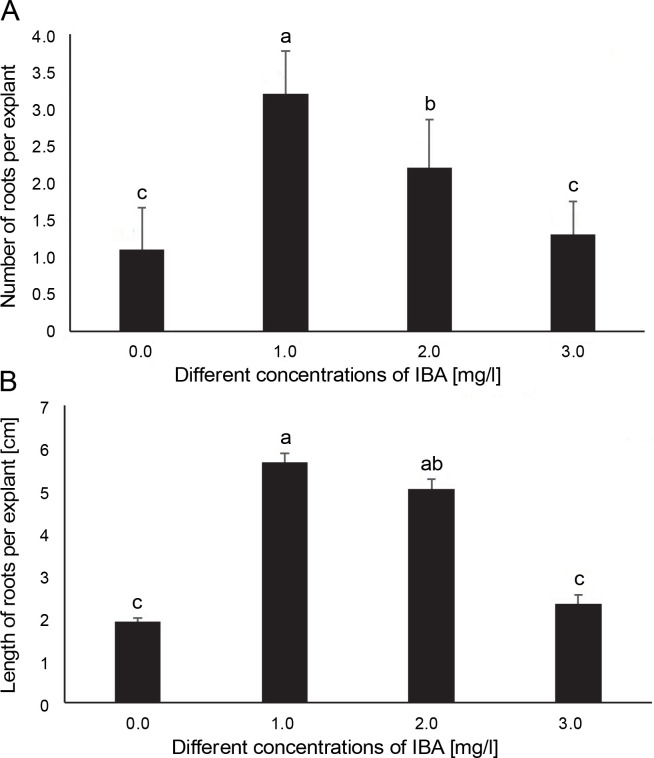
{"title":"Auxin and cytokinin synergism in micropropagation for mass production of <i>Aloe vera</i>.","authors":"Sabina Yasmin, Jakir Hasan, Shakhaowat Hossain, Sumitra Saha, Fahmida Khatun","doi":"10.5114/bta.2022.118672","DOIUrl":null,"url":null,"abstract":"<p><p><i>Aloe vera</i> [<i>Aloe vera</i> (L.) Burm. f.] is considered a valuable medicinal plant worldwide due to its remarkable beneficial effects on human health. However, challenges in <i>A. vera</i> propagation hinder meeting the increasing demand in the health and beauty sectors. As an alternative method, <i>in vitro</i> propagation is crucial for the mass production of Aloe plants, which is a rapid method as well. Therefore, the present study aimed to establish an efficient micropropagation protocol for <i>A. vera</i> by <i>in vitro</i> optimization of the effect of different plant growth regulators (PGRs). For shoot proliferation, sterilized explants were inoculated on the Murashige and Skoog (MS) medium supplemented with 6-benzylaminopurine (BAP) and thidiazuron (0.5, 1.0, 2.0, and 4.0 mg/l) in combination with 0.5 mg/l naphthaleneacetic acid (NAA). Subsequently, indole-3-butyric acid (IBA) (1.0, 2.0, and 3.0 mg/l) was used for root induction. It was found that the explants cultured on the MS medium supplemented with 4.0 mg/l BAP + 0.5 mg/l NAA showed the highest percentage of response (90 ± 1.29) for shoot induction within the minimum number of days (5 ± 0.33). The highest number of shoots (2.7 ± 0.36) and length of shoots (4.7 ± 0.42 cm) per explant were also observed with the same concentration of PGRs. However, the highest number of roots (3.2 ± 0.57), length of roots (5.67 ± 0.21 cm), and root induction (80 ± 1.97 %) were noticed within the minimum number of days (11 ± 0.79) on the MS medium supplemented with 1.0 mg/l IBA. Thus, the proposed method is a quick and effective approach for the mass propagation of <i>A. vera</i> with appropriate dosages of auxins and cytokinins, which may allow meeting the increasing commercial demand.</p>","PeriodicalId":8999,"journal":{"name":"BioTechnologia","volume":"103 3","pages":"301-310"},"PeriodicalIF":0.0000,"publicationDate":"2022-01-01","publicationTypes":"Journal Article","fieldsOfStudy":null,"isOpenAccess":false,"openAccessPdf":"https://ftp.ncbi.nlm.nih.gov/pub/pmc/oa_pdf/26/7a/BTA-103-3-47614.PMC9642961.pdf","citationCount":"1","resultStr":null,"platform":"Semanticscholar","paperid":null,"PeriodicalName":"BioTechnologia","FirstCategoryId":"1085","ListUrlMain":"https://doi.org/10.5114/bta.2022.118672","RegionNum":0,"RegionCategory":null,"ArticlePicture":[],"TitleCN":null,"AbstractTextCN":null,"PMCID":null,"EPubDate":"","PubModel":"","JCR":"Q3","JCRName":"Agricultural and Biological Sciences","Score":null,"Total":0}
引用次数: 1
Abstract
Aloe vera [Aloe vera (L.) Burm. f.] is considered a valuable medicinal plant worldwide due to its remarkable beneficial effects on human health. However, challenges in A. vera propagation hinder meeting the increasing demand in the health and beauty sectors. As an alternative method, in vitro propagation is crucial for the mass production of Aloe plants, which is a rapid method as well. Therefore, the present study aimed to establish an efficient micropropagation protocol for A. vera by in vitro optimization of the effect of different plant growth regulators (PGRs). For shoot proliferation, sterilized explants were inoculated on the Murashige and Skoog (MS) medium supplemented with 6-benzylaminopurine (BAP) and thidiazuron (0.5, 1.0, 2.0, and 4.0 mg/l) in combination with 0.5 mg/l naphthaleneacetic acid (NAA). Subsequently, indole-3-butyric acid (IBA) (1.0, 2.0, and 3.0 mg/l) was used for root induction. It was found that the explants cultured on the MS medium supplemented with 4.0 mg/l BAP + 0.5 mg/l NAA showed the highest percentage of response (90 ± 1.29) for shoot induction within the minimum number of days (5 ± 0.33). The highest number of shoots (2.7 ± 0.36) and length of shoots (4.7 ± 0.42 cm) per explant were also observed with the same concentration of PGRs. However, the highest number of roots (3.2 ± 0.57), length of roots (5.67 ± 0.21 cm), and root induction (80 ± 1.97 %) were noticed within the minimum number of days (11 ± 0.79) on the MS medium supplemented with 1.0 mg/l IBA. Thus, the proposed method is a quick and effective approach for the mass propagation of A. vera with appropriate dosages of auxins and cytokinins, which may allow meeting the increasing commercial demand.
BioTechnologiaAgricultural and Biological Sciences-Plant Science
CiteScore
1.60
自引率
0.00%
发文量
8
审稿时长
8 weeks
期刊介绍:
BIOTECHNOLOGIA – a high standard, peer-reviewed, quarterly magazine, providing a medium for the rapid publication of research reports and review articles on novel and innovative aspects of biotechnology, computational biology and bionanotechnology.






 京公网安备 11010802042870号
京ICP备2023020795号-1
京公网安备 11010802042870号
京ICP备2023020795号-1

 分享
分享
 求助内容:
求助内容: 应助结果提醒方式:
 扫码关注我们
