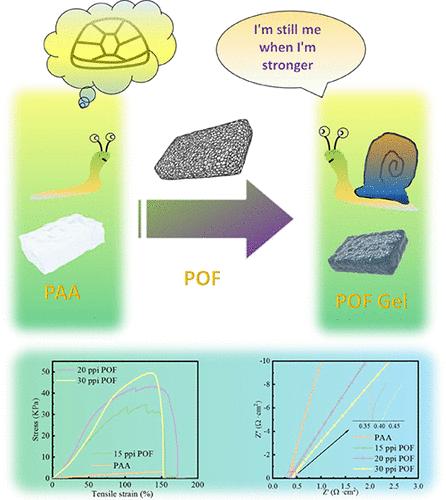
{"title":"A Polyurethane Organic Framework for Flexible Al–Air Batteries","authors":"Songmao Zhang, Yichun Wang*, Yawen Li, Manhui Wei and Keliang Wang*, ","doi":"10.1021/acsaem.2c03445","DOIUrl":null,"url":null,"abstract":"<p >Flexible Al–air batteries with hydrogels are regarded as a promising power source owing to their high specific capacity, their high ionic conductivity, and having no leakage. However, the mechanical properties of the hydrogels remain unresolved. Here, we present a polyurethane organic framework (POF) employing a polyurethane skeleton as an internal support for poly(acrylic acid) (PAA) hydrogel, where the POF can exhibit high strength and toughness, and an Al–air battery using the POF can output good electrochemical properties. The results demonstrate that the tensile stress of 30 ppi POF is 49.5 kPa owing to the stress-transfer mechanism, while that of PAA is only 3.1 kPa. Compared to that of the PAA hydrogel, the discharging capacity of Al–air batteries with 20 ppi POF can be increased by 79 mAh cm<sup>–2</sup> at a current density of 1 mA cm<sup>–2</sup>, which can be attributed to corrosion inhibition and the surface roughness change of the POF during the discharging process. This work will deliver a selectable strategy for a trade-off between mechanical and electrochemical properties.</p>","PeriodicalId":4,"journal":{"name":"ACS Applied Energy Materials","volume":"5 12","pages":"15909–15917"},"PeriodicalIF":5.5000,"publicationDate":"2022-11-29","publicationTypes":"Journal Article","fieldsOfStudy":null,"isOpenAccess":false,"openAccessPdf":"","citationCount":"1","resultStr":null,"platform":"Semanticscholar","paperid":null,"PeriodicalName":"ACS Applied Energy Materials","FirstCategoryId":"88","ListUrlMain":"https://pubs.acs.org/doi/10.1021/acsaem.2c03445","RegionNum":3,"RegionCategory":"材料科学","ArticlePicture":[],"TitleCN":null,"AbstractTextCN":null,"PMCID":null,"EPubDate":"","PubModel":"","JCR":"Q2","JCRName":"CHEMISTRY, PHYSICAL","Score":null,"Total":0}
引用次数: 1
Abstract
Flexible Al–air batteries with hydrogels are regarded as a promising power source owing to their high specific capacity, their high ionic conductivity, and having no leakage. However, the mechanical properties of the hydrogels remain unresolved. Here, we present a polyurethane organic framework (POF) employing a polyurethane skeleton as an internal support for poly(acrylic acid) (PAA) hydrogel, where the POF can exhibit high strength and toughness, and an Al–air battery using the POF can output good electrochemical properties. The results demonstrate that the tensile stress of 30 ppi POF is 49.5 kPa owing to the stress-transfer mechanism, while that of PAA is only 3.1 kPa. Compared to that of the PAA hydrogel, the discharging capacity of Al–air batteries with 20 ppi POF can be increased by 79 mAh cm–2 at a current density of 1 mA cm–2, which can be attributed to corrosion inhibition and the surface roughness change of the POF during the discharging process. This work will deliver a selectable strategy for a trade-off between mechanical and electrochemical properties.
水凝胶柔性铝空气电池具有高比容量、高离子电导率、无泄漏等优点,是一种很有前途的电源。然而,水凝胶的力学性能仍未得到解决。在这里,我们提出了一种聚氨酯有机框架(POF),采用聚氨酯骨架作为聚丙烯酸(PAA)水凝胶的内部支撑,其中POF可以表现出高强度和韧性,并且使用POF的铝空气电池可以输出良好的电化学性能。结果表明,由于应力传递机制,30 ppi POF的拉伸应力为49.5 kPa,而PAA的拉伸应力仅为3.1 kPa。与PAA水凝胶相比,当电流密度为1 mA cm-2时,20 ppi POF铝空气电池的放电容量可增加79 mAh cm-2,这可能是由于POF在放电过程中的缓蚀作用和表面粗糙度的变化。这项工作将为机械性能和电化学性能之间的权衡提供一种可选择的策略。
期刊介绍:
ACS Applied Energy Materials is an interdisciplinary journal publishing original research covering all aspects of materials, engineering, chemistry, physics and biology relevant to energy conversion and storage. The journal is devoted to reports of new and original experimental and theoretical research of an applied nature that integrate knowledge in the areas of materials, engineering, physics, bioscience, and chemistry into important energy applications.



 京公网安备 11010802042870号
京ICP备2023020795号-1
京公网安备 11010802042870号
京ICP备2023020795号-1

 分享
分享
 求助内容:
求助内容: 应助结果提醒方式:
 扫码关注我们
